
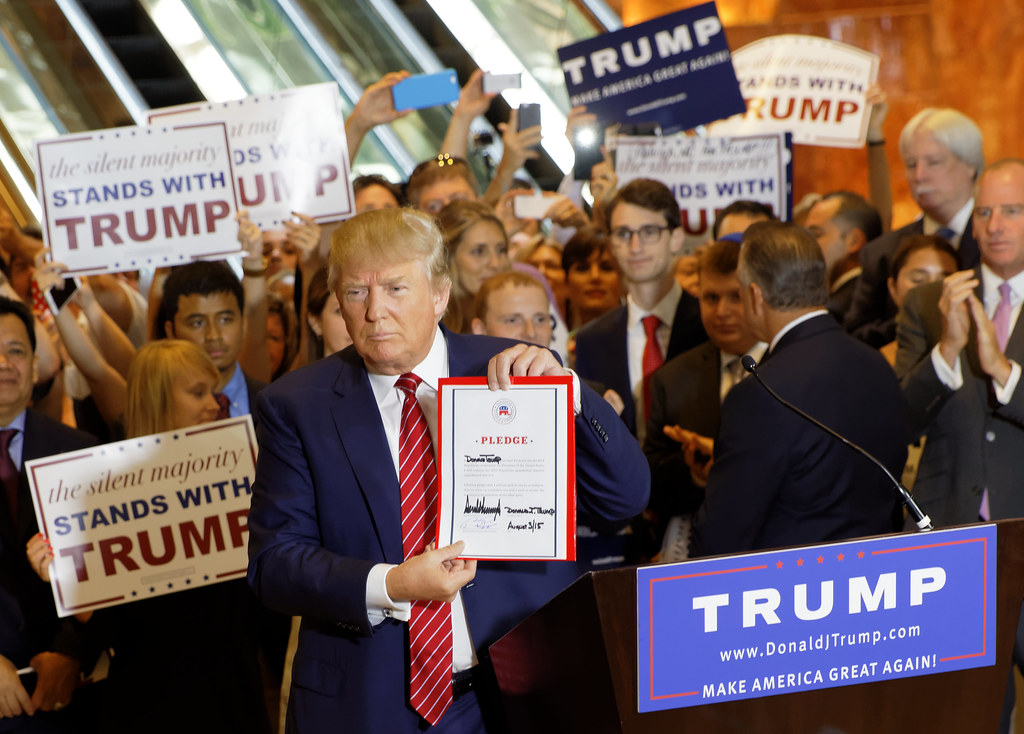
The most revealing part is not the ranking itself. It is how completely Republicans and Trump’s critics appear to be answering different questions about the same man.
A poll framing Donald Trump as the worst American in history while Republicans name him the greatest is designed to stop thumbs. It also says something more durable than any one ranking.
Trump is not just being judged as a president or a candidate. For many voters, he has become a stand-in for what they think America is losing, saving or becoming.
The poll’s real punch
Newsweek reported that a survey placed Trump at the bottom of American history among respondents overall, while Republican respondents put him at the top. That kind of split is easy to mock, but it captures a serious feature of the Trump era: the same conduct that alarms one bloc can reassure another.
The finding should not be read as a definitive historical judgment. Ranking the worst or greatest American in history is a loaded exercise, and the results can be shaped by wording, timing and the names offered to respondents.
Still, the contrast is useful because it strips away the softer language of approval polling. Voters were not just asked whether they like Trump’s performance. They were asked, in effect, what moral category he belongs in.
Partisans see different people
That divide shows up clearly in other public polling. A recent YouGov survey found that majorities of Americans said several negative descriptors apply a lot to Trump, including arrogant at 65%, opportunistic at 57%, reckless at 56%, dishonest at 54% and corrupt at 54%.
But the same YouGov data showed how sharply those judgments depend on party identity. Republicans were far more likely than Democrats to say Trump is a strong leader, qualified, intelligent and competent. Democrats were far more likely than Republicans to describe him as corrupt, dishonest and reckless.
The numbers are not close. YouGov found 80% of Republicans said strong leader applies a lot to Trump, compared with 7% of Democrats. On the other side, 93% of Democrats said corrupt applies a lot to him, compared with 10% of Republicans.
That is not a normal disagreement over policy performance. It is a clash over character, legitimacy and what kind of behavior counts as strength.
Approval ratings miss the scale
Traditional approval ratings make Trump look historically weak in some ways, but they do not fully explain his hold on Republican politics. The Roper Center’s presidential approval archive lists Trump’s approval high at 49%, in a McLaughlin & Associates poll from March 2019, and his low at 29%, in a Pew survey conducted shortly after Jan. 6, 2021.
Those numbers are striking when compared with presidents who enjoyed broad national surges. George W. Bush reached 92% in an ABC News poll after the Sept. 11 attacks. John F. Kennedy hit 83% in Gallup polling in 1961. Franklin D. Roosevelt reached 84% during World War II.
Trump never had that kind of cross-party honeymoon. His ceiling was lower, but his floor inside the Republican coalition proved unusually durable.
That is why a greatest-versus-worst finding lands so hard. It reflects a politician who can be historically unpopular with many Americans while remaining historically meaningful to many in his own party.
Why extreme labels spread
Polls built around words like greatest and worst travel faster than ordinary approval numbers because they turn politics into identity shorthand. People do not share them only to inform others. They share them to say which side of the argument they are on.
For Trump supporters, calling him great can mean more than endorsing a tax policy, a border policy or a judicial appointment. It can signal that he fought institutions they distrust, said things other Republicans would not say and treated criticism from media, courts and Democrats as proof of the fight.
For his critics, calling him the worst can also mean more than disliking his agenda. It can point to his efforts to overturn the 2020 election result, his rhetoric toward opponents, his legal and ethical controversies, and the belief that he weakened democratic norms.
Both reactions are intensified by the fact that Trump is still politically active. Americans are not only judging a past presidency. They are also arguing over a present force in national life.
The caveats behind the outrage
Ranking polls are especially vulnerable to recency bias. A figure dominating the news today is more likely to be named than someone from a distant century, even if historians would weigh the comparison differently.
Question wording matters too. Asking for the worst American can produce a different answer than asking for the worst president, the most damaging political figure or the most disliked public figure. Each phrase nudges respondents toward a different standard.
Subgroup results also need context. If Republican respondents name Trump the greatest American, that does not mean every Republican ranks him above George Washington, Abraham Lincoln or Martin Luther King Jr. It means that, within the survey design reported, Trump was the answer that rose to the top among that group.
Those caveats do not erase the political meaning. They keep the meaning in the right place: this is a measure of intense symbolic attachment and rejection, not a settled verdict from history.
The next number matters more
The more practical question is whether these extreme views change behavior. In elections, voters may dislike a candidate’s character and still prefer that candidate on an issue they care about most.
YouGov found that Americans were more likely to say they had a lot of trust in Trump on immigration than on any of the other issues it tested, with 39% expressing a lot of trust. At the same time, 47% said they did not trust his handling of immigration at all.
That split mirrors the broader Trump problem for both parties. His strongest issues can still mobilize supporters, while his personal brand continues to repel many voters with equal force.
The poll’s headline may be about history, but its real message is about the present. Trump remains one of the rare American political figures whose critics and supporters do not merely disagree over his record. They often seem to be describing two different people.







Leave a Reply