
The ruling cut into one of Trump’s central economic tools and exposed a deeper fight over whether presidential appointees owe loyalty to the president who chose them.
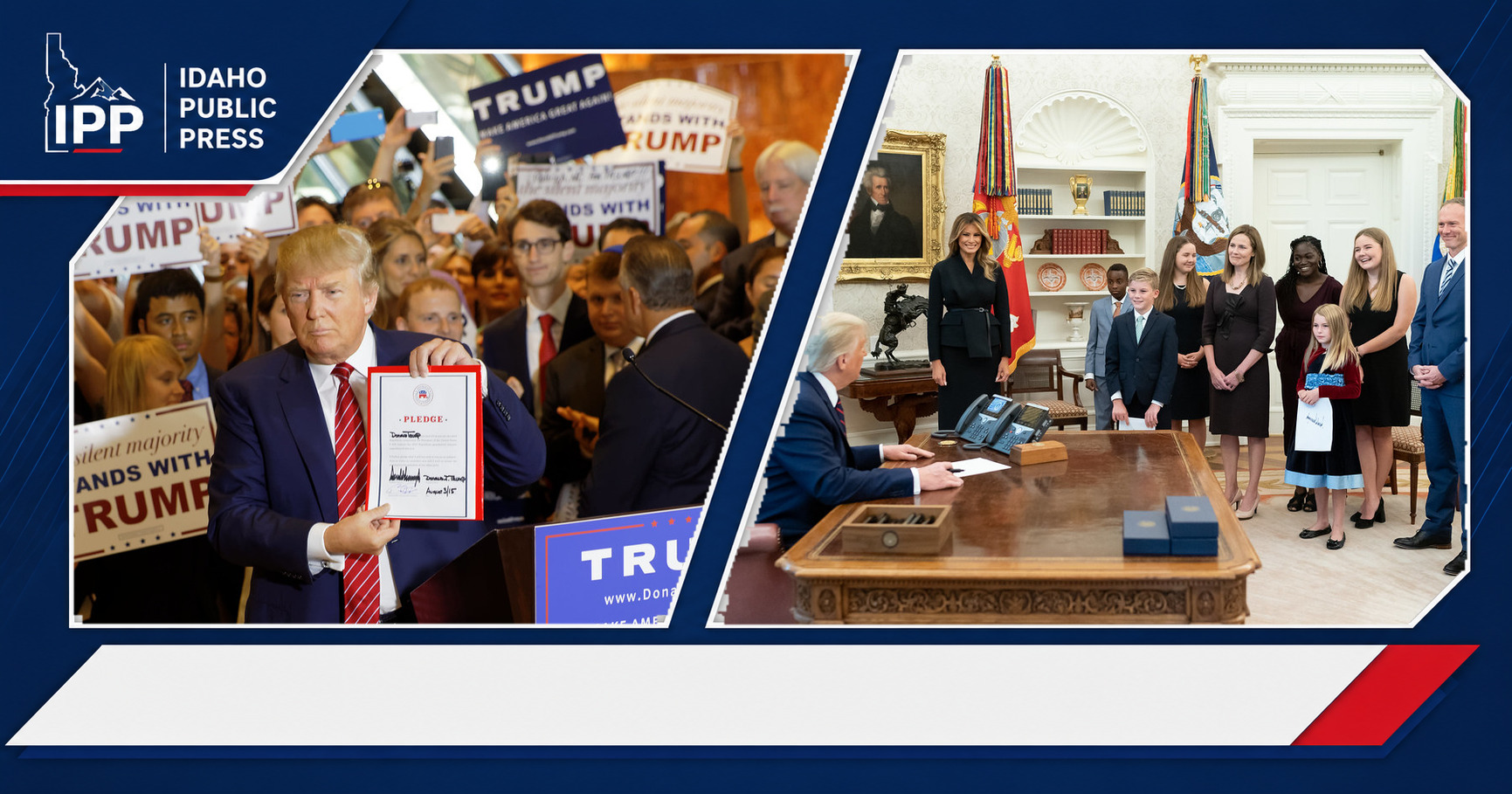
Donald Trump attacked Supreme Court Justice Amy Coney Barrett in Washington on Friday after the Supreme Court ruling against Trump in the 6-3 tariff decision that struck down his global tariffs imposed under an emergency powers law. Barrett and Justice Neil Gorsuch, both Trump appointees, joined the majority, prompting Trump to criticize them in unusually personal terms.
Asked about Gorsuch and Amy Coney Barrett after the ruling, Trump said, “I think it’s an embarrassment to their families, if you want to know the truth, the two of them,” according to The Associated Press. The remark turned a legal loss into a public test of how Trump views the court he helped remake.
A tariff loss becomes personal
The court’s decision landed directly on one of Trump’s signature economic policies: global tariffs imposed under an emergency powers law. By a 6-3 vote, the justices rejected the administration’s legal theory, with Chief Justice John Roberts writing the majority opinion, according to AP.

Trump did not respond only by criticizing the reasoning of the court. Speaking in the White House briefing room hours after the decision, he attacked the justices who ruled against him and said he was “ashamed” of certain members of the court for lacking “the courage to do what’s right for the country,” AP reported.
He drew a distinction between Democratic appointees and “some of our people,” suggesting that he expected less from the liberal wing of the court and more from justices appointed by Republican presidents — especially his own nominees.
That is why Barrett’s role matters. She was Trump’s third Supreme Court appointee, confirmed in 2020 after the death of Justice Ruth Bader Ginsburg. Gorsuch, Trump’s first appointee, also joined the majority. Their votes undercut the idea that the current conservative supermajority will automatically side with Trump when executive power is on the line.
Why Barrett drew Trump’s fire
Barrett has long occupied a complicated space in Trump’s political universe. Her confirmation gave conservatives a 6-3 Supreme Court majority, a legacy Trump frequently points to when arguing that he reshaped the judiciary.
But Supreme Court justices do not serve as representatives of the presidents who nominate them. They have life tenure precisely to insulate them from electoral pressure, party demands and presidential retaliation. Trump’s frustration reflects a different expectation: that his appointees should be reliable defenders of his agenda.
The tariff case put that expectation under stress. The majority’s decision did not come from the court’s liberal bloc alone. It required conservative votes, including votes from justices Trump placed on the bench.
That made Barrett and Gorsuch politically visible in a way many justices try to avoid. Trump’s “embarrassment to their families” line was not a technical argument about emergency powers. It was a personal rebuke aimed at two members of the court’s conservative wing.
The ruling challenges emergency power
The legal fight centered on whether Trump could use an emergency powers law to impose sweeping global tariffs. Tariffs are taxes on imports, and presidents have some authority to adjust trade measures under statutes passed by Congress. The dispute was over how far that authority reaches when the White House invokes emergency powers.
According to AP, legal opposition to the tariffs crossed ideological lines. A key challenge came from the libertarian-leaning Liberty Justice Center, while pro-business groups including the Chamber of Commerce supported the opposition.
That mix matters. The case was not simply a partisan challenge from Democrats to a Republican president. Many businesses dislike broad tariffs because they can raise costs, disrupt supply chains and invite retaliation from trading partners. Libertarian legal groups often object to expansive executive authority, even when used by Republican administrations.
For Trump, though, tariffs are not a side issue. They are central to his economic identity and negotiating style. A ruling limiting that tool is both a policy defeat and a symbolic one.
Loyalty versus judicial independence
The sharpest tension in the episode is not just Trump versus Barrett. It is Trump’s view of institutional loyalty versus the court’s insistence that it is not part of a president’s political team.
Presidents have criticized Supreme Court rulings before. Thomas Jefferson objected to the court’s assertion of judicial review in Marbury v. Madison. Franklin Roosevelt, angry over rulings against New Deal programs, tried and failed to expand the court. Barack Obama criticized the Citizens United decision during a State of the Union address with justices in attendance.
There is also history of presidents souring on their own appointees. Dwight Eisenhower reportedly called appointing Chief Justice Earl Warren a major mistake after Warren led the court through decisions including Brown v. Board of Education. Theodore Roosevelt was said to have mocked Justice Oliver Wendell Holmes after a dissent he disliked.
The difference, as AP noted through legal conservative Ed Whelan, is tone and setting. Whelan said it is “entirely fine” for a president to criticize a ruling, but called it “demagogic” to accuse justices of lacking courage because they voted against him.
Conservatives are split too
Vice President JD Vance echoed Trump’s anger at the court, though not in the same personal language. “This is lawlessness from the Court, plain and simple,” Vance wrote on X, according to AP.
That response shows how quickly a Supreme Court ruling can become a political loyalty test, even on the right. For Trump allies, the decision may look like judicial obstruction of an elected president’s agenda. For legal conservatives wary of executive overreach, the ruling may look like exactly what courts are supposed to do: enforce limits, even against a Republican administration.
Barrett’s vote is likely to be read differently by those camps. Critics of Trump may see it as evidence that the court is not fully captured by him. Trump loyalists may see it as betrayal. Institutionalists may see a justice doing ordinary judging in a high-stakes case.
None of those interpretations erases the bigger political fact: Trump appointed three justices expecting a durable conservative court, but a conservative court is not always the same thing as a court personally loyal to Trump.
What comes next
The practical consequences of the tariff ruling will depend on the court’s mandate, the administration’s response and whether Trump seeks a different legal route to revive or replace the policy. The ruling, as described by AP, struck down tariffs imposed under the emergency powers theory at issue; it does not mean every possible tariff tool is off the table.
The political consequences may arrive sooner. Trump and several justices are expected to be in the same room for the State of the Union address, AP reported. That would place the president and members of the court face to face after one of his most pointed public attacks on sitting justices.
The unanswered question is whether Trump’s criticism remains a one-day eruption or becomes part of a broader campaign against conservative justices who cross him. Barrett and Gorsuch have now shown they can be decisive votes against Trump in a major case. That makes them harder to frame simply as products of his presidency.
The takeaway is blunt: Trump won a generational reshaping of the Supreme Court, but he did not win ownership of it. The 6-3 tariff decision exposed that gap, and Barrett’s vote made it impossible for Trump to ignore.






Leave a Reply