
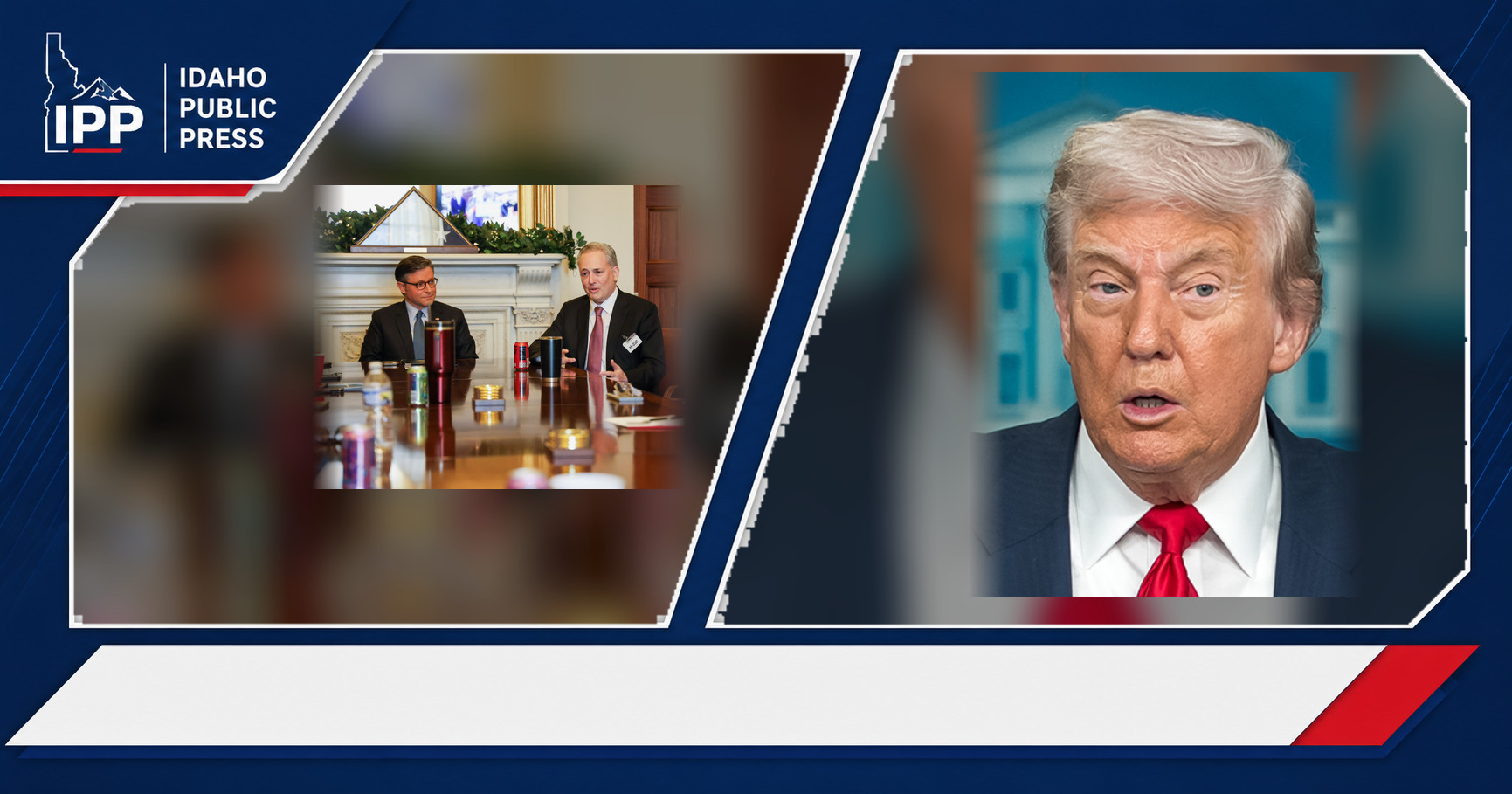
Johnson’s defense of his party’s economic agenda leaned on the Iran conflict as an explanation for pressure on gas and grocery prices. That argument raises a politically awkward question: who voters hold responsible when a president and Congress share the same party.
Mike Johnson blamed Donald Trump’s conflict with Iran for economic difficulties during a Saturday appearance on Fox News, while trying to defend himself and his party from criticism over the worsening economy. The House speaker argued that Republican policies had set the economy up to grow before the Iran conflict became, in his words, a major “headwind.”
Johnson’s comments on America with Kayleigh McEnany matter because they amount to a delicate political defense: protect Republicans’ economic record, acknowledge that families are feeling pressure, and point toward a crisis associated with Trump without directly making the president the target.
Johnson’s economic defense on Fox
According to the Raw Story report, Johnson told viewers that Congress had created conditions for the economy to “take off like a rocket,” and said improvement had begun in the first quarter of the year.

He then identified the Iran conflict as the reason that momentum did not continue. Johnson did not frame the argument as a criticism of Trump personally, but the logic placed responsibility for the immediate economic disruption outside the congressional agenda he was defending.
That distinction is central to the political moment. A governing party generally wants voters to associate strong economic conditions with its legislative program. When prices climb or confidence falls, it must also explain why those outcomes should not be treated as a verdict on that program.
Johnson’s answer was that the economic case for Republicans remains intact but has been interrupted by events abroad. It is a familiar governing-party argument, though one that becomes harder to sustain when the foreign-policy event is linked to the president from the same party.
The Iran conflict becomes the explanation
Raw Story reported that Johnson connected the conflict to concerns over gas and grocery prices and said he expected the situation to end soon. He suggested prices could return “to planet Earth” once the conflict subsided.
The report also said Iran had vowed to maintain a blockade of the Strait of Hormuz. That waterway is widely significant to global energy shipping, so any prolonged disruption can feed concerns about fuel costs and broader price pressures. Still, Johnson did not present detailed evidence during the interview showing how much of any specific increase in consumer costs could be attributed to the conflict.
That gap matters. Prices at the pump and at the grocery store respond to many forces, including energy markets, supply chains, company pricing decisions, wages, weather and consumer demand. A geopolitical shock may be a real factor without being the only explanation for what households pay.
Johnson’s claim is therefore both a political message and an economic one: the problem, he argued, is external disruption rather than the domestic agenda Republicans promised voters.
A difficult line for Trump allies
The speaker faces a built-in tension. He is one of Trump’s most prominent congressional allies, yet he is defending his party at a time when some conservatives are reportedly unhappy with both the economy and the Iran conflict.
Raw Story cited reporting from Sarah Longwell of The Bulwark based on interviews with Trump’s 2024 supporters in Florida. Some of those voters reportedly gave Trump weak marks and pointed to economic concerns and the war as reasons for their disappointment.
Those interviews are not a national poll, and they cannot establish how the country as a whole views Trump or Johnson. They do illustrate a problem that can matter well beyond one state: voters who backed a president for economic improvement may be less receptive to assurances that better conditions are coming later.
For Johnson, saying the Iran conflict is the main obstacle may reassure supporters who believe the party’s domestic agenda needs more time. It may also sharpen the perception that Republican leaders are conceding that the administration’s foreign-policy choices have economic consequences at home.
Congress is part of the picture
Johnson’s formulation also invites scrutiny of Congress’s role in a conflict that has become part of the domestic economic debate. Raw Story reported that Trump did not seek congressional approval for the action involving Iran.
If that account is accurate, Johnson can argue that Congress should not carry the same direct responsibility for the decision. But Congress is not simply a bystander in questions involving military action, spending, oversight and the broader political direction of a unified government.
That creates competing narratives. Critics can say Republicans control major institutions and cannot credibly separate their economic agenda from the consequences of the president’s choices. Johnson and his allies can counter that their legislative measures should be judged separately from a sudden international crisis.
Neither argument automatically resolves what voters experience at checkout counters or gas stations. Political accountability often turns less on which institution has the cleaner constitutional argument than on whether leaders offer a convincing explanation and a believable route to lower costs.
McEnany raised voters’ daily pressures
The interview’s most revealing exchange may have come when Kayleigh McEnany described a young person who cannot afford a home, is struggling with health care costs and feels failed by the economy. She asked what Republicans offer that voter.
Johnson answered that the solution was not to hand more responsibility to government, saying that approach “never works.” The response restated a core Republican critique of expanded government intervention, but it did not lay out a specific short-term plan for housing, health care or household costs.
That is the practical challenge behind the broader debate. Voters can understand that wars and trade routes affect prices while still wanting a concrete answer about rent, insurance, food and transportation expenses now.
Johnson’s comments sought to pair long-term confidence in Republican policy with a short-term explanation for hardship. Whether that combination holds depends on the duration of the Iran conflict, the direction of consumer prices and whether the public accepts the distinction between Trump’s decisions and the party’s governing record.
What remains unsettled
Johnson predicted the conflict would end soon, but the report did not identify a timetable or provide details of a path toward de-escalation. It also remains unclear how long any reported Strait of Hormuz disruption might last and how directly it may affect prices paid by U.S. consumers.
There is also a political question with no easy answer for Republicans: can they campaign on an economic agenda as their own while treating the consequences of a president’s foreign-policy decisions as separate? Johnson’s Fox News appearance was an effort to do exactly that.
For now, the speaker’s message is clear. He wants voters to see Republican economic policy as sound, the Iran conflict as the disruptive force and Trump as connected to that disruption without Johnson having to say so explicitly.








Leave a Reply