
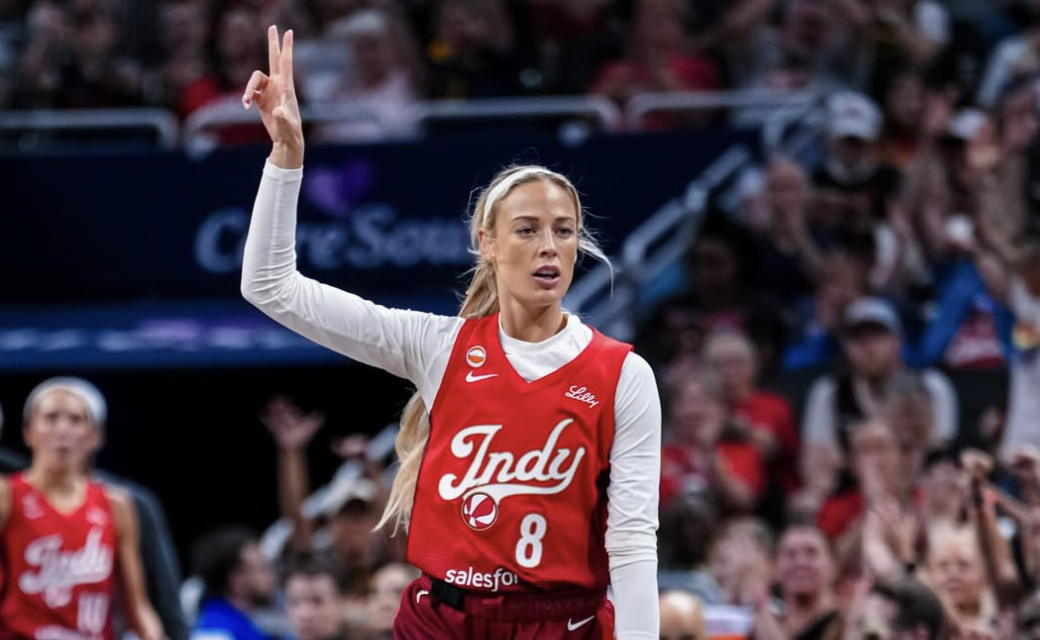
The dispute is bigger than one hard foul or one player’s popularity. It has become a debate over who gets cast as a WNBA hero, a threat or someone in need of protection.
Tanya Ray Fox launched a scathing criticism of Sophie Cunningham, the Indiana Fever guard, arguing that the controversy around Cunningham has involved racism, homophobia and white-supremacist rhetoric. The former FOX Sports analyst also characterized praise focused on Cunningham’s appearance as rooted in eugenics, a charge that pushes a WNBA argument far beyond a routine debate about physical basketball.
Fox’s criticism arrives amid renewed scrutiny of how Cunningham and other players are discussed after hard fouls, confrontations and viral moments. The central question is not whether Cunningham can be a popular player or a forceful teammate; it is whether the language and imagery used to celebrate her can reinforce unequal standards for white players and Black players.
Fox’s criticism targets the framing
The available source material identifies Fox’s remarks as a sharp response to public discourse around Cunningham rather than a report of league discipline or a new allegation of misconduct by Cunningham herself.
That distinction matters. Fox’s argument, as described in the source brief, is aimed at the rhetoric surrounding Cunningham: the way fans, commentators and political voices can turn a player into a symbol. Her references to racism, homophobia and white-supremacist rhetoric are allegations about that wider cultural frame.
Fox’s use of the word “eugenics” is especially charged. In this context, it refers to her view that idealizing certain physical traits — particularly whiteness, blondness and conventional femininity — can echo a harmful history of ranking people according to race and appearance. It is not an established finding about every person who supports Cunningham, and it should not be read as one.
The full text of Fox’s remarks and any response from Cunningham were not included in the material available for this article. That leaves important questions about the specific comments Fox was addressing and how broadly she intended her critique to apply.
The Carrington foul reignited tensions
The immediate backdrop is a game between the Chicago Sky and Indiana Fever in which Chicago guard DiJonai Carrington was ejected after receiving a Flagrant 2 foul for contact with Cunningham’s head and neck while defending in transition, according to a Guardian opinion column by former NBA player Etan Thomas.
Carrington, who is Black, said she had been making a play on the ball and did not intend to hurt Cunningham. Thomas reported that Fever coach Stephanie White also said she did not believe Carrington had intentionally tried to injure Cunningham. Carrington acknowledged she should have been penalized, then posted “WHITE PRIVILEGE” on social media.
That post created its own argument. Critics may see the flagrant-foul ruling as evidence that the league handled an excessive play appropriately. Supporters of Carrington’s larger point argue that the issue is not simply the call on the floor, but the public reaction that followed it.
Those are separate questions, and combining them can obscure both. A player can deserve a foul or ejection while the surrounding commentary still reveals double standards.
Why Cunningham became the symbol
Cunningham’s recent WNBA profile gives the debate fuel. In June 2025, she was ejected and fined after a Flagrant 2 foul against Connecticut Sun guard Jacy Sheldon, Thomas wrote. Cunningham wrapped up Sheldon during a drive and the play sparked an altercation.
Thomas’s argument was that Cunningham’s ejection did not become a lasting indictment of her character. Instead, many fans embraced her as an “enforcer,” particularly because of her association with Fever teammate Caitlin Clark. Cunningham’s social-media following grew rapidly, and Ring later used her protector image in advertising, according to the column.
That does not prove that every fan response was racist, nor does it erase Cunningham’s own competitive appeal. Players regularly gain followings because they are expressive, physical and memorable. But Fox’s criticism and Thomas’s column point to a harder comparison: would a Black player receive the same playful, marketable treatment after a similar incident?
For critics of the current discourse, the answer is often no. They argue Black women athletes are more readily labeled dangerous, dirty or aggressive, while white players can be described as tough, feisty or protective.
Race and femininity shape sports narratives
The debate also reaches beyond officiating. Women athletes are judged not only on performance but on appearance, emotion, sexuality and perceived femininity. Those judgments do not land evenly across races.
Fox’s reported critique of appearance-based praise addresses that imbalance directly. When popularity is tied to an ideal of white, blonde, conventionally feminine beauty, critics say it can turn athletic support into something more exclusionary: a preference for who looks like the imagined face of the sport.
Others will argue that finding Cunningham attractive, stylish or charismatic does not automatically carry an ideological meaning. That is fair. Individual admiration is not the same as a political program. The concern arises when those traits are repeatedly treated as proof that one player is more relatable, more innocent or more worthy of protection than others.
That is why the eugenics language is so provocative. It challenges audiences to distinguish between ordinary fandom and broader patterns that elevate particular racialized ideals.
The political reaction raised stakes
Thomas also highlighted a response that took the basketball dispute into political territory. Florida Attorney General James Uthmeier said he would be willing to charge players with assault and battery for hard fouls in Florida, the column reported.
Thomas criticized that idea as grandstanding and noted that the WNBA already has rules and penalties for excessive contact. Basketball has long dealt with hard fouls, technicals, flagrants, ejections and suspensions through its own disciplinary system.
The political attention helped intensify the sense that Cunningham’s incident represented more than a game. For Fox and other critics, that escalation is part of the problem: sports contact involving Black women can be framed as a public-safety or moral crisis in ways comparable conduct by white players is not.
What remains unsettled
Cunningham has every right to compete physically, build a public profile and benefit from support that comes with being a recognizable WNBA player. Carrington, likewise, can be held accountable for a foul without being reduced to a villain or used as shorthand for a claim about the league’s Black players.
The unresolved issue is how fans, broadcasters, advertisers and politicians tell these stories after the whistle. Fox’s criticism puts that storytelling under a harsh light, arguing that the praise attached to Cunningham can carry assumptions about race, beauty, gender and protection that many people would rather leave unspoken.
The record available here does not establish that all praise of Cunningham is bigotry, and it does not provide a full response from Cunningham or the Fever. It does show why the argument has become so heated: the WNBA’s growth has made its players cultural figures, and cultural figures are rarely judged only by the box score.







Leave a Reply