
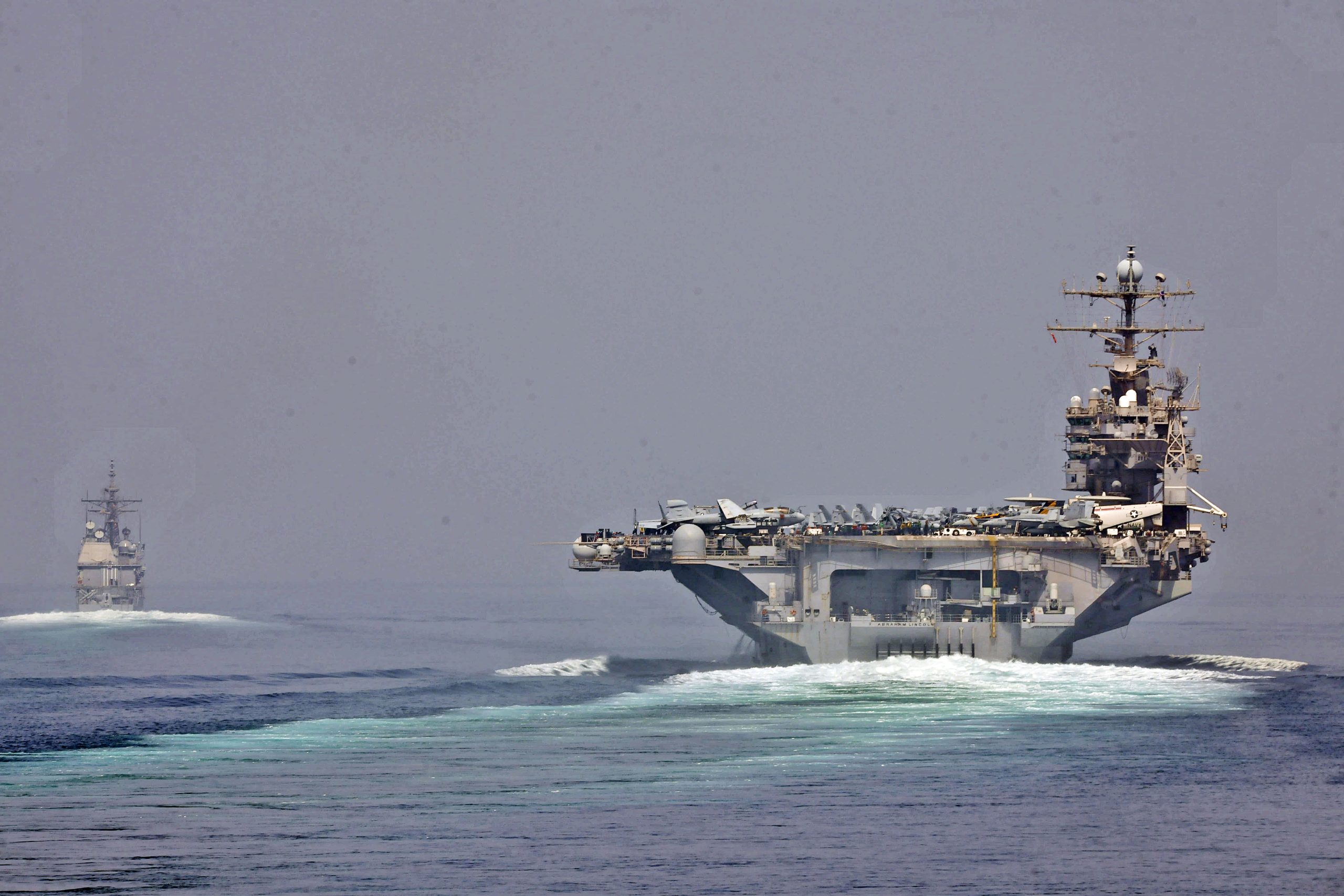
A maritime confrontation is now testing a fragile ceasefire and raising the risk of wider military and economic fallout. The danger runs through Gulf bases, commercial shipping lanes and the oil markets that depend on them.
The United States and Iran are escalating strikes across the Middle East, exchanging attacks tied to shipping and military sites around the Strait of Hormuz. U.S. Central Command said it hit Iranian targets after a drone attack on a Panama-flagged tanker; Iran’s Islamic Revolutionary Guard Corps said it answered with missiles and drones at U.S.-linked infrastructure in Kuwait and Bahrain, raising alarms in Gulf countries including Qatar.
The clash matters because retaliatory attacks across the region can turn a maritime dispute into a wider security and energy crisis. As the US and Iran escalate strikes, both accuse the other of violating a ceasefire meant to keep the Mideast from sliding into open conflict.
A ceasefire under fire
The latest reported exchange began with competing claims over who broke the deal first. According to a BBC report carrying Reuters details, U.S. Central Command said Iranian forces launched a one-way attack drone that struck the MT Kiku, a Panama-flagged tanker, in the Strait of Hormuz.
Centcom described the American response as direct retaliation for continued aggression against commercial shipping. It said U.S. fighter jets struck 10 Iranian military targets at multiple locations in and near the Strait of Hormuz, including military equipment, communications systems, air defense sites and drone storage facilities.
Iran’s Islamic Revolutionary Guard Corps gave a sharply different account. In a statement shared to state media, the IRGC said the U.S. had attacked five Iranian coastal posts under the pretext of responding to the confrontation with the vessel.
The result is a familiar but dangerous pattern: each side says it is retaliating, and each side says the other has violated the ceasefire. That makes de-escalation harder, because backing down can look like accepting the rival’s version of events.
The Strait is the pressure point
The Strait of Hormuz is not just a backdrop. It is the lever that gives this confrontation global weight.
The narrow waterway links the Persian Gulf with the Gulf of Oman and is one of the world’s most important routes for oil and gas shipments. When traffic through the strait is disrupted, the consequences can move quickly from military briefings to fuel prices, shipping insurance costs and commodity markets.
The BBC report said the ceasefire arrangement, described as a 14-point memorandum of understanding agreed on 17 June, included language calling for Iran to use its best efforts to ensure safe passage for commercial vessels without charge for 60 days. That provision is now at the center of the dispute.
Iran has argued that it has authority over passage and navigation arrangements in the Strait of Hormuz. U.S. officials have objected to reports that Tehran is charging or seeking fees from tankers, and many maritime observers view tolling commercial vessels there as a break with international norms.
Kuwait and Bahrain feel exposed
The escalation moved beyond the waterway when Iran said it had fired ballistic missiles and drones at U.S.-linked infrastructure in Kuwait and Bahrain. The IRGC claimed it targeted facilities at Ali al-Salem base in Kuwait and the U.S. Fifth Fleet presence in Port Salman, Bahrain.
A U.S. official told Reuters, according to the BBC report, that there were no reported American casualties and no major impacts or damage to U.S. facilities in the Middle East. That is an important distinction: the military and political impact of an attack can be significant even when immediate damage appears limited.
Kuwait and Bahrain both signaled the seriousness of the moment. Kuwait’s armed forces said air defenses were confronting hostile missile and drone attacks and urged the public to follow security instructions. Bahrain’s Interior Ministry told citizens to remain calm and move to the nearest safe place.
Qatar was not named in the reported Iranian target list, but it sits inside the same Gulf security architecture. Any widening of strikes around U.S. facilities in Kuwait and Bahrain inevitably sharpens concern across nearby countries that host, support or sit near American military operations.
Two stories, one escalation loop
The United States is framing its strikes as a response to attacks on commercial shipping. Iran is framing its response as punishment for U.S. strikes on Iranian territory and infrastructure. Both narratives are aimed at domestic audiences, regional partners and the other side’s decision-makers.
Centcom said commercial vessels were continuing to operate in the Strait of Hormuz. That message is meant to reassure markets and signal that the U.S. can keep the channel open despite Iranian pressure.
Tehran’s message is different. The IRGC warned that enemy aggression, even against what it described as minor targets, would receive a crushing response. Iran’s Foreign Ministry also condemned the U.S. strikes as brutal attacks and said they showed Washington did not value its commitments.
Those statements leave little room for compromise. They also increase the odds that a single drone strike, intercepted missile or damaged ship could become the next justification for a larger response.
Shipping dispute becomes strategy
The military exchange is tied to a deeper argument over who controls risk in the Gulf. Iran has suggested that the management of navigation in the Strait of Hormuz cannot simply return to its prewar status. The U.S. position, as described in the report, is that toll-free and safe passage must continue.
That gap matters because commercial ships cannot operate normally if every transit carries the risk of military confrontation, inspection disputes, drones or sudden fees. Even if vessels continue moving, insurers, cargo owners and energy traders react to uncertainty.
The source report also cited earlier U.S. retaliatory strikes after an attack on a Singapore-flagged cargo ship, the MV Ever Lovely, on 25 June. Tehran reportedly said that vessel had used an unauthorized route. Washington said the attack violated the ceasefire.
That sequence shows how fast technical claims can become strategic ones. A route dispute becomes a drone attack. A drone attack becomes airstrikes. Airstrikes become missile launches toward Gulf facilities.
The next risk is miscalculation
The most immediate question is whether the ceasefire still has practical value. A ceasefire can survive accusations and isolated violations if both sides want a way back. It becomes fragile when both sides use the language of retaliation to justify the next move.
There are also unresolved facts. The full extent of damage from the strikes has not been independently established in the source brief. Iran’s claims of destruction at Gulf targets are disputed by the U.S. account that reported no major damage or casualties. The condition of the affected vessels and the operational impact on shipping remain key points to watch.
The larger danger is not that either side necessarily wants a full-scale war. It is that both sides may believe they can fire limited shots, absorb limited damage and still control the ladder of escalation.
In the Strait of Hormuz, that is a dangerous assumption. The waterway is crowded, strategically vital and surrounded by countries with little interest in becoming the next battlefield. For Kuwait, Bahrain, Qatar and the wider Gulf, the latest U.S.-Iran exchange is a warning that a regional conflict can spread without a formal declaration of war.










Leave a Reply