
The claim is less a prediction than a stress test for Trump’s standing with lawmakers. Impeachment talk only becomes real when the House has allegations, votes and a political reason to move.
Donald Trump could be impeached, a conservative newspaper says this is a real possibility, and the claim matters because only Congress can turn that political warning into a formal case. The new discussion, amplified by Alternet under the phrase “Conservative newspaper panics,” puts impeachment back in the context that counts: the House’s power to charge a president and the Senate’s role in deciding whether to convict and remove him.
The warning should not be read as the same thing as an impeachment proceeding. Based on the available materials, it is a political argument about risk — not proof that the House has already filed articles or scheduled a vote.
The warning is political first
A conservative newspaper saying impeachment is a “real possibility” is notable because it signals anxiety inside, or at least near, Trump’s own political coalition. Impeachment talk from Trump critics is familiar. Impeachment talk from a conservative outlet lands differently because it suggests the issue may be moving beyond predictable opposition messaging.
That does not mean impeachment is likely. It means at least one conservative voice sees a path by which congressional Republicans, Democrats or both could be forced to deal with the question more directly.
The distinction matters. In Washington, impeachment often begins as a pressure campaign before it becomes a legal document. Lawmakers test the public mood. Allies warn the White House. Opponents look for a clean allegation that can survive more than a news cycle.
For readers, the key question is not whether the word “impeachment” is being used. It is whether any faction in the House is prepared to write articles of impeachment, defend them publicly and gather enough votes to pass them.
Impeachment starts in the House
Congress is not a backdrop in this story. It is the mechanism. The Constitution gives the House the sole power of impeachment, while the Senate conducts the trial if the House approves articles.
That means Donald Trump could be impeached only if a majority of the House supports at least one article of impeachment. Removal from office would require a much higher bar in the Senate: conviction by two-thirds of senators present.
That two-step structure is why impeachment headlines can sound more dramatic than the process actually is. The House can impeach a president, but impeachment alone does not remove a president. It is closer to an indictment than a final verdict.
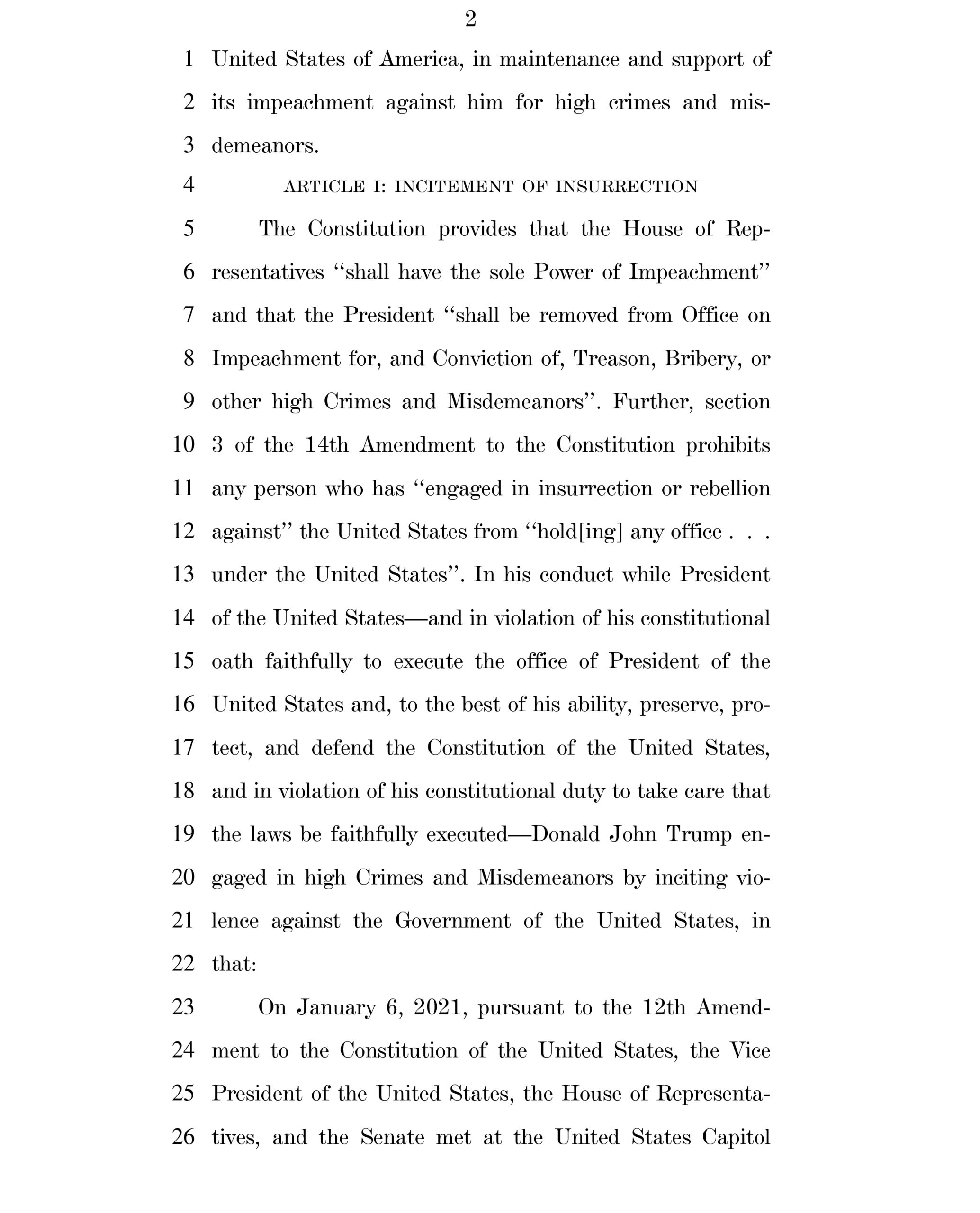
Congress.gov’s records from Trump’s first impeachment show how formal the process becomes once the House acts. In 2019, House Resolution 755 set out articles of impeachment against Donald J. Trump, and the House Judiciary Committee issued a report to accompany the resolution. Those documents show the difference between political anger and an official impeachment case: charges must be written, debated and voted on.
Why conservative concern matters
The conservative angle is the most revealing part of the current flare-up. Trump’s political survival has often depended on keeping Republican lawmakers aligned behind him, even when criticism from Democrats was intense.
If a conservative newspaper is warning that impeachment is a “real possibility,” it may be speaking to several audiences at once: Trump’s advisers, Republican members of Congress, conservative voters and donors who want to know whether a fight is coming.
There are competing ways to read that warning. One view is that it is alarmism — a way to rally Trump supporters by presenting impeachment as an imminent threat. Another is that it is an early sign that some conservatives think the political environment in Congress could shift quickly if damaging facts, legal findings or internal party conflicts pile up.
Both readings can be true at the same time. Impeachment talk can be used to mobilize supporters, and it can still reflect real concern about where events may lead.
Trump’s history changes the frame
Trump is not entering this discussion as a president with no impeachment history. He has already been impeached by the House twice, making any new impeachment talk part of a longer constitutional and political story.
The first impeachment, documented in Congress.gov records, centered on abuse of power and obstruction of Congress. The House Judiciary Committee’s 2019 report accused Trump of conduct serious enough, in the committee’s view, to warrant articles of impeachment. Trump denied wrongdoing, and the Senate later acquitted him.
That history cuts in two directions. Trump’s critics argue it shows impeachment is not a wild idea when Congress believes presidential conduct crosses constitutional lines. Trump’s allies argue the repeated use of impeachment against him proves the process has become a partisan weapon.
That unresolved fight over legitimacy is why a new impeachment warning immediately carries more weight than an ordinary political prediction. For Trump supporters, it can sound like a rerun. For opponents, it can sound like accountability delayed.
The missing piece is conduct
The available report flags the possibility of impeachment, but the central question remains: impeachment for what? Without a specific allegation, documented act or proposed article, the claim is still incomplete.
Historically, impeachment debates gain traction when lawmakers can point to conduct they say fits the constitutional phrase “high crimes and misdemeanors.” That phrase is political-constitutional language, not a requirement that a president be charged with an ordinary criminal offense.
Still, successful impeachment efforts need a narrative that lawmakers can explain simply. They need evidence, hearings or investigative findings. They need enough public support to make members of Congress believe the political cost is manageable.
That is the gap between a conservative newspaper’s warning and an actual impeachment process. The warning may be meaningful, but it is not a substitute for articles, hearings or votes.
What would make it real
Several developments would move the story from speculation toward action. The most obvious would be a member of the House introducing articles of impeachment. Another would be a committee opening an inquiry specifically tied to impeachable conduct.
Other signs would be more subtle: Republican lawmakers refusing to defend Trump, conservative media shifting from attack mode to concern, or party leaders declining to rule out an impeachment process. In a closely divided Congress, even small changes in party discipline can matter.
The Senate remains the tougher hurdle. Even if the House impeached Trump, conviction would require a level of bipartisan agreement that has been extremely difficult to achieve in modern presidential impeachments.
That is why the conservative newspaper’s warning is best understood as a signal, not a verdict. It says the possibility is being discussed seriously enough to break through on the right. It does not show that Congress is ready to act.
The practical takeaway
For now, the phrase “real possibility” should be treated carefully. It is not meaningless, especially coming from a conservative newspaper. But it is also not the same as an official impeachment effort.
The story matters because impeachment is one of the few tools Congress has to confront alleged presidential misconduct at the highest level. It also matters because the politics around Trump remain unusually volatile: his opponents see danger in inaction, while his supporters often see impeachment talk as proof of institutional hostility.
The next useful facts are concrete ones: whether articles are introduced, whether House leaders engage, whether committees investigate, and whether Trump’s Republican support in Congress holds.
Until then, the impeachment claim is a warning shot. It tells readers that some conservatives are no longer dismissing the possibility out of hand — but Congress, not commentary, will decide whether it becomes anything more.










Leave a Reply