
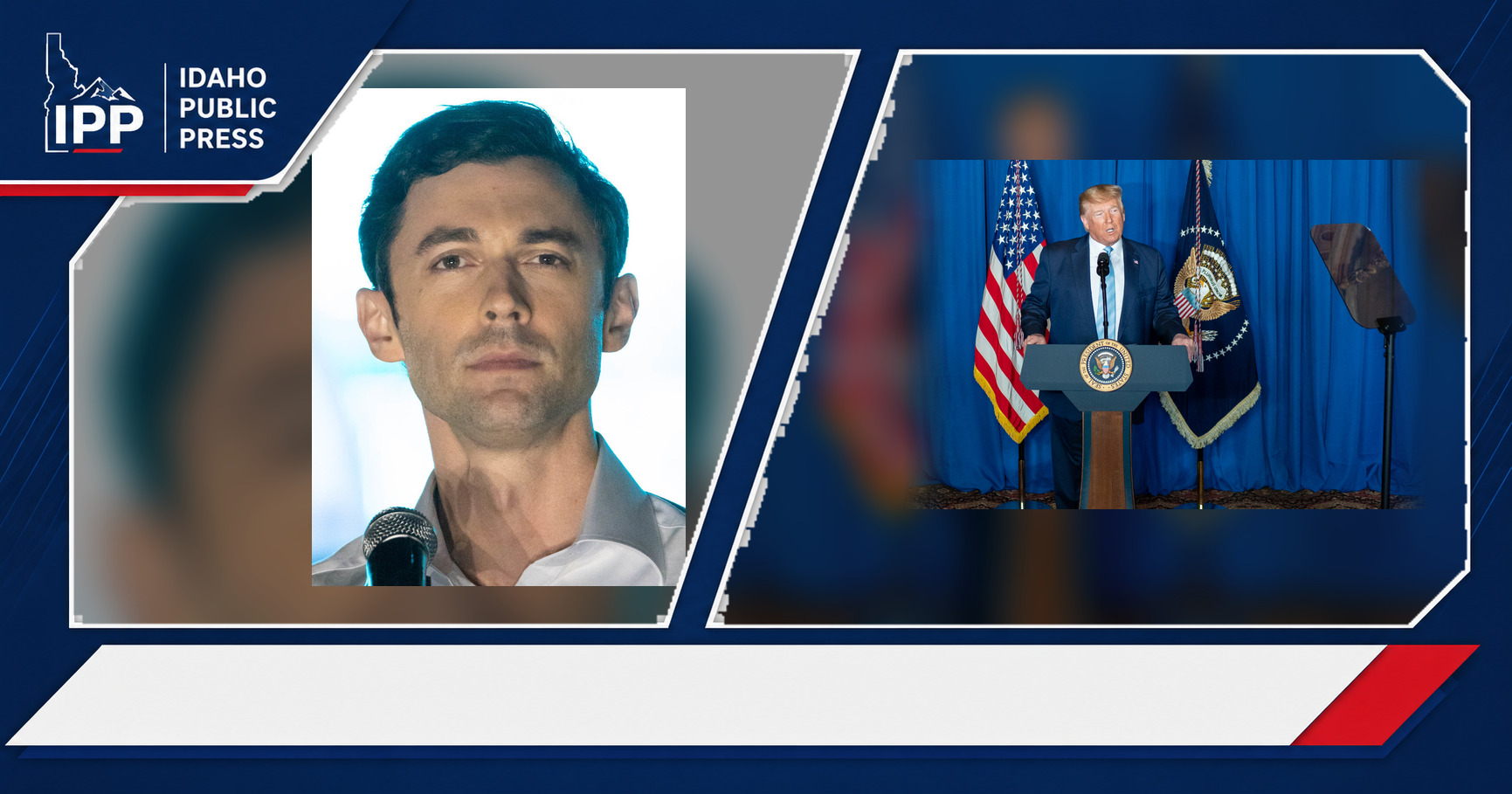
Ossoff’s remarks were not simply a one-day political insult. They tied a personal defense of Mark Kelly to larger arguments over military service, presidential power and Trump’s conduct in office.
Jon Ossoff denounced Donald Trump at a Georgia town hall on Tuesday, August 18, calling the president a “draft-dodging, crook president” while defending fellow Democratic Sen. Mark Kelly. The remarks intensified Ossoff’s feud with the White House, which responded with its own personal attacks.
The clash matters because Ossoff framed his criticism around Kelly’s military record and prior threats Trump made against lawmakers who urged service members to reject unlawful orders. It turns a heated political exchange into a fight over the boundaries of presidential rhetoric, military law and public dissent.
Ossoff put Mark Kelly at center stage
Ossoff appeared with Kelly, an Arizona senator, and Kelly’s wife, former Rep. Gabby Giffords, at the town hall with Georgia voters. He used the event to praise Kelly’s public service as a decorated combat veteran, naval aviator, astronaut, space shuttle commander and senator.
Then Ossoff contrasted that record with Trump, saying the president had tried to imprison Kelly for publicly stating a principle of military law. The audience applauded, according to reporting from The Hill.
Ossoff and Kelly both serve on the Senate Intelligence Committee, giving the encounter a sharper political context than a standard campaign-style appearance. Ossoff presented Kelly as a figure whose service and resilience, in his view, made threats directed at him especially troubling.
The disputed warning about unlawful orders
Ossoff’s comments referred to Trump’s previous threat to imprison Kelly and five other lawmakers after they encouraged members of the military to disregard unlawful orders. Trump had described the lawmakers’ message as “SEDITIOUS BEHAVIOR FROM TRAITORS!!!”
That underlying dispute is central to why this exchange has escalated. Civilian control of the military is a foundational American principle, but service members are also not required to carry out unlawful orders. Political leaders can sharply disagree over whether public appeals about that duty are responsible guidance or a dangerous intervention in military discipline.
Ossoff’s argument was that Kelly had merely voiced a fundamental legal principle. Trump’s earlier response portrayed the lawmakers’ statement as disloyal and potentially harmful. Neither side is treating the dispute as a narrow disagreement over language; both are casting it as a question of patriotism and national security.
A broader attack on Trump’s conduct
The “draft-dodging, crook president” line also folded in Ossoff’s broader criticism of Trump. At the town hall, Ossoff accused Trump of recklessly taking the country into a war that he said Trump did not know how to end or win.
Ossoff had made similar arguments at an Atlanta rally days earlier, criticizing what he characterized as misleading the public into war and treating people who serve in uniform as political pawns. Those claims reflect Ossoff’s political assessment of Trump’s decisions, not an established factual finding.
He also criticized Trump’s travel arrangements after a NATO summit in Turkey, mocking the president over his use of an older Air Force One and references to a Qatari-gifted plane. Trump had said he was changing planes in response to a possible Iranian threat.
The effect was to connect a defense of Kelly to a much larger indictment of Trump’s priorities and leadership. That is a more consequential strategy than trading isolated insults: it gives Ossoff a recurring argument built around veterans, military service and executive conduct.
The White House answered in kind
The White House did not respond by addressing Ossoff’s specific assertions about Kelly or unlawful orders. Communications director Steven Cheung instead attacked Ossoff personally in a social-media post, calling him a crude variation on his surname and labeling him a radical extremist.
Trump also responded when reporters asked about Ossoff’s criticism, calling the senator “Pee-wee Herman,” referring to the comedy character played by the late actor Paul Reubens.
That response fits a familiar political pattern: Ossoff is trying to make the confrontation about presidential behavior and respect for military service, while Trump and his White House are answering with character attacks intended to diminish the messenger.
For supporters of Ossoff, the White House’s tone may reinforce his claim that criticism is being met with intimidation or ridicule. Trump supporters may see Ossoff’s language as an inflammatory attempt to turn military issues into partisan theater. The immediate public record shows both sides escalating rather than narrowing the dispute.
Why Georgia raises the stakes
Ossoff represents Georgia, a closely watched state where national political fights can quickly become local tests of party strength. His willingness to attack Trump in unusually blunt terms signals that he sees confrontation with the White House as politically valuable, not merely unavoidable.
His focus on Kelly also broadens the message beyond Georgia. Kelly’s biography gives Democrats a prominent military and space-exploration figure through whom they can challenge Republican criticism on national-security issues.
At the same time, inflammatory language carries risks. It can energize loyal supporters, dominate a news cycle and make a point memorable. It can also harden partisan divisions and leave less room for a substantive debate about military law, civilian authority and the standards officials should follow when discussing troops.
The conflict is likely to continue
There is no indication that Ossoff plans to soften his criticism or that the White House intends to engage his arguments on their merits. The immediate question is whether this remains a rhetorical clash or develops into a sustained campaign issue centered on Trump’s handling of military-related criticism.
What is clear is that Ossoff has chosen a specific frame: honor the service of people such as Kelly, question Trump’s treatment of dissent and connect those disputes to the president’s broader conduct. The White House has chosen a different frame, portraying Ossoff as a partisan antagonist.
That leaves the larger legal and civic questions unresolved. The argument over how elected officials should speak about unlawful orders—and how a president should respond when they do—now sits beneath an increasingly personal fight between a Georgia senator and the Trump White House.


Leave a Reply