
Muhammad Ali’s achievements made him a global icon, but his family life was far more private and complex than his larger-than-life public image. His nine children have carried pieces of that legacy into boxing, writing, advocacy and everyday life.
Muhammad Ali was the father of nine children: seven daughters and two sons. Muhammad Ali’s nine children include Maryum, Jamillah, Rasheda, Muhammad Jr., Khaliah, Miya, Hana, Laila and Asaad Amin Ali, and together they offer a fuller picture of the man known worldwide as “The Greatest.”
Ali’s boxing legacy is fixed in sports history, but his family story is less neatly packaged. The children grew up across different households and eras of his life, with some choosing public careers and others maintaining a lower profile while still speaking about the father they knew.
Nine children, one complicated family
Accounts of Ali’s family consistently describe him as the father of seven daughters and two sons. Time, reporting after Ali’s death in 2016, noted that his children publicly mourned him and identified that seven-and-two breakdown.
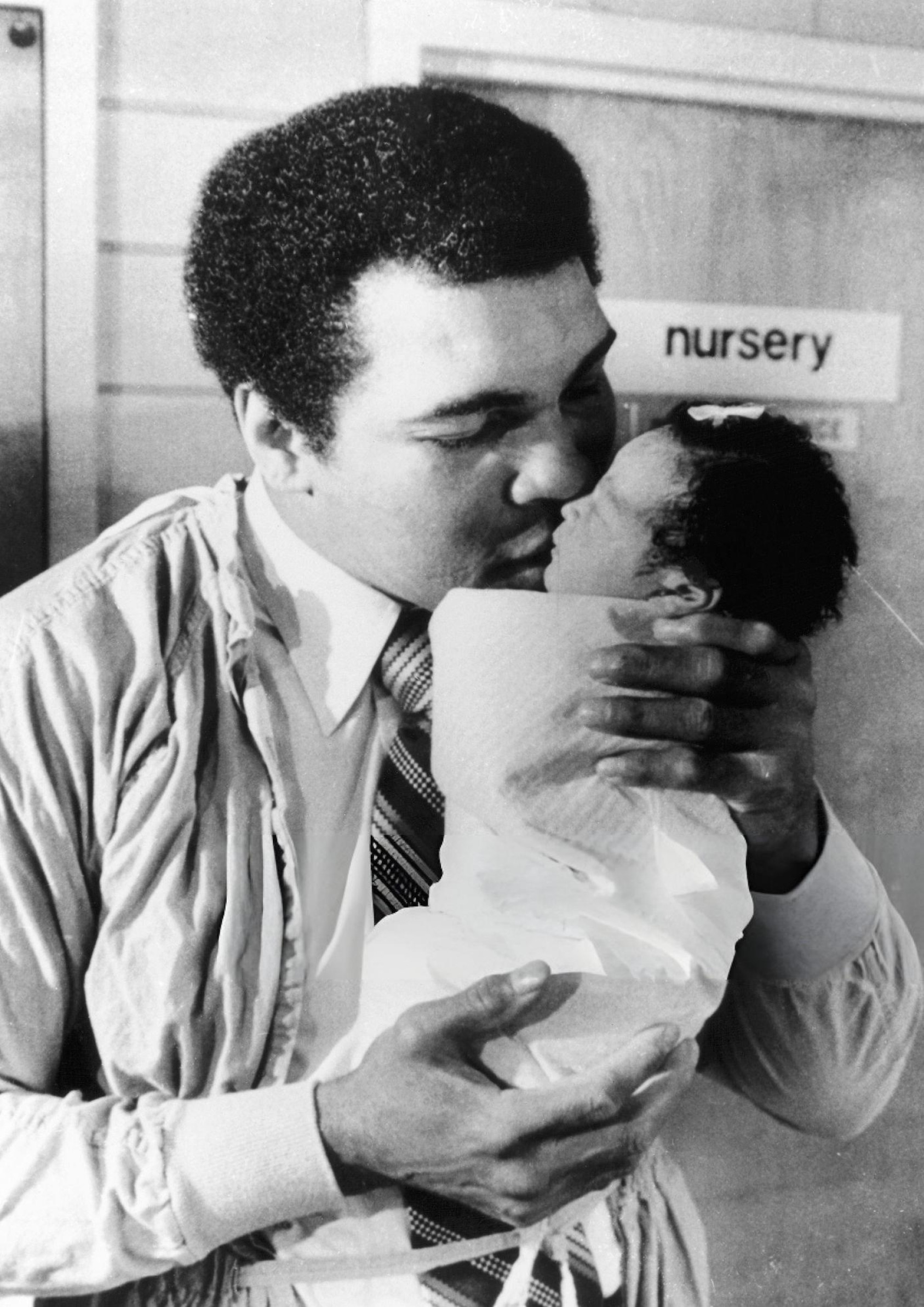
The number matters because Ali’s public persona could make his private life seem simpler than it was. He was married four times and had children through different relationships, while his youngest son, Asaad Amin Ali, joined the family through adoption.
That history means there is no single Ali-child experience. Some were raised while Ali was at the peak of his boxing fame; others came into his life after his retirement, when Parkinson’s disease had changed the practical rhythms of family life.
Maryum Ali was the eldest
Maryum Ali, also known as May May, is widely identified as Ali’s oldest child. She has worked in entertainment and youth-focused public speaking, and has also written about her father and the values he tried to pass along.
After Ali died at age 74 in June 2016, Maryum called him “THE GREATEST father” in a social-media tribute quoted by Time. The wording captured a theme repeated by several of his children: the world saw a transcendent athlete and activist, while they remembered a parent with an intensely personal place in their lives.
That distinction is central to understanding the family. Ali’s children have often been asked to explain the legend, but their memories tend to focus on affection, humor, lessons and the complicated demands placed on a family attached to a world-famous name.
His first family included four children
Ali’s marriage to Khalilah Ali, formerly Belinda Boyd, produced four children: Maryum, twins Jamillah and Rasheda, and Muhammad Ali Jr. Their childhoods overlapped with some of the most consequential years of Ali’s career, from his championship reigns to his outspoken opposition to the Vietnam War.
Jamillah Ali has generally lived more privately than several of her siblings. Rasheda Ali has been one of the more visible family members, writing and speaking about her father’s Parkinson’s disease and the impact it had on those around him.
Muhammad Ali Jr., his father’s eldest son, has also appeared in public discussions about Ali’s legacy. Carrying the same name as a globally recognized figure comes with obvious attention, but it can also make a child’s individual identity harder for outsiders to see.
The family’s public appearances and tributes have made clear that fame did not erase ordinary family bonds. It simply made the boundaries between private grief, public expectation and personal identity harder to manage.
Khaliah and Miya widened the circle
Ali’s daughters Khaliah Ali and Miya Ali are also part of the family’s seven-daughter count. Their lives underline why summaries of Ali’s children can become confusing: the family expanded across separate relationships, and some relatives have chosen to share much more publicly than others.
Khaliah has written about difficult parts of her early life and her relationship with her father. Her account offers a counterweight to the polished mythology that can surround celebrity families, acknowledging that a celebrated parent can be loving, absent, inspiring and imperfect at different times.
Miya has kept a comparatively lower public profile. That choice is worth recognizing on its own terms. Not every child of a public figure wants to turn a family name into a career, and privacy can be especially meaningful when the parent is one of the most photographed and discussed athletes of the 20th century.
Hana and Laila found distinct voices
Ali’s daughters Hana and Laila were born during his marriage to Veronica Porché Ali. Both have spoken publicly about their father, though they took notably different professional paths.
Hana Ali became an author and has written extensively about living with a father whose Parkinson’s disease progressed over many years. Her work has helped shift attention from Ali the public symbol to Ali as a father navigating illness, aging and dependence within his family.
In the hours after Ali’s death, Hana shared a vivid account of the family gathering at his bedside. Time reported her description of relatives holding his hands, praying and telling him they loved him. It remains one of the most intimate public accounts of his final moments.
Laila Ali followed her father into boxing, but built a career that was unmistakably her own. She became an undefeated professional fighter and later expanded into television and wellness work. Her success invited inevitable comparisons, yet it also demonstrated that the Ali name could open a door without defining every step after it.
Asaad joined the family by adoption
Asaad Amin Ali is Muhammad Ali’s youngest son. Ali and his fourth wife, Lonnie Ali, adopted him when he was a child, and his place in the family is part of the nine-child total.
Following Ali’s death, Asaad posted a tribute reflecting on the courage and love he said his father had taught him. Time quoted his message about being grateful for those lessons and about trying to remain strong during a devastating loss.
His experience also broadens the usual shorthand around Ali’s family. The nine children were not connected through one household or one chapter of Ali’s life. Their shared link was a father whose fame was extraordinary, but whose influence reached them in individual ways.
Why the family story still matters
Ali’s legacy is often told through title fights, his conversion to Islam, his political courage and his unforgettable command of language. Those chapters deserve their place. But the stories of his children show what public legend leaves out: the long, uneven work of family relationships.
There are competing impulses in any celebrity-family story. Readers may want a clean family tree and a list of accomplishments, while relatives may want room for private memories, disagreements and parts of their lives that do not belong to the public.
The clearest takeaway is not that all nine children followed the same path. They did not. Some became public advocates, authors or athletes; others chose a quieter life. Together, they preserve a more human understanding of Muhammad Ali: not only a champion who changed sports and culture, but a father whose children continue to define his legacy in their own voices.







Leave a Reply