
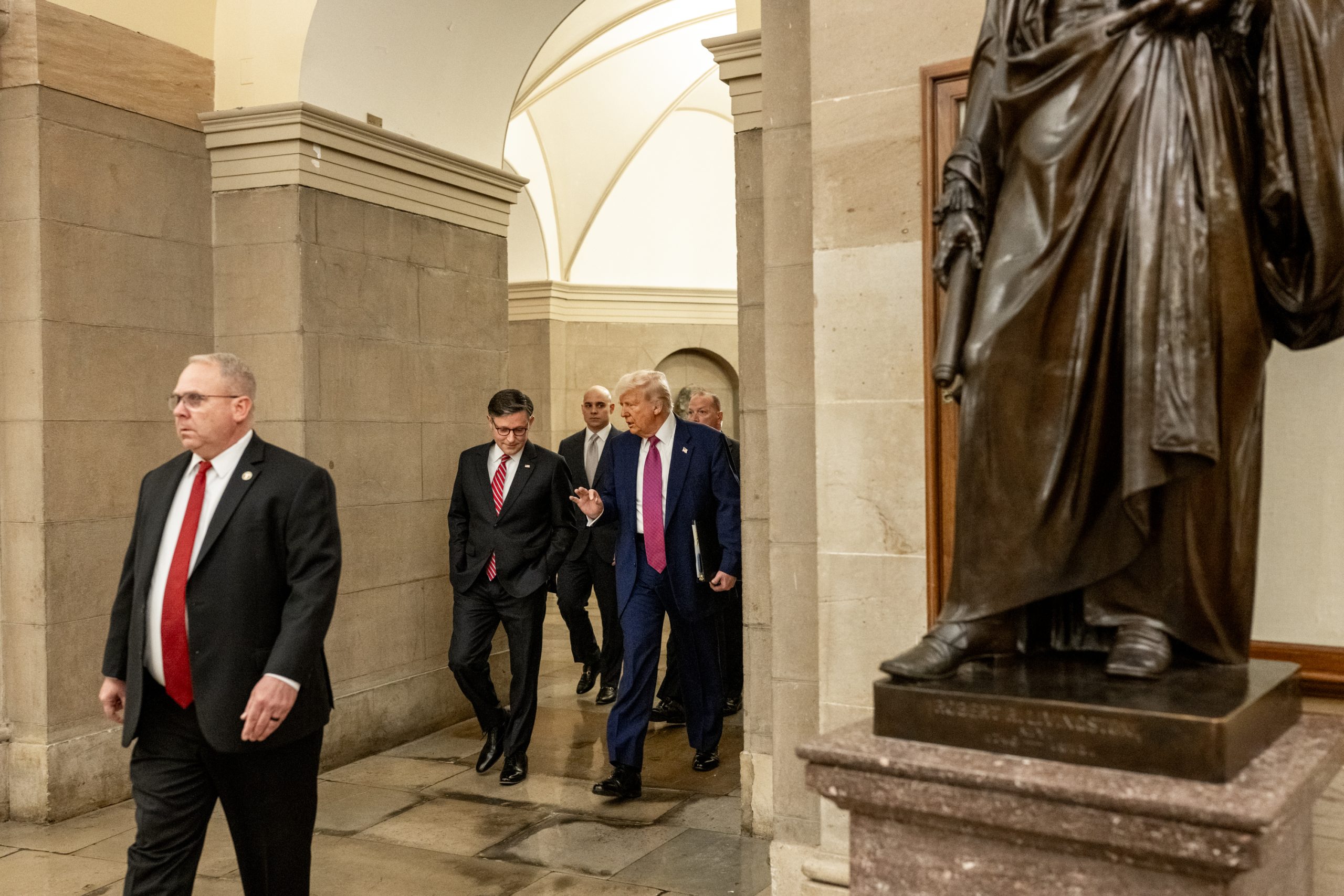
A floor standoff led by GOP hardliners has left the House speaker balancing Trump-aligned demands, angry Republicans and a shrinking legislative calendar.
Mike Johnson is under pressure from another Republican rebellion in the House after a floor standoff with GOP hardliners left the speaker unable to advance parts of his party’s agenda. The Independent described Johnson losing his cool; Johnson loses his composure and apologizes in the episode that has put the House conflict back at the center of questions about his leadership.
CNN reported that a small group of House Republicans, led by Rep. Anna Paulina Luna of Florida, blocked Johnson’s path forward and forced him to abandon the floor agenda. The fight matters because it shows how a narrow majority can turn a few defectors into power brokers.
A speaker boxed in
Johnson’s immediate problem was control of the House floor. That sounds procedural, but in the House it is the difference between governing and watching the agenda collapse in public.

According to CNN, Luna and other GOP hardliners refused to let Republican leaders move ahead with party priorities until they produced a plan to pass President Donald Trump’s federal elections overhaul bill. Their leverage came through a procedural blockade, the kind of vote speakers usually expect their own party to support.
When that support disappears, the speaker cannot simply muscle through. Johnson eventually instructed members to leave Washington early, a striking concession that he could not regain command of the chamber that week.
The result was not just a bad news cycle. CNN reported it was the second straight week Republican leaders had to scrap plans, costing them nearly a full week of floor time at a point when the legislative calendar was already tight.
Luna’s demand reshaped the fight
The standoff centered on an elections measure favored by Trump and pushed by hardliners. Luna said she wanted Republican leaders to attach voter ID and proof-of-citizenship language to the annual defense bill, according to CNN’s account.
That demand put Johnson in a political trap. The hardliners were trying to force action on a Trump priority, while GOP leaders faced the reality that Congress did not appear to have the votes to pass the bill in the form Trump wanted.
The Senate was another obstacle. CNN reported that some hardliners wanted Senate Republicans to take extraordinary steps, including changing chamber rules, but Senate GOP leaders said they lacked the votes to do that.
Trump’s role added another layer of tension. He publicly encouraged the defectors to back down, though CNN reported that some hardliners did not believe he was truly ready to abandon the elections push.
The temper flare mattered
The headline-grabbing moment was Johnson’s frustration. The Independent framed it as the speaker losing his cool and apologizing after another GOP rebellion, while CNN described a scene in which Johnson approached Luna and Rep. Tim Burchett as his plan was going down.
According to CNN, Johnson told the two lawmakers they were wrong, did not get it and that their votes would lead to embarrassment. They did not change their votes.
That exchange helps explain why the apology resonated. Johnson has often been described as even-tempered, but the floor revolt exposed the limits of that style when members of his own party are willing to block leadership in real time.
Johnson later described the situation in unusually blunt terms. CNN quoted him saying Republicans have “the smallest margin in US history” and that people “get very emotional” and sometimes make “irrational decisions.” He also called the episode a “self-inflicted wound” for the party.
Republicans split over blame
Some Republicans were openly angry at the hardliners, arguing that the blockade wasted a rare chance to move conservative priorities while the party controlled the House, the Senate and the White House.
Rep. Troy Nehls, quoted by CNN, said Republicans had “squandered away an opportunity to do something great for the Fourth of July,” referring to the annual defense bill. He argued that the party was wasting time it could not get back.
Luna rejected the criticism. CNN quoted her saying she was being singled out because she understood procedure and was “not stupid,” adding that she would “fight on behalf of the American people.”
That split captures the larger House GOP problem. One faction sees procedural rebellion as sabotage. Another sees it as the only available tool to force leadership to act on promises made to conservative voters.
Tiny margins, huge leverage
Johnson’s speakership has been shaped by math as much as ideology. With a razor-thin majority, even a small group of Republicans can shut down the floor if Democrats stay united against GOP rules and bills.
That gives rank-and-file conservatives leverage far beyond their numbers. CNN reported that roughly a dozen Republicans blocked Johnson’s effort to move ahead on the annual Pentagon policy bill, jeopardizing broader plans to pass parts of Trump’s agenda.
The timing made the revolt more costly. The House was not scheduled to return until mid-July, leaving only two more scheduled workweeks before the August recess, according to CNN. That compressed schedule threatens everything from defense legislation to other Republican priorities.
Rep. Thomas Massie, a frequent Johnson critic, told CNN that members were getting restless after primary season. His point was simple: lawmakers who feel politically secure, or who have little left to lose, are more willing to defy leadership.
The unresolved leadership test
The immediate question is whether Johnson can find a way to satisfy hardliners without promising something the Senate cannot deliver. If he cannot, the same procedural weapon can be used again.
The broader issue is whether House Republicans can turn unified party control into legislation. Control of the chamber does not mean much if the majority cannot agree to let its own bills reach the floor.
- For Johnson: the revolt raises doubts about whether persuasion and patience are enough to manage his conference.
- For hardliners: the standoff proves they can force attention, but it also risks blame for derailing conservative bills.
- For Trump’s agenda: the fight shows that even priorities with strong MAGA support can stall inside the GOP’s own governing machinery.
- For the House: more failed floor votes would mean fewer bills, more public infighting and a weaker leadership hand.
Johnson’s apology may soften the personal fallout from a heated exchange. It does not solve the structural problem underneath it: in this House Republican majority, a speaker can win the title and still struggle to command the floor.





Leave a Reply