
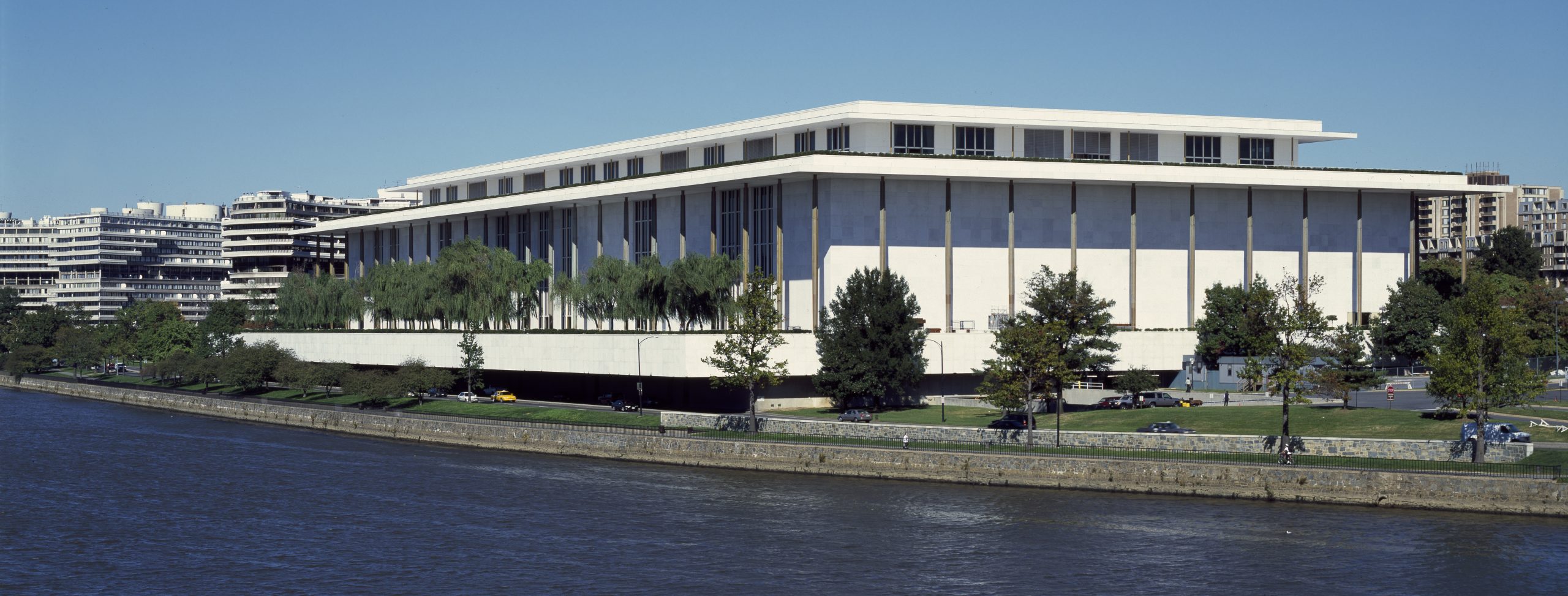
A construction covering at Washington’s Kennedy Center has become the latest flash point in a larger fight over the institution’s legal name and public identity. Officials cite safety and roof work; a Democratic board member’s lawyers say the tarp is obscuring the memorial Congress created for John F. Kennedy.
The Kennedy Center tarp-covered scaffolding will remain in place indefinitely, lawyers say, and is expected to stay up for the foreseeable future. Kennedy Center leaders said Tuesday that the covering has been in place for more than two months while crews conduct water testing and make structural repairs to the front portico’s roof overhang in Washington, D.C.
The facade dispute has returned to court, bringing the fight over the building’s public identity and Donald Trump’s name back before a judge. The scaffolding was originally erected June 12 to comply with a federal judge’s order requiring Trump’s name to be removed from the Kennedy Center’s facade. Lawyers for Rep. Joyce Beatty say the tarp obscures the center’s name and the result of that ruling, while officials describe it as a safety measure needed during ongoing testing and repairs.
A repair explanation meets skepticism
In a court filing, Matt Floca, the Kennedy Center’s executive director, described the tarp as a necessary barrier for workers and the building’s marble exterior. Justice Department lawyers representing the center also said the scaffolding and its protective cover are needed for an upcoming renovation.
Neither account offered a timetable for finishing the work or taking the covering down. That absence of a date is why the tarp is expected to remain for the foreseeable future, rather than being treated as a short-term response to the earlier court order.
The center’s stated purpose is not simply cosmetic. Its leaders say crews need the existing structure to conduct water testing and assess or repair the roof overhang at the front portico. Work around a marble facade can involve legitimate safety and preservation concerns, especially when workers need to protect both the building and people below.
But the litigation has made the practical question unusually charged: how much of the building must stay covered for that work, and for how long?
Why Beatty’s lawyers object
Beatty, an Ohio Democrat and ex officio member of the Kennedy Center board, previously sued over the effort to put Trump’s name on the building. Her attorneys, Nathaniel Zelinsky and Norm Eisen, argue that the continuing cover is a pretext, not a proportionate construction measure.
They say the setup leaves the Kennedy Center’s name largely obscured while appearing to have seen little visible use since it was installed. Their filing asks U.S. District Judge Christopher Cooper to require an explanation of why the tarp cannot be removed within 30 days.
The attorneys also challenge the center’s account of the roof inspection. They noted that the soffits cited by the center are roughly 20 feet above the scaffolding, and they questioned why additional scaffolding referred to in the filing had not been erected.
That does not establish that repairs are unnecessary. It does frame the dispute in terms a court can assess: whether the scope and duration of the cover reasonably match the work claimed, and whether the order to remove Trump’s name is being honored in substance as well as form.
The facade is the legal battleground
Judge Cooper’s earlier rulings set the stage for the current conflict. Beginning in May, he ruled that the board had illegally voted to rename the institution, directed trustees to remove Trump’s name and later sought an explanation for why the tarp continued to cover the facade.
The legal stakes are tied to the building’s unusual status. Congress created the center after President John F. Kennedy’s assassination as a living memorial to him, and the governing law requires that it bear Kennedy’s name alone, according to Beatty’s lawyers.
That history is why a covered sign carries more significance here than a typical construction screen. To the center’s critics, obscuring the facade deprives the public of the memorial’s identifying name even after Trump’s name was removed. To officials, the tarp is a temporary consequence of work required to preserve the structure.
The source material does not establish when the roof work will begin in earnest, how extensive it will be or whether the court will accept either side’s account. Those unresolved details are now central to the case.
A new Trump inscription plan
The tarp fight is unfolding alongside a separate effort to recognize Trump on the building again. Kennedy Center trustees recently approved a resolution seeking, by what it called all legal means, to add an inscription beneath the existing sign: “Restored and Renovated by President Donald J. Trump.”
The resolution also contemplates another line if a Trump-named endowment fund reaches $100 million. Beatty’s lawyers objected to the process, saying trustees did not receive advance notice or a draft of the proposal before the vote.
The center’s lawyers have said the institution will wait until Sept. 8 before reinstalling Trump’s name. Beatty is asking Cooper to rule that plan illegal before then.
That deadline gives the dispute a concrete next step. The court may need to address both the visibility of the existing Kennedy memorial name and whether any new Trump-related inscription is legally permissible.
How a tarp became a symbol
For visitors, the issue has moved beyond court filings. The covered entrance has become a conspicuous feature of one of Washington’s best-known cultural landmarks, prompting photos, jokes and public criticism during an already turbulent period at the performing arts center.
Its symbolism cuts both ways. Critics see the tarp as a physical barrier between the public and the name Congress required on the building. The center’s leadership describes it as protection needed to perform testing and repairs without risking workers or the marble facade.
The immediate takeaway is straightforward: the tarp is not expected to disappear soon, and its continued presence will remain part of the naming litigation. Whether it comes down within weeks, stays through a broader renovation or prompts a sharper court order depends on information the parties have yet to provide and Judge Cooper’s next decisions.




Leave a Reply