
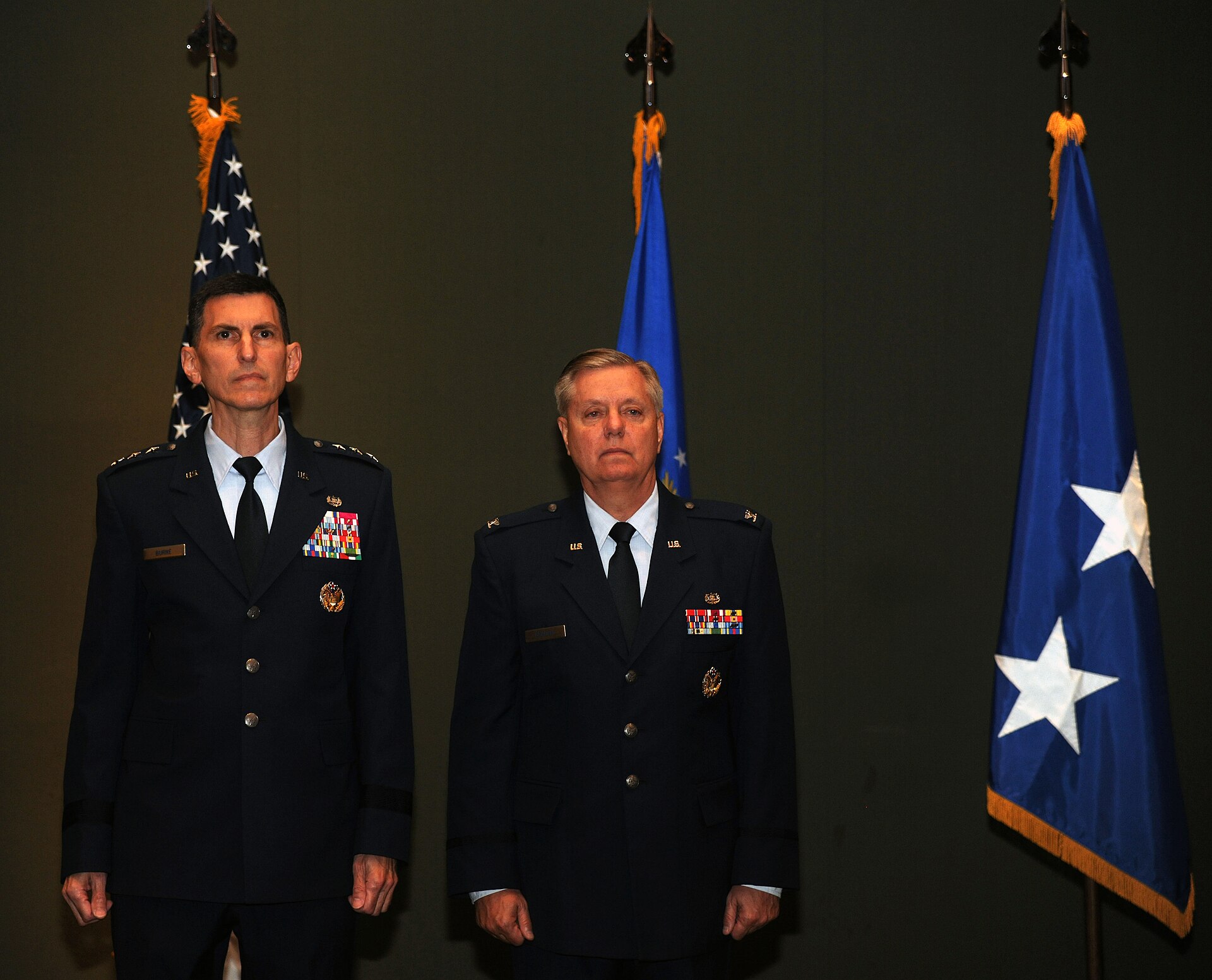
The guest list reflected Graham’s decades in Congress and his central role in Republican politics, national security debates and Senate relationships.
Lindsey Graham’s memorial was attended by high-profile guests, including White House and cabinet officials and members of Congress, with JD Vance and Sen. John Thune among the notable names identified in a Wall Street Journal rundown. The memorial drew attention because Graham, the South Carolina Republican whose congressional career ran from 1995 through 2026, occupied a rare place in Washington: a partisan fighter with deep ties across the Senate, national-security circles and the executive branch.
The attendee list is more than a Washington roll call. It shows how Graham’s death became an institutional moment, bringing together figures from the White House, Cabinet-level leadership and Congress around a senator whose influence extended far beyond South Carolina.
The names that stood out
The most visible names in the publicly identified group were JD Vance and Sen. John Thune, according to the Wall Street Journal’s listing of high-profile attendees. Vance appeared under the category of White House and cabinet officials, while Thune was listed among members of Congress.

That pairing alone says a great deal about the shape of the memorial. Vance represented the executive-branch side of Republican power. Thune represented the Senate institution where Graham spent the most consequential portion of his career.
The Journal’s summary also pointed to broader attendance from White House and Cabinet officials and from members of Congress. The available public extract does not provide a complete list of every senior official present, but the categories are significant: this was not a local-only remembrance or a small private gathering outside the political world.
It was a memorial attended by people who had worked with Graham, argued with him, depended on him, or measured their own politics against his.
Why the room mattered
Memorials for long-serving senators often carry two meanings at once. They honor a person, but they also reveal the networks that person built over decades. In Graham’s case, the presence of White House figures, Cabinet officials and members of Congress reflected his unusual durability inside Republican politics.
Graham was not simply a backbench vote. Congress.gov lists him as serving in Congress from 1995 through 2026, a span that covered major shifts in the Republican Party, the post-9/11 security era, the wars in Afghanistan and Iraq, the rise of Donald Trump and the remaking of the Senate’s judicial politics.
That kind of career creates long memories. Some attendees likely came because they were ideological allies. Others may have come because Graham was a central Senate negotiator, a committee voice, a foreign-policy hawk or a colleague who had been present for nearly every major fight of the modern GOP era.
In Washington, attendance can be read as respect, solidarity, obligation or all three. The significance here is that Graham’s memorial drew from multiple centers of power rather than from a single faction.
A Senate career with reach
Graham’s political identity was rooted in South Carolina, but his career was built in Washington’s highest-pressure arenas. He served in the House before moving to the Senate, and Congress.gov’s record underscores the length of that federal service.
His Senate years made him a fixture in debates over defense policy, foreign affairs, judicial nominations and presidential politics. Supporters saw him as a serious legislator with a command of national-security issues. Critics saw him as a fiercely partisan operator whose alliances shifted with the political moment.
Both views help explain the memorial’s guest list. A senator who spends three decades near the center of national debate tends to accumulate allies, rivals and institutional relationships that outlast a single election cycle.
That is why the appearance of figures such as Vance and Thune matters. Their presence connects Graham’s career to both the current Republican executive branch and the Senate leadership class that continues to shape the party after him.
Official honors added weight
The memorial followed formal signs of national recognition. A White House proclamation dated July 13, 2026, ordered U.S. flags flown at half-staff in Graham’s memory at the White House, public buildings and grounds, military posts, naval stations and U.S. facilities abroad until 6 p.m. on July 18.
The proclamation described the order as a mark of respect for Graham’s memory and longstanding service. That language is standard for major federal observances, but it also places a senator’s death within the rituals of the state.
Graham’s Senate office also posted an in-memory page and funeral service schedule, another sign that the transition from public service to public remembrance was being handled through official channels.
Those official gestures help explain why the memorial drew high-ranking attendees. When a long-serving senator dies, the response is not only personal. It becomes part of the government’s own ceremony of continuity.
The politics underneath the tribute
Graham’s legacy was never uncomplicated. He was known for strong positions on military intervention, close involvement in judicial and Senate fights, and a political evolution that mirrored some of the Republican Party’s biggest internal changes.
That makes the memorial notable in a different way. Public remembrance often softens conflict, but it does not erase it. Graham’s admirers could point to his loyalty, work ethic and command of policy. His detractors could point to his combative style and the polarizing choices that defined parts of his later career.
The attendance of senior political figures does not settle those debates. It does show that Graham remained important enough that Washington’s leaders treated his passing as a moment requiring presence.
For readers outside the Beltway, that may be the key takeaway: the guest list was a map of influence. It showed where Graham’s relationships ran and which institutions considered his career consequential enough to mark publicly.
What remains unclear
The public material available so far does not give a complete, independently detailed roster of every high-profile attendee. The Wall Street Journal identified categories and notable names, including JD Vance and John Thune, while official government sources confirm the broader memorial and honors context.
It is also unclear from the available extracts how much of the attendance was personal, political, ceremonial or tied to official roles. In Washington, those lines often overlap.
What is clear is that Lindsey Graham’s memorial drew senior figures from the White House, Cabinet ranks and Congress. For a senator whose career stretched across more than three decades of national politics, that attendance was itself a final measure of his reach.






Leave a Reply