

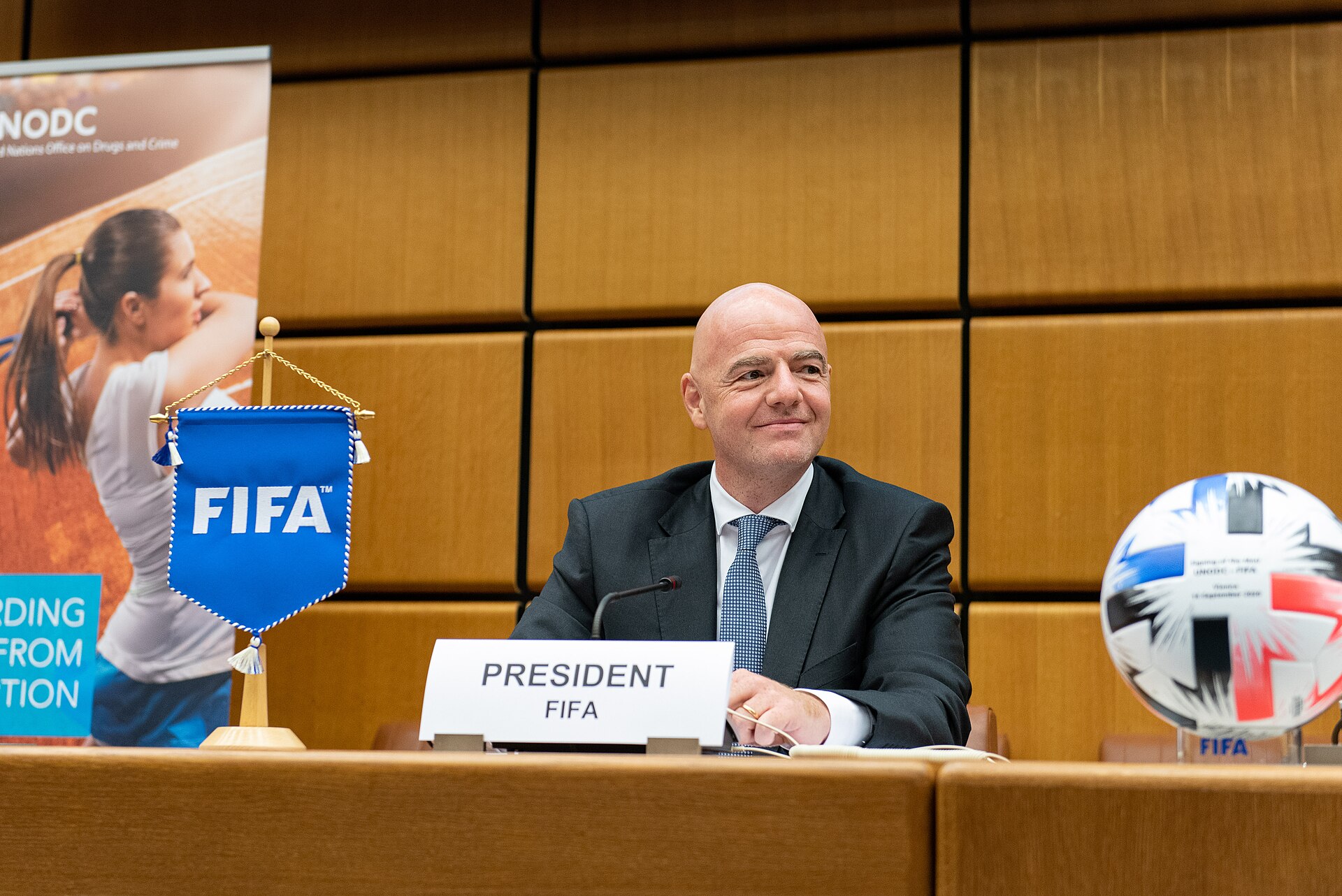
Gianni Infantino has asked FIFA’s 211 member federations to decide on a private-investor plan tied to World Cup revenues. The dispute now centers on money, timing and who would control the sport’s biggest competitions.
The pressure point in FIFA’s private-investor plan is now a date and a number: Sept. 19, and $20 million for each member federation. The Associated Press reported that FIFA President Gianni Infantino set that deadline Wednesday for the soccer body’s 211 members to accept one-off offers tied to a project that would bring outside investors into a new World Cup events business.
Reuters reported that FIFA said Tuesday it plans to create a $20 billion subsidiary to run the World Cup and other events, with stakes of up to 20% available to private investors. The proposal has drawn objections from major soccer organizations, not only over the valuation but over how quickly federations are being asked to consider it.
The decision before FIFA’s members
FIFA’s proposal would move key commercial operations for its competitions into a new subsidiary. According to Reuters reporting, that entity would run the World Cup and other FIFA events while allowing outside investors to buy minority stakes.
The Associated Press reported that Infantino described the plan in a letter as a “singular and unique funding opportunity.” In the same letter, he said it was his duty and responsibility as FIFA president to present such opportunities to member federations.
The plan is not final. The New York Times reported that the proposals are subject to approval by a majority of FIFA’s national associations and by FIFA’s 37-member council. That makes the coming member response the practical test of whether the project moves forward.
What the $20 million offer does
The AP reported that the one-off $20 million offers are part of the project to sell stakes in the World Cup to private investors. The money is the immediate benefit FIFA is presenting to federations as it asks them to consider the new structure.
The New York Times reported that FIFA has framed the plan as a way to increase development funding for its 211 member associations. Its reporting also said the proposed entity, FIFA Forward Enterprises, would run FIFA’s main events while FIFA remained the global governing body and retained a majority stake.
That framing is central to the dispute. Supporters can point to a large funding stream for national associations. Critics are focusing on whether a short-term funding offer should be tied to a long-term change in how FIFA’s most valuable competitions are operated.
Process objections are driving the backlash
The Asian Football Confederation said stakeholders should receive enough information and time to assess the proposal, including its governance, legal, commercial and strategic implications. That statement goes directly to the pace of the process.
CONCACAF also objected to the rollout. AP reporting said the North and Central American and Caribbean confederation was “deeply concerned by the lack of due process.” A statement carried by Reuters said CONCACAF shared disappointment that details had been designed and shared publicly before discussion with relevant governance bodies and stakeholders.
UEFA has taken one of the strongest public positions. AP reported that the European body said there was “significant and growing opposition to FIFA’s scheme” after discussions across the game. UEFA also said the World Cup “is not FIFA’s to sell,” according to AP reporting.
AP reported that UEFA was aiming to call its 55 member federations to an emergency online meeting, likely Thursday. That would give European federations a separate forum to discuss the proposal before FIFA’s Sept. 19 deadline.
The investor structure is under scrutiny
The proposed outside investors are also part of the story. AP reported that the $20 billion FIFA subsidiary was bankrolled by the brother of Jared Kushner. The New York Times reported that Thrive Eternal, a long-term investment vehicle set up by Joshua Kushner, was expected to lead the proposed investor group, with J.P. Morgan serving as FIFA’s chief adviser on the project.
Private investment does not, by itself, establish that FIFA’s competitions would change. The governance question is what rights investors would receive, how commercial decisions would be made, and what protections would keep sporting decisions separate from investor returns.
Those details are why confederations are asking for more time and information. A minority stake can still matter if it comes with influence over strategy, revenue targets or the commercial direction of events such as World Cups and Club World Cups.
What remains unresolved
The core facts are clear: FIFA has proposed a $20 billion subsidiary, private investors could receive stakes of up to 20%, and member federations have been offered $20 million tied to the project. The unresolved questions are about approval, oversight and timing.
Federations still have to assess how the new entity would be governed, what FIFA would retain control over, and how any investor rights would be limited. The AFC’s reference to governance, legal, commercial and strategic implications shows how broad that review could be.
For now, FIFA’s investor plan is no longer only a finance proposal. It has become a test of whether the organization can persuade its own members and continental partners that World Cup revenues can be opened to private capital without weakening trust in how the game is run.








Leave a Reply