
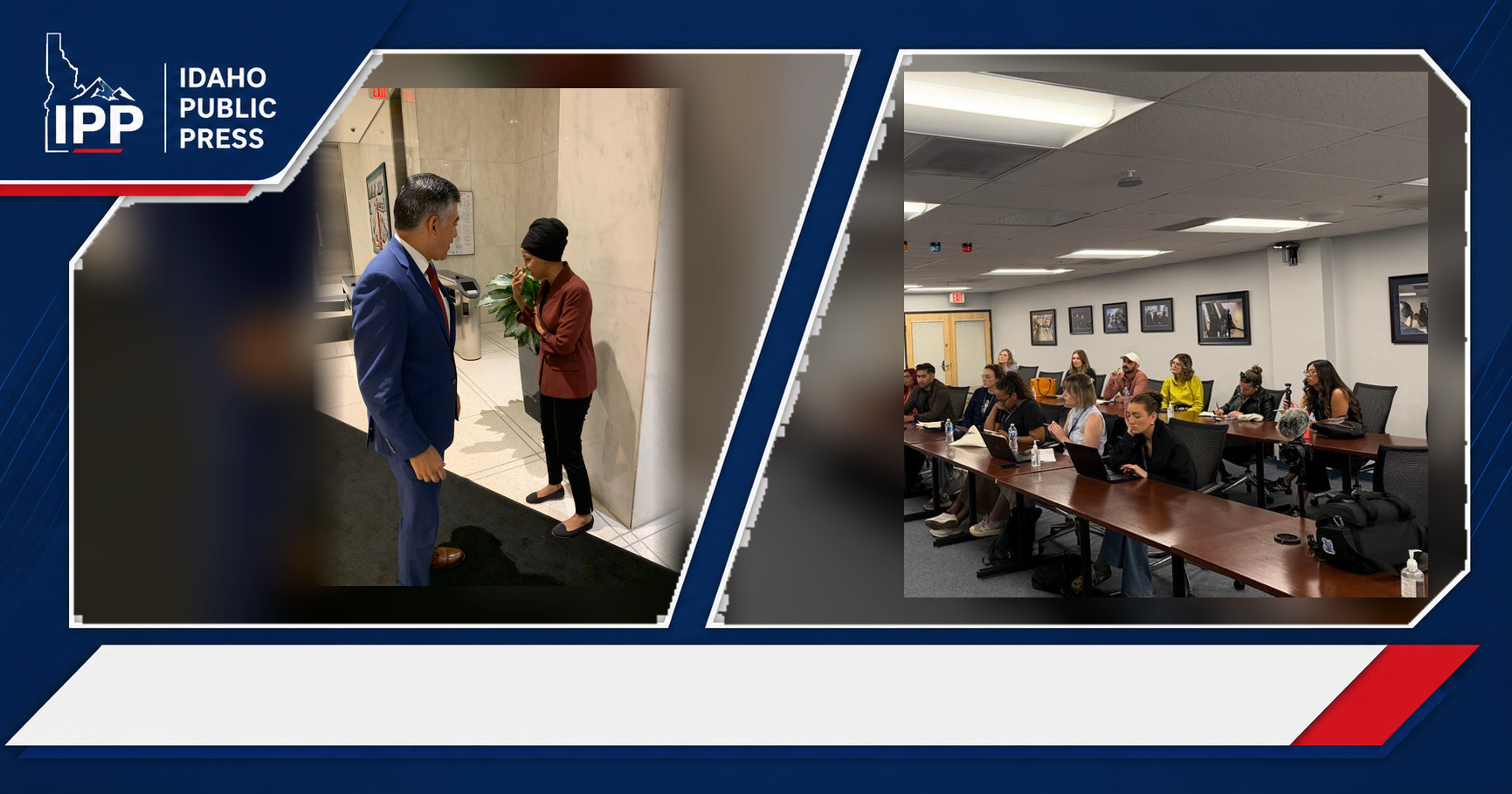
Omar’s letter puts the focus on why a federal agent was near a public congressional event and whether local police should have been alerted. Homeland Security Investigations has not been represented in the available materials as having publicly explained the assignment.
Ilhan Omar said a federal agent was posted outside her monthly town hall meeting in Richfield, Minnesota, a Minneapolis suburb, and she is demanding an explanation from Homeland Security Investigations. Omar’s office says the agent was working undercover near the August 6 event at Richfield Community Center, raising questions about the purpose of the assignment and whether local police should have been notified.
The Minnesota Democrat has framed the episode as a public-safety and government-accountability concern. The available account does not establish why the agent was there, whether the town hall was the intended focus of the operation or whether HSI had a separate investigative purpose nearby.
Omar’s account of the encounter
In an August 10 press release, Omar said she sent an oversight letter to HSI after an undercover agent was stationed outside her regular town hall in Richfield. Her office described the location as the parking area of a community center hosting the congressional event.
According to Omar’s statement, the agent said she was conducting an undercover criminal operation. Omar’s office said the operation had not been coordinated in advance with the Richfield Police Department.
That distinction matters. An agent working in the vicinity of a public event is not, on its own, proof that the event or its attendees were being investigated. But the unusual proximity to an elected official’s town hall makes the operational context central to understanding what happened.
The questions sent to HSI
Omar is asking HSI to explain why an agent was assigned to Richfield Community Center on the evening of August 6. She also wants to know when the agent and supervisors learned that a town hall was taking place there, and what they did after learning that information.
Her letter seeks information about the agent’s training and length of service, as well as HSI’s general procedures for coordinating undercover work with local law enforcement. Omar’s office said Richfield police reported receiving no advance notice of the claimed undercover operation.
The requests extend beyond that one evening. Omar is also seeking details about any official events she has held that HSI agents may have been assigned to observe, and whether agents have observed official activities involving other Minnesota officials this year.
- Why was an HSI agent assigned near the community center?
- Did the agent know the town hall was underway?
- Why, if an undercover operation was in progress, did Richfield police reportedly receive no advance communication?
- Was this an isolated deployment or part of a wider practice?
Why police coordination is central
Undercover work often depends on discretion, so not every operational detail can necessarily be shared widely. At the same time, local law enforcement can face immediate decisions when officers encounter a suspicious vehicle or person near a crowded public gathering.
Omar’s office said the agent was in a vehicle with mismatched license plates, which it characterized as a state-law violation and inconsistent with earlier commitments HSI had made to her. The available material does not include HSI’s explanation of the plates, the nature of any prior commitments or whether officials view a law-enforcement vehicle as subject to a particular exemption.
Omar argued that Richfield police had to spend time investigating the agent’s presence rather than concentrating on potential threats to attendees. That is her assessment, but it captures the practical tension: secrecy can protect an investigation, while a lack of basic coordination can create confusion for officers responsible for a venue’s safety.
A town hall changes the stakes
A congressional town hall is a public-facing government event, not a private campaign gathering. Residents attend to question their representative, hear updates and raise concerns. The setting heightens sensitivity around any law-enforcement activity that might appear connected to political expression or to the monitoring of a public official.
Omar has tied the incident to broader criticism of the Trump administration’s immigration and homeland-security enforcement posture, arguing that federal agencies may be used to intimidate political opponents. That is a political allegation from Omar, not an established finding in the information available so far.
Her statement also offered an alternative explanation: that the agent may have been pursuing a legitimate criminal investigation but chose an unsuitable location near a congressional event. That possibility is why HSI’s account is consequential. It could clarify whether this was an operational error, a misunderstanding between agencies, or a deployment unrelated to the town hall itself.
What remains unverified
There is no public HSI response included in the available source material. As a result, several major facts remain unresolved: the specific objective of the undercover operation, the agent’s instructions, whether the town hall was known to supervisors beforehand and whether any local coordination was attempted through channels not known to Richfield police.
There is also no independently established evidence in the provided material that the agent was assigned to monitor Omar, her constituents or the town hall. Omar’s letter asks directly about that possibility because the reported presence occurred outside one of her official events.
Those distinctions are important in a case that blends federal law enforcement, local policing and political mistrust. A federal agent may lawfully work near a public event for reasons unrelated to it; a public official is likewise entitled to seek an explanation when the operation creates concern among attendees and local police.
The response will determine the story
The next meaningful development is likely to be HSI’s response to Omar’s oversight letter, if one is made public. A detailed account could address whether the agency had an active criminal case in the area, what safeguards were used and why Richfield police were not alerted.
If HSI does not provide a clear explanation, Omar’s broader questions about oversight and surveillance at official events will remain at the center of the dispute. For Richfield residents, the immediate issue is simpler: public meetings work best when people know who is responsible for safety and when agencies operating in the same space are not working at cross-purposes.

Leave a Reply