
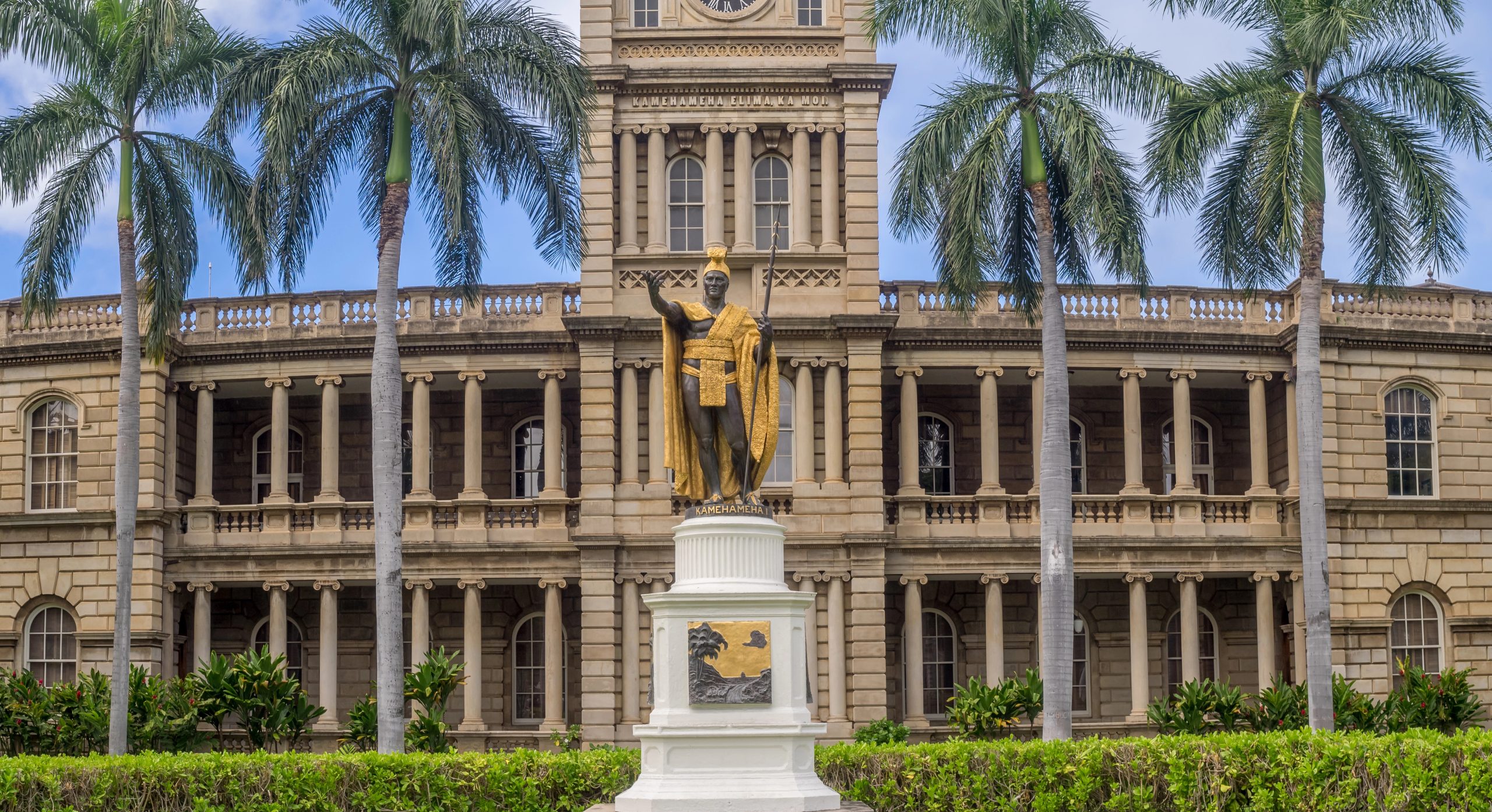
The Hawaiʻi Supreme Court has ordered a new trial for a man convicted in 1990 after determining that materially inaccurate forensic testimony may have affected the jury’s verdict. The ruling also includes an exceptionally strong critique of the U.S. Supreme Court and several of its recent constitutional decisions.
Associate Justice Todd Eddins wrote the majority opinion in Granillo v. State, which was issued July 15. Chief Justice Vladimir Devens and Associate Justice Sabrina McKenna joined the opinion. Justice Lisa Ginoza, joined by Circuit Judge Peter Kubota, agreed that Daniel Granillo should receive a new trial but issued a separate opinion disputing the legal standard adopted by the majority.
The 91-page majority opinion concluded that the Hawaiʻi Constitution protects criminal defendants when scientific testimony introduced at trial is later established to have been materially false, even when prosecutors were unaware at the time that the underlying science was unreliable.
The Case Against Daniel Granillo
Granillo was charged in 1989 with kidnapping, two counts of first-degree sexual assault and one count of attempted first-degree sexual assault involving a woman on Maui. A jury found him guilty on every count in 1990, and he was sentenced to 40 years in prison.
During the trial, FBI supervisory special agent Wayne Oakes was accepted as an expert in microscopic hair and fiber examination. Oakes testified that a hair found in Granillo’s vehicle was consistent with the woman’s hair and that fibers recovered from her clothing matched material located inside the vehicle.
Prosecutors repeatedly relied on that evidence to support their claim that the woman had been inside Granillo’s car. The Hawaiʻi Supreme Court later determined that the forensic evidence gave contested witness testimony an impression of scientific certainty and occupied a central place in the prosecution’s case.
In 2017, the U.S. Department of Justice informed Maui prosecutors that Oakes’s testimony concerning microscopic hair comparison had gone beyond what the science could reliably establish. According to the letter, the testimony improperly implied that a hair could be linked to a particular individual or assigned meaningful statistical significance.
The federal examination directly addressed the testimony involving the hair evidence. The Hawaiʻi Supreme Court also reviewed major scientific reports released in 2009 and 2016 and concluded that parts of Oakes’s fiber testimony expressed a level of certainty unsupported by the available science.
Why the Court Ordered a New Trial
A lower court had recognized that the hair evidence was admitted improperly but concluded that the mistake was harmless because it considered the remaining evidence of Granillo’s guilt overwhelming. The Hawaiʻi Intermediate Court of Appeals affirmed the rejection of post-conviction relief while applying a different legal test.
The state Supreme Court rejected both approaches. It held that when advances in science establish that expert testimony presented during a trial was invalid, courts must apply a false-evidence standard under article I, section 5 of the Hawaiʻi Constitution.
Under that framework, a defendant is not required to establish that prosecutors knowingly introduced false evidence. Instead, the defendant must demonstrate a reasonable possibility that the invalid testimony contributed to the conviction.
The majority concluded that Granillo had met that requirement. It found that the hair and fiber evidence provided the prosecution’s primary scientific connection between the woman and Granillo’s vehicle and may have significantly affected the jury’s decision. The court vacated the judgment denying post-conviction relief and returned the matter for a new trial.
Ginoza and Kubota agreed that the error was not harmless and that Granillo was entitled to another trial. They disagreed, however, with the majority’s decision to adopt the false-evidence materiality standard and instead favored a harmless-beyond-a-reasonable-doubt analysis.
Why the Opinion Discussed the U.S. Supreme Court
The dispute over the proper legal test prompted the majority to examine federal due-process precedent.
The majority determined that existing U.S. Supreme Court decisions had not answered whether the unknowing introduction of evidence later proven false violates federal due process. It then stressed that Hawaiʻi courts interpret their state Constitution independently and may recognize broader protections than those presently available under the federal Constitution.
That principle is not unusual on its own. State supreme courts are permitted to interpret their constitutions as providing individual rights beyond those guaranteed by the federal Constitution. When a ruling clearly depends on an adequate and independent ground of state law, the U.S. Supreme Court generally lacks authority to overturn that state-law conclusion. The federal Constitution nonetheless remains binding on every state and sets the minimum level of constitutional protection.
The unusual feature of the opinion was the majority’s language.
Across several pages, Eddins accused the Roberts Court of selectively applying originalism, diminishing voting protections, increasing the political power of wealth, restricting reproductive freedom, shielding partisan gerrymandering and expanding presidential authority.
Addressing the U.S. Supreme Court’s six-member conservative majority, Eddins wrote: “When six justices walk away from those they are supposed to protect, state constitutions hold the line.”
The majority referred to cases including Dobbs v. Jackson Women’s Health Organization, Citizens United v. Federal Election Commission, Rucho v. Common Cause, Trump v. United States, New York State Rifle & Pistol Association v. Bruen and several rulings issued during the Supreme Court’s 2025–26 term.
Eddins contended that those decisions revealed a recurring pattern in which protections for people with less political influence were weakened while institutions and individuals possessing greater power were strengthened. That characterization reflected the majority’s interpretation of the Supreme Court’s record and was not an independent factual determination required to resolve Granillo’s forensic-evidence claim.
References to Brown, Dred Scott and Plessy
The opinion compared the present Court’s approach with Brown v. Board of Education, the 1954 ruling that declared state-imposed segregation in public schools unconstitutional.
Eddins also referred to Dred Scott v. Sandford, the 1857 decision that denied federal citizenship to Black Americans, and Plessy v. Ferguson, the 1896 ruling that upheld government-enforced segregation under the “separate but equal” doctrine.
He argued that contemporary originalism sometimes relies on forms of historical reasoning similar to methods used in discredited nineteenth-century rulings. The comparison constitutes a severe criticism of originalist interpretation and should not be characterized as an undisputed account of the Supreme Court’s present jurisprudence.
The majority further criticized what it called the Roberts Court’s “colorblind” understanding of equal protection. It argued that the history of the Fourteenth Amendment cannot be separated from its purpose of protecting formerly enslaved people and their descendants.
Criticism of the Opinion’s Tone
The opinion’s language prompted criticism from outside commentators who said it was improper for a state supreme court ruling to dedicate extensive discussion to federal cases unrelated to the dispute before it.
Criticism also came from within the Hawaiʻi court. Ginoza’s separate opinion, joined by Kubota, noted that the majority expressed disdain for recent U.S. Supreme Court rulings involving matters that were not relevant to Granillo’s case.
That difference is significant. All five members of the panel agreed on the ultimate result—that Granillo should receive a new trial—but they did not agree on the appropriate legal standard or on whether the majority’s broad examination of federal constitutional law was pertinent.
Direct quotations attributed to Iowa Solicitor General Eric Wessan and George Washington University law professor Jonathan Turley should be included only after being verified against the commentators’ original posts. Their statements represent criticism of the opinion rather than conclusions reached by another court.
Connection to Hawaiʻi’s Gun-Law Case
The Granillo opinion was released 20 days after the U.S. Supreme Court issued its decision in Wolford v. Lopez.
In Wolford, a 6-3 majority ruled that Hawaiʻi could not bar licensed concealed-carry permit holders from bringing handguns onto private property open to the public unless the property owner had expressly permitted firearms. Critics referred to the restriction as the “vampire rule” because an armed person had to receive an affirmative invitation to enter the property while carrying a weapon.
Eddins cited Wolford as an additional example of what he regarded as the Supreme Court’s failure to respect Hawaiʻi’s constitutional traditions and public-safety judgments.
What the Decision Means
The ruling’s immediate consequence is that Granillo is entitled to a new trial. It also creates a more protective state due-process standard for certain Hawaiʻi cases in which scientific testimony is found to be invalid after a conviction has already been entered.
The decision does not permit Hawaiʻi courts to disregard binding federal law or violate rights protected by the federal Constitution. Instead, it maintains that the Hawaiʻi Constitution may provide criminal defendants with protections exceeding the federal minimum when a ruling rests independently on state law.
The decision’s lasting importance will depend in part on how lower courts use the newly adopted false-evidence standard in later post-conviction proceedings. Its unusually confrontational treatment of the Roberts Court is also likely to continue generating debate among judges and constitutional-law scholars.
Eddins has served as a justice on the Hawaiʻi Supreme Court since December 2020.






Leave a Reply