

The survey gives Republicans the edge in a state that has moved sharply right. But the numbers also show why Democrats are not treating Florida as entirely out of reach.
A new poll about Byron Donalds’ chances against Democrats in Florida shows the Republican congressman leading Democrat David Jolly by 5 points in the Florida governor’s race. The University of North Florida survey puts Donalds ahead 46 percent to 41 percent, a result that shows how vulnerable Donalds is in the Florida governor’s race while still giving Republicans the advantage.
That tension is the story: Florida has shifted right, Donalds has Donald Trump’s endorsement, and Democrats have struggled statewide. Yet the poll suggests the 2026 governor contest may not be a blowout if Jolly becomes the Democratic nominee.
A lead, but not a runaway
The University of North Florida poll surveyed 848 likely voters from July 8 to July 17, 2026, using telephone and web-based interviews. Its margin of error was plus or minus 3.8 percentage points.
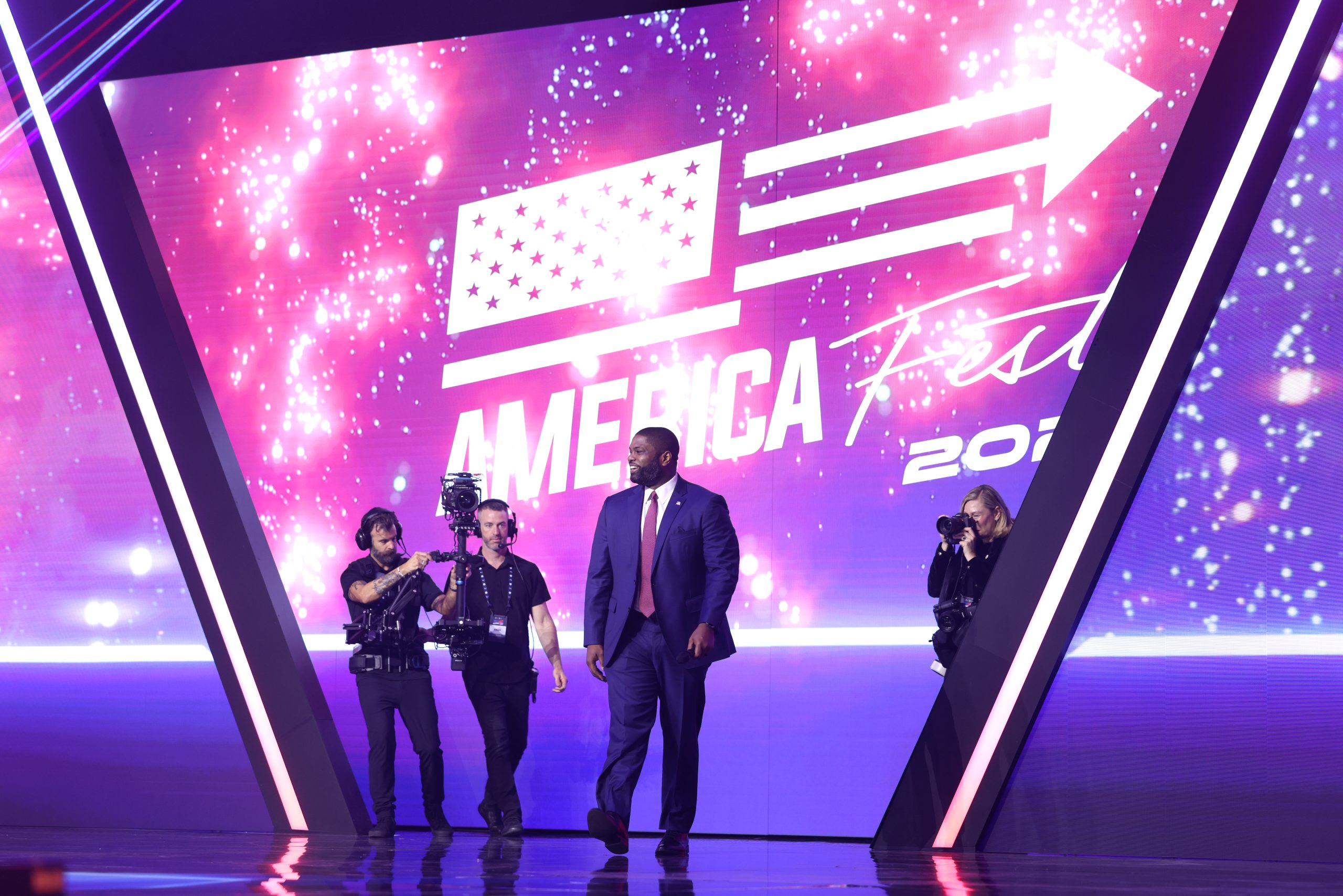
Donalds led Jolly 46 percent to 41 percent. Another 6 percent of voters were undecided, while 5 percent said they would choose another candidate.
For Donalds, that is a real lead in a state Republicans now expect to win. For Democrats, the gap is close enough to argue that Florida’s governor race could be more competitive than recent statewide results would suggest.
The key caution is that this is one poll, taken months before the August 18, 2026 primaries and well before a general-election campaign would fully define either candidate.
Why Jolly is still in range
Jolly’s path in the poll runs through the kinds of voters Democrats would need to make Florida competitive again: independents, Hispanic and Latino voters, and Republicans uneasy with the party’s current direction.
Among voters not affiliated with either major party, Donalds led Jolly by just 1 point, 39 percent to 38 percent. That is a narrow split in a bloc that can decide close statewide races, even in a state with a growing Republican registration edge.
Jolly also led Donalds among Hispanic and Latino voters in the poll, 53 percent to 35 percent. That finding stands out because Republicans, including Trump, have made major gains with Latino voters in Florida in recent cycles.
Jolly is not running as a standard Democratic figure. He is a former Republican congressman who represented Pinellas County from 2014 to 2017 before leaving the GOP. That biography may help explain why Democrats see him as a potentially unusual fit for a difficult state.
Florida’s red tilt still looms
The same poll that gives Democrats some hope also shows why Florida remains a hard climb. Trump carried the state by 13 points in 2024, after winning it by 3 points in 2020 and by about 1 point in 2016.
Florida was once a premier presidential battleground. Barack Obama won it in 2008 and 2012. Since then, Republicans have built a stronger statewide machine, expanded their appeal in key regions and grown their voter-registration advantage.
According to Florida Division of Elections figures cited in the reporting, as of June 30 there were 5,569,028 registered Republicans in the state, compared with 4,040,000 registered Democrats and 3,324,324 voters with no party affiliation.
That registration gap matters because a close poll is not the same thing as an equal playing field. Democrats would need strong turnout, a favorable national climate and enough crossover or independent support to overcome the state’s structural Republican advantage.
The Trump factor cuts both ways
Donalds, who represents the Fort Myers area in Congress, has Trump’s endorsement. In a Republican primary, that remains a major asset. In a general election, it can be both a mobilizer and a target.
The UNF poll found Florida voters narrowly disapproving of Trump, with 51 percent disapproving and 48 percent approving. That is not a collapse in a state he won comfortably, but it gives Democrats a message if the race becomes a referendum on Trump-aligned leadership.
At the same time, Republican voters appeared slightly more certain about participation. The poll found 93 percent of Republicans saying they would definitely vote, compared with 91 percent of Democrats.
That small turnout signal should not be overread, but in a midterm electorate, enthusiasm and reliability can matter as much as persuasion.
Other polls tell a mixed story
The UNF result is not the only recent snapshot of a Donalds-Jolly matchup, and the broader picture is uneven.
A Change Research poll from May showed Jolly ahead by 4 points, 46 percent to 42 percent. That survey included 1,593 likely voters and was conducted from May 13 to May 16. Change Research is affiliated with Democrats, which is relevant context when comparing polls.
A Cherry Communications survey conducted May 1 to May 9 showed Donalds ahead by 8 points, 47 percent to 39 percent. It surveyed 604 likely voters, had a margin of error of plus or minus 4 percentage points and was commissioned by the Florida Chamber of Commerce.
A Stetson University poll conducted from March 15 to April 13 also gave Donalds a lead, 47 percent to 40 percent, among 848 likely voters. Put together, the polling points to a single-digit race in hypothetical matchups, but not necessarily to a toss-up once Florida’s partisan fundamentals are included.
The primaries come first
Neither Donalds nor Jolly is guaranteed a general-election matchup yet. Donalds faces other Republicans in the primary, including Lieutenant Governor Jay Collins, former Florida House Speaker Paul Renner and Azora Partners founder James Fishback.
Jolly is also running in a Democratic primary against state Representative Dotie Joseph. Orange County Mayor Jerry Demings, once seen as a possible contender, withdrew from the race.
That matters because primary campaigns can change the shape of the general election. Candidates may spend money early, take positions that create vulnerabilities later, or emerge with stronger name recognition than expected.
Outside forecasters are still skeptical that Democrats can truly flip the seat. The Cook Political Report and Sabato’s Crystal Ball do not currently rate the Florida governor race as competitive, classifying it as safe or solid Republican.
What the poll really says
Jolly’s campaign rejected the idea that the UNF poll should be read as bad news. Senior adviser Mark Riddle told Newsweek that the poll “samples a universe that doesn’t exist in Florida’s November election” and argued that it still showed Jolly was well positioned.
Newsweek reported that it also reached out to Donalds’ campaign for comment by email. The extracted report did not include a response from the campaign.
Prediction markets were more bullish on Republicans than the head-to-head polling. As of Monday morning, Republicans were listed with an 81 percent chance of winning the governor’s race on Kalshi and 82 percent on Polymarket. Those markets reflect trader sentiment, not a final forecast.
The practical takeaway is narrower than either party’s preferred spin. Donalds is ahead, Florida’s Republican lean is real, and Democrats still have to prove they can win statewide again. But a 5-point UNF lead is not a coronation. It is an early warning that the race could be worth watching if the national environment shifts, Jolly consolidates support and Donalds cannot expand beyond the GOP base.




Leave a Reply