
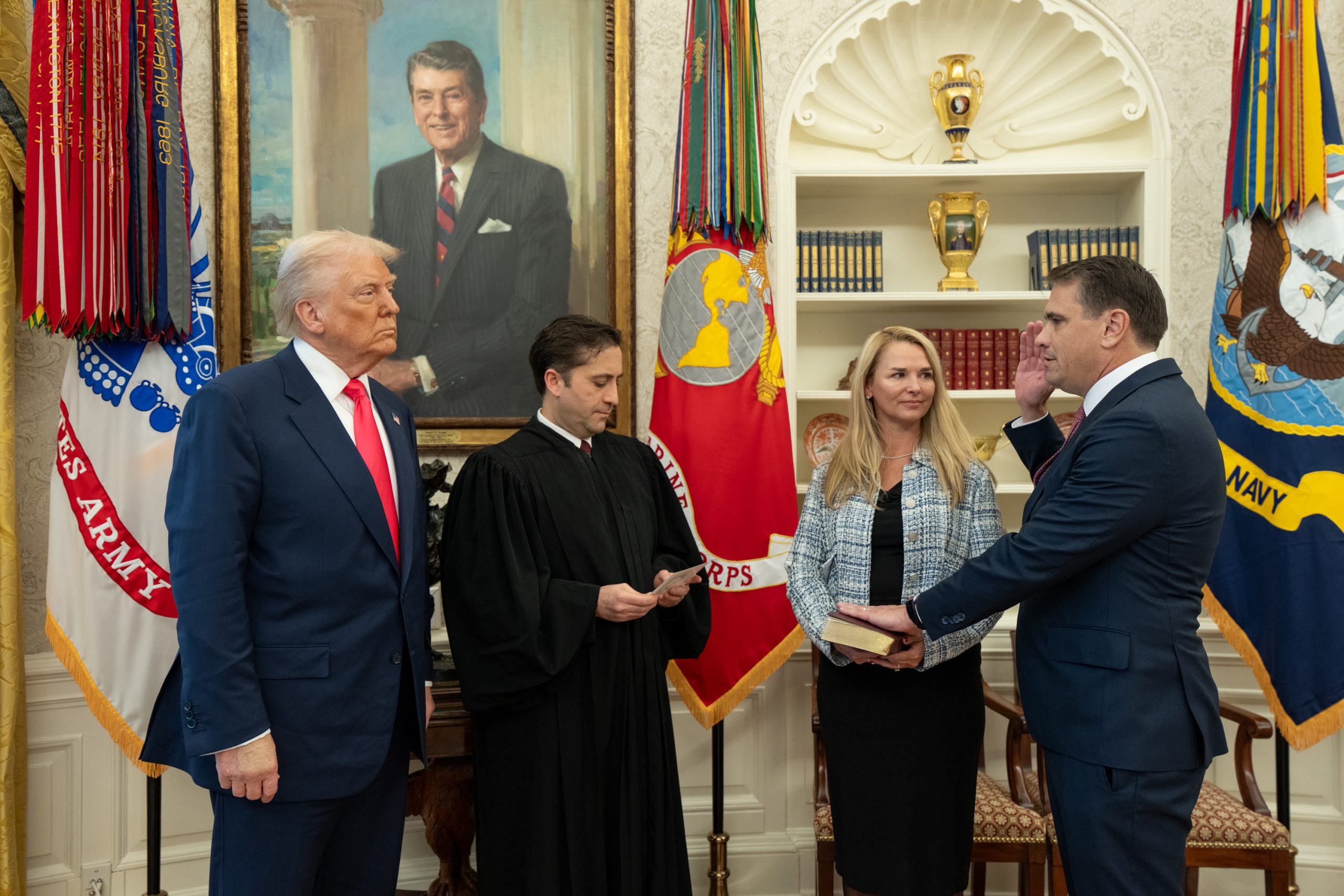
The hearings were not just about résumés. They showed how Trump’s nominees are being measured against old controversies that still carry real power in Washington.
Todd Blanche and Jay Clayton were the subjects of hearings on Wednesday, and senators used them to press two nominees central to President Donald Trump’s agenda on a fund for Trump allies and the 2020 election. Blanche, Trump’s pick for attorney general, faced the Senate Judiciary Committee. Clayton, nominated to lead the U.S. intelligence community, appeared before the Senate Intelligence Committee.
The key takeaway is that both men were questioned less as routine nominees than as test cases for how far Trump’s team will go in defending his priorities and handling politically charged disputes. Blanche was forced to answer for the administration’s compensation fund for Trump allies, while Clayton was drawn into questions tied to the 2020 election. Together, the hearings showed that the same controversies continue to shadow Trump’s governing choices in Washington.
Two nominees, one loyalty test
According to CNN’s account of the hearings, Blanche and Clayton entered Wednesday with different vulnerabilities but the same burden: both had to convince senators that they could run powerful federal offices without simply acting as extensions of Trump’s political interests.
For Blanche, that challenge was especially sharp. He previously served as Trump’s personal attorney and is now seeking to become the nation’s top law enforcement official. That made every answer about independence, conflicts and political pressure carry extra weight.
Clayton’s hearing had a different tone. His nomination appeared more secure, CNN reported, but senators still pressed him on subjects that have become recurring tests for Trump nominees: the legitimacy of the 2020 election and the use of government power against critics or the press.
The hearings also showed how confirmation battles can become proxy fights. Senators were not only evaluating the nominees in front of them. They were also relitigating broader concerns about Trump’s Justice Department, election denialism, and the boundaries of executive power.
The fund that rattled Republicans
The most politically dangerous issue for Blanche was a controversial anti-weaponization fund, described by critics as a potential compensation vehicle for Trump allies. CNN reported that the fund was nearly $1.8 billion and that critics warned it could benefit allies of the president, including some people connected to the January 6 attack on the Capitol.
Blanche tried to shut down that concern with a clear line: he said the "weaponization fund is dead." He also argued that the remaining tax-related addendum binds only the IRS and, by extension, the Treasury Department, not the rest of the federal government.
That answer did not settle the issue for everyone. Sen. John Cornyn of Texas, a Republican whose vote could matter in committee, told CNN his concerns had not been alleviated. He said Blanche had effectively confirmed that the arrangement could not be changed without written consent of the parties and could be enforced as a contract.
That dispute matters because it exposes the narrow path Blanche is walking. Democrats are likely to oppose him. If even one Republican on the Senate Judiciary Committee defects, CNN reported, his nomination could be in serious trouble.
Blanche tried to stay controlled
Blanche’s strategy was restraint. He avoided the more combative style associated with some other Trump allies and tried to reassure Republicans that he would be aggressive at the Justice Department without allowing direct White House political interference.
Still, the hearing produced tense moments. CNN reported that Sen. Cory Booker pressed Blanche about whether he attended a private dinner with Paramount chairman David Ellison while the Justice Department was reviewing Paramount’s planned takeover of Warner Bros. Discovery, which owns CNN. Blanche pushed back, saying, "You won’t even let me answer the question, man."
Sen. Sheldon Whitehouse also challenged Blanche over FBI Director Kash Patel, asking whether Blanche would tolerate alleged misconduct, including misuse of FBI aircraft. Blanche called the question "extraordinarily obnoxious," according to CNN.
Those exchanges did not appear to derail Blanche, but they underscored why his nomination is unusually delicate. He has to satisfy Trump-aligned conservatives who want a forceful Justice Department while persuading institutionalists that he will not turn federal law enforcement into a political weapon.
Cornyn and Tillis hold leverage
The Blanche nomination may come down to two Republican senators with unusual freedom to break with Trump: Cornyn and Sen. Thom Tillis of North Carolina. CNN reported that either one voting no in committee could effectively sink the nomination.
Both have criticized the proposed anti-weaponization fund. Tillis, who is not running for reelection, told Blanche during the hearing that he had done well and later indicated to CNN that he was leaning toward supporting him. But he also said he needed certainty that the fund could not "rear its ugly head."
Cornyn was less reassuring. CNN reported that he remained undecided and was not satisfied by Blanche’s explanation of the fund’s legal status.
That leaves Blanche in a politically awkward place. The White House needs Republican unity, but the fund gives skeptical GOP senators a concrete issue they can point to without sounding like they are simply siding with Democrats.
Clayton faced the 2020 question
Clayton’s hearing put the 2020 election back at the center of a confirmation fight. Senators pressed him on who won the election, and CNN reported that his election-related answers frustrated lawmakers at points.
For nominees in Trump’s orbit, the 2020 question is not a history quiz. It is a signal about whether they are willing to state basic facts even when those facts cut against Trump’s long-running claims about the election.
Clayton also faced scrutiny over subpoenas he signed for New York Times journalists, according to CNN. That line of questioning raised concerns about press freedom and the government’s willingness to pursue reporters in sensitive investigations.
Even so, CNN reported that the overall tenor of Clayton’s hearing suggested his nomination was on track. One reason: Democrats have shown concern about Bill Pulte, Trump’s acting choice, over what critics describe as a lack of national security experience, making some eager to shorten his tenure.
Epstein records added pressure
Blanche also had to defend the Justice Department’s handling of records related to Jeffrey Epstein. CNN reported that the department released more than 3 million pages from the investigation and faced criticism over redaction problems.
Some documents reportedly redacted perpetrators rather than victims, while others accidentally included names and details of victims. Blanche acknowledged redaction issues but said mistakes were corrected after release and that only about 1% of redactions required fixes, according to CNN.
That issue was separate from the fund fight, but it fed the same concern: whether the Justice Department under Trump’s appointees can manage politically explosive matters with competence and independence.
For Blanche, every controversy compounds the confirmation math. A nominee can survive tough Democratic questioning. Surviving doubts from Republicans on a closely divided committee is harder.
Why the hearings matter now
The Blanche and Clayton hearings were about more than two jobs. They offered an early measure of how the Senate will handle nominees who are closely tied to Trump’s legal, political and institutional battles.
Supporters can argue that Trump is entitled to staff his administration with people who share his views and who will carry out his agenda. They may also see Democratic questioning as an attempt to relitigate old fights rather than evaluate current qualifications.
Critics see something more dangerous: a pattern in which personal loyalty, election denial and grievances against perceived enemies become qualifications for power. The fund for Trump allies sharpened that concern because it attached a dollar figure and a potential beneficiary class to a broader political fear.
What remains unclear is whether Blanche’s assurance that the fund is dead will be enough for Cornyn, Tillis and other Republicans who want more than verbal guarantees. Clayton, meanwhile, appears better positioned, but his hearing showed that the 2020 election still functions as a threshold test for Trump nominees seeking control of national institutions.





Leave a Reply