
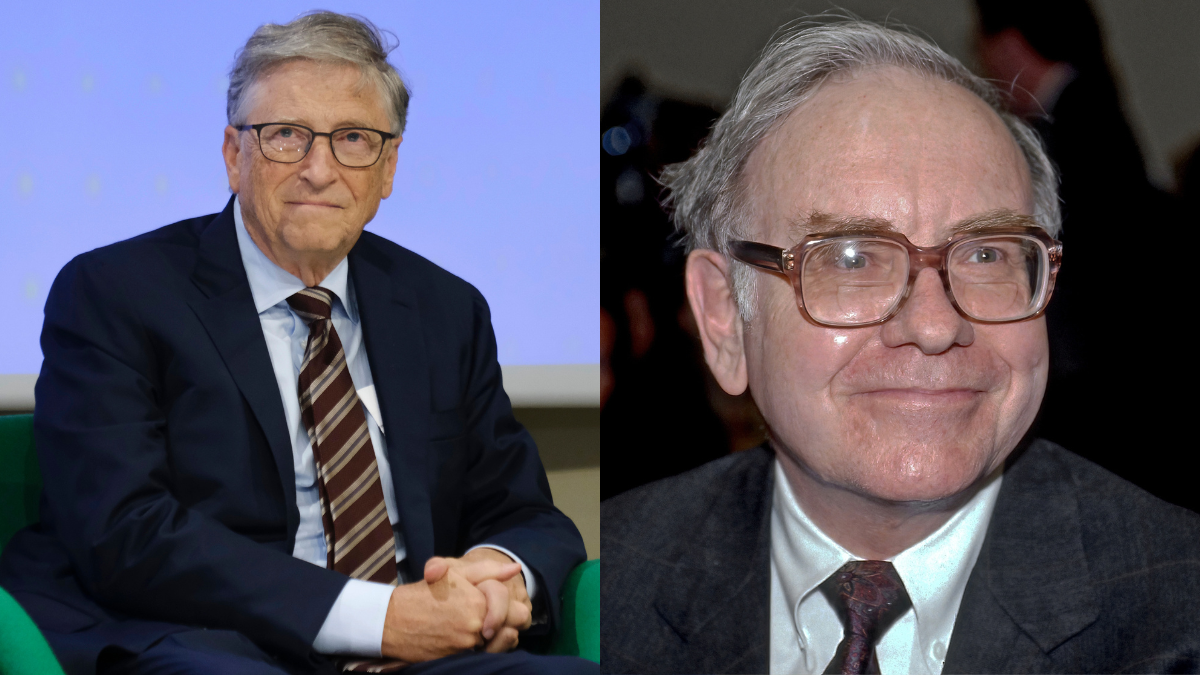
The Microsoft co-founder has said he once believed success required a relentlessly full schedule. Buffett’s example offered a quieter lesson: control over time may matter more than visible busyness.
Bill Gates shared a lesson from Warren Buffett and said he wished he had learned it sooner: a full calendar is not proof of success. Gates says the lesson affected his schedule and productivity because, during his Microsoft years, he often treated every packed minute as evidence that serious work was getting done.
The lesson sounds deceptively simple. Its bite is that Gates, one of the defining figures of modern work culture, is now pointing to Buffett’s intentionally light calendar as a model for doing less on purpose.
Buffett’s calendar made the point
Gates has described the realization in blunt terms. In a May 2024 post on Meta’s Threads, he wrote that it took him “far too long” to understand that success does not require filling “every second” of the day.
He connected that shift directly to Buffett, his longtime friend and the chairman and CEO of Berkshire Hathaway. Gates said he could have learned the lesson earlier if he had taken more looks at Buffett’s deliberately open schedule.
That image has stuck because it runs against the usual executive mythology. Buffett was not showing Gates a calendar packed with back-to-back meetings, status calls and performative urgency. He was showing him white space.
In a 2017 interview with journalist Charlie Rose, Gates recalled Buffett showing him a calendar with days that had nothing scheduled. Gates said the message was that people control their own time, and that filling every minute is not a reliable measure of seriousness.
Gates once ran on overload
The advice landed because Gates had lived the opposite way. As Microsoft’s CEO, a role he held for 25 years before stepping down in 2000, he has said his calendar was packed minute by minute.
He has also acknowledged that his early management style could be intense. CNBC has reported on Gates’s past comments about sending late-night requests and expecting the people around him to operate at a pace that matched his own.
That context matters. Gates is not offering generic lifestyle advice from someone who never believed in grinding. He is describing a reversal from inside the culture of overwork he helped symbolize.
At Northern Arizona University’s 2023 commencement, Gates told graduates that when he was their age, he did not believe in vacations or weekends. He added that he did not believe the people who worked with him should take them either.
The real lesson is control
Buffett’s calendar lesson is easy to flatten into a slogan: work smarter, not harder. But Gates’s takeaway is sharper than that. The issue is not whether a person is busy. It is whether the busyness is chosen, useful and proportionate.
Buffett’s own line in the 2017 interview was simple: he could buy almost anything he wanted, but he could not buy time. Coming from one of the world’s most successful investors, the comment reframed time as the scarce asset, not money or meetings.
That does not mean an empty calendar is automatically virtuous. For many workers, time is controlled by managers, customers, caregiving needs, hourly schedules or financial pressure. Buffett’s level of autonomy is rare.
Still, the principle travels. A calendar can become a record of other people’s demands rather than a plan for one’s highest-value work. Gates’s point is that a crowded schedule may feel productive while quietly making clear thinking harder.
Research backs the warning
The case against endless hours is not just philosophical. CNBC cited a 2014 Stanford-related study by economist John Pencavel that found productivity drops sharply after about 50 hours of work per week.
That research is often summarized by one striking finding: people working roughly 70 hours may produce little more than those working 55. Past a certain point, extra hours can become fatigue disguised as commitment.
Other research complicates the picture. A 2021 study on discretionary time found that people tend to benefit from having more free time, but not without limit. Too little time creates stress; too much unstructured time can leave people feeling aimless.
That nuance is useful. Gates is not saying everyone should work less at all costs. He is arguing against the reflex to treat maximum scheduling as maximum achievement.
Why the advice resonates now
The Gates-Buffett lesson keeps resurfacing because it collides with the way many professionals now experience work. Digital calendars, workplace chat, email and remote meetings have made it easier to fill every gap before anyone asks whether the gap should be filled.
There is also a status element. A packed calendar can signal importance. Being unavailable can look powerful. But Gates’s reflection challenges that performance: if every moment is occupied, there may be no room left for judgment, recovery or the kind of thinking that changes direction.
The competing view is that high achievers often do need periods of extreme effort. Startups, turnarounds, campaigns, medical training and other demanding fields can require bursts of long hours. Buffett’s calendar is not a universal template for every career stage.
The harder question is whether intensity has become a permanent identity. Gates’s regret is not that he worked hard. It is that he waited too long to learn that relentless scheduling was not the only way to be serious.
The practical takeaway
For people without Buffett-level control, the lesson may start small. It can mean protecting a meeting-free block, declining a low-value call, leaving recovery time after travel or refusing to use every open slot as proof of dedication.
It can also mean rethinking what a good day looks like. A day with fewer meetings but better decisions may be more valuable than one filled with visible activity. A manager who leaves employees room to breathe may get better work than one who treats constant availability as loyalty.
Gates has framed the lesson in human terms as much as business terms. In his commencement speech, he urged graduates not to wait as long as he did to nurture relationships, celebrate wins, recover from losses and take breaks when needed.
That is the tension at the center of the story: Buffett’s calendar was not empty because nothing mattered. It was open because time mattered. Gates’s regret suggests the most expensive productivity mistake may be spending years confusing busyness with control.











Leave a Reply