
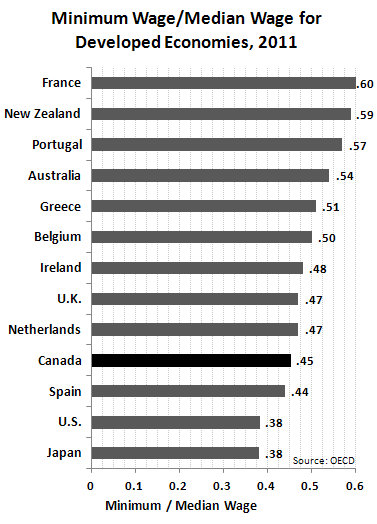
The fight over a $20 wage is not just about whether workers deserve more. It is about how businesses absorb a sudden jump in labor costs — and who feels the trade-offs first.
A $20 minimum wage sounds simple: workers get a bigger paycheck, and low-wage jobs become a little easier to live on.
The harder part starts after the raise lands. Businesses still have to make the math work, customers react to higher prices, and workers may find that a higher hourly rate does not always mean more hours on the schedule.
California made it real
The sharpest recent test is California’s fast-food wage law, which raised pay for covered fast-food workers from $16 to $20 an hour. According to the Cato Institute’s summary of the law, it was signed on Sept. 28, 2023, and took effect on April 1, 2024.
The rule does not apply to every restaurant in the state. Cato describes it as applying to restaurants, coffee shops and juice bars with at least 60 locations nationwide, including large chains such as McDonald’s, Wendy’s and Pizza Hut.
That detail matters. The $20 debate is often framed as a small-business issue, but California’s fast-food law targeted larger operators. Even so, franchise owners and individual locations can face tight margins, rent pressure and volatile customer demand.
That is why the policy has become a national test case. It offers supporters a chance to argue that low-wage workers need a floor closer to the cost of living, while critics point to job cuts, price hikes and automation as signs of strain.
The paycheck is only one lever
A minimum wage raise directly increases the hourly pay rate for workers below the new floor. For someone moving from $16 to $20, the headline gain is 25% per hour before taxes.
But employers do not respond to labor costs in only one way. They can raise prices, reduce hours, slow hiring, cut lower-profit services, trim benefits, invest in labor-saving technology or accept lower margins for a while.
For workers, the distinction is crucial. A higher hourly wage helps most when hours stay stable. If a worker earns more per hour but gets scheduled for fewer shifts, the weekly benefit can shrink or disappear.
That does not mean wage increases are automatically bad. It means the real-world effect depends on the local labor market, consumer demand, rent, food costs, competition and how quickly the change is phased in.
Job-loss claims need context
Cato, a libertarian think tank that generally opposes minimum wage mandates, argues that California’s fast-food increase led to thousands of job losses. It cites Employment Policies Institute estimates of 6,166 fast-food jobs lost between September 2023 and June 2024.
Cato also cites Edgeworth Economics as estimating at least 9,600 job losses, and as many as 19,300, from September 2023 to September 2024. Those figures have been used by critics as evidence that the wage floor priced out some entry-level work.
The same Cato piece says Employment Policies Institute reported that nationwide private-sector fast-food employment grew 1.6% from September 2023 to June 2024, while California fast-food employment declined 1.1%. It also says California’s overall private employment fell 0.3% during that period.
Those comparisons are striking, but they are not the whole story. Early employment numbers can be influenced by closures, inflation, consumer spending, seasonal patterns and business decisions made before a law takes effect. Readers should treat first-year claims as evidence in a debate, not the final verdict.
Prices move before jobs do
For many customers, the most visible effect of a wage hike is not a layoff notice. It is a higher menu price.
Restaurants are especially sensitive because labor is one of their largest controllable costs. If payroll rises sharply, operators often test whether customers will tolerate higher prices before making deeper staffing cuts.
That can create a quiet transfer. Workers who keep their hours may earn more, while customers pay more for the same burger, coffee or burrito. Some customers barely notice. Others trade down, skip add-ons or visit less often.
If traffic falls enough, the pressure circles back to workers. A store that sells fewer meals may need fewer labor hours, even if every remaining employee earns more per hour.
Automation becomes more tempting
A higher wage floor can also speed up decisions that were already coming. Kiosks, mobile ordering, kitchen screens and self-service pickup shelves were not invented because of one wage law, but higher labor costs can make them more attractive.
Cato quotes economist Stephen G. Bronars of Edgeworth Economics arguing that limited-service restaurants will replace employees with kiosks as they adapt to a $20 wage. That is a common concern among wage-hike critics.
The automation story is more complicated than a simple worker-versus-machine swap. Technology can reduce cashier hours, but it can also shift workers toward food prep, cleaning, customer assistance and order management.
Still, the direction is clear: when labor becomes more expensive, businesses look harder at every task a machine can handle. That is especially true for repetitive work with predictable demand.
The patchwork matters
The $20 figure gets attention, but minimum wage policy in the U.S. remains a patchwork. States and cities set different floors, and some industries have special rules.
Illinois, for example, says through its Department of Labor that its minimum wage guarantees $15 an hour for workers 18 and older. The same state guidance says employers with tipped workers may pay 60% of the minimum wage, subject to the rules that apply to gratuities.
Those carveouts shape how a wage law feels on the ground. A fast-food counter worker, a server earning tips and a small-shop employee may all live in the same city but operate under different pay rules.
That is one reason national arguments about a $20 wage can get messy. A wage that looks manageable in a high-cost urban market may hit differently in a rural area, a low-margin franchise or a business already facing rent and supply-cost increases.
The real question is design
The cleanest argument for a higher minimum wage is moral and practical: full-time work should not leave people unable to cover basic costs. In many parts of the country, rent, food, gas and child care have climbed faster than entry-level pay.
The cleanest argument against a sharp wage mandate is also practical: if a law raises labor costs faster than productivity or revenue, employers will adjust somewhere. That adjustment may show up in hiring, hours, prices, benefits or technology.
The policy question is not only whether $20 is too high or too low. It is whether the change is phased in, whether it varies by region or industry, how it treats small employers, and whether tax credits or training programs soften the shock.
For workers and customers, the takeaway is less dramatic than the slogans. A $20 wage can improve lives, but it is not free money dropped into the economy. It is a new cost structure — and every business touched by it has to decide where that cost goes.








Leave a Reply