
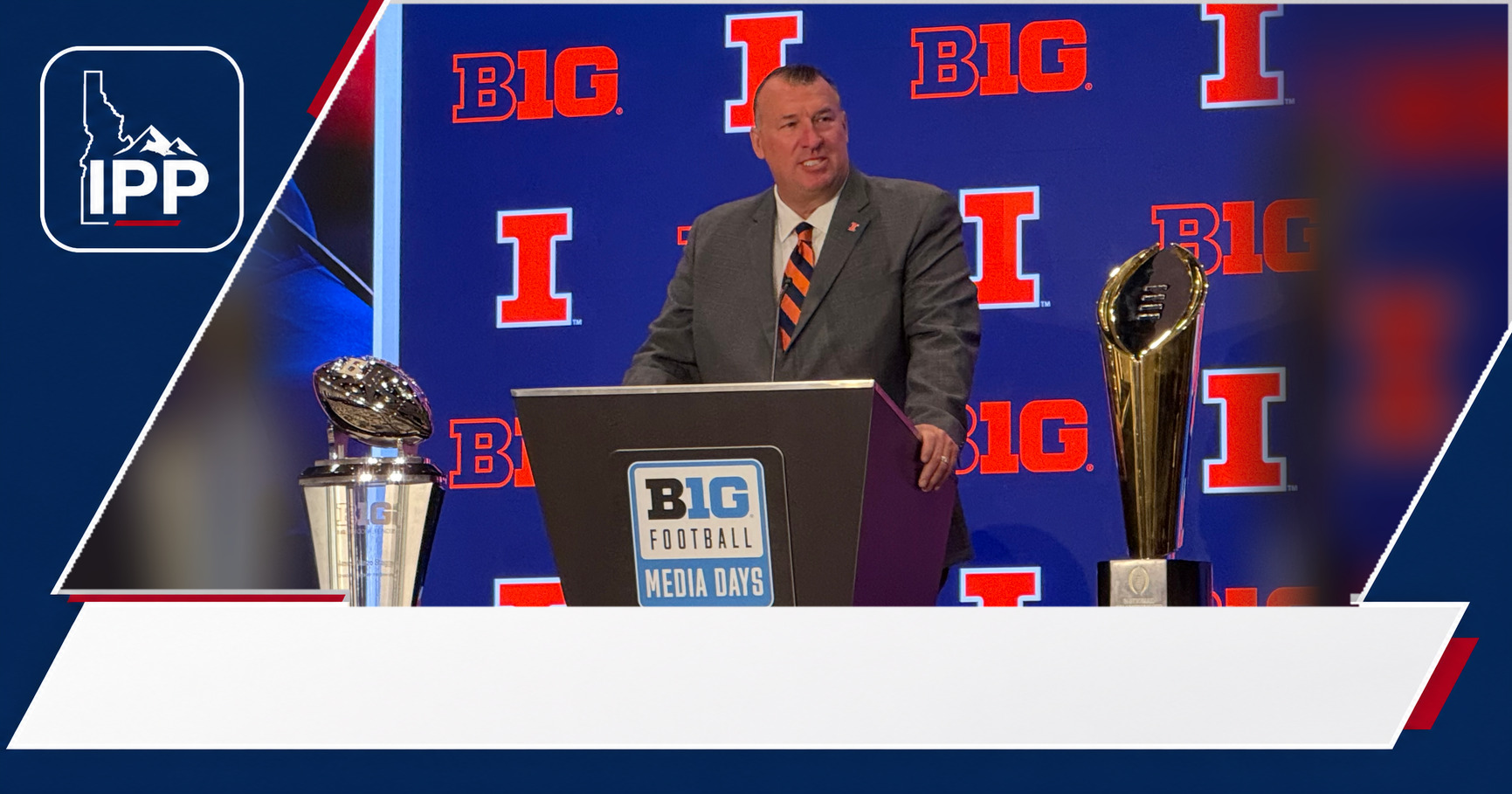
The Illinois coach knows both leagues well, which is why his media-days swipe landed. The bigger question is whether it was analysis, trolling or both.
Bret Bielema criticized Greg Sankey and the SEC on Tuesday in Chicago; Bielema said the SEC and its commissioner want to “live in 2005 forever.” The Illinois coach’s jab at Big Ten media days matters because college football has changed since the SEC’s mid-2000s rise and even since 2015, with NIL, transfers and Big Ten spending redrawing power. The available account places the remarks Tuesday, not last week, and the dispute now is substance: is Sankey defending an old SEC order, or managing a league still powerful enough to shape the sport?
Bielema is not a random critic. He has coached in the Big Ten, worked in the SEC and rebuilt Illinois into a relevant program. That makes the line more than conference banter, even if it was designed to needle a rival league.
The quote landed like a dare
According to Sports Illustrated, Bielema made the comment during Big Ten media days in Chicago while discussing the SEC broadly and Greg Sankey more specifically. His point was not that the 2005 season itself was sacred to the SEC. It was that college football before the transfer portal and NIL belonged to another age.
When asked to explain the year, Bielema tied it to the old operating system of the sport. Once players gained more transfer freedom and name, image and likeness money entered the marketplace, he said, “the whole world changed.”
That is the key to the jab. Bielema was not arguing over a media guide. He was arguing over mindset. His accusation was that the SEC still wants the sport judged by the assumptions of an earlier era, when its depth, budgets and recruiting geography gave it a gravitational pull no other conference could match.
Why Bielema can say it
Bielema’s resume gives him unusual standing in this particular argument. He was Wisconsin’s head coach from 2006 to 2012, going 68–24 and leading the Badgers to three Rose Bowls, according to Sports Illustrated. He then left for Arkansas, a move that gave him a firsthand view of SEC life before he was fired in 2017.
After NFL stops with the Patriots and Giants, Bielema returned to the college game at Illinois in 2021. Sports Illustrated noted that he is 37–26 with the Illini and had a No. 16 finish in 2024. That matters because Illinois is not Ohio State or Michigan. If Illinois can feel emboldened in the Big Ten’s new economy, the league’s middle class has changed.
His recent bowl results also fuel the message. The Illini have beaten SEC opponents in back-to-back bowls, including South Carolina in the Citrus Bowl to close 2024 and Tennessee in the Music City Bowl to end 2025, per the SI account. Bowl games are imperfect measuring sticks, but coaches use them because they are public scoreboards.
Where the jab has bite
Bielema’s strongest point is that the SEC can no longer claim automatic ownership of college football’s future. In the 2000s and early 2010s, the league’s pitch was simple: the best players, the best coaches, the biggest crowds and the toughest Saturdays. The results often backed it up.
The 2005 season itself did not end with an SEC champion. Texas, then in the Big 12, beat USC in the Rose Bowl. But Sports Illustrated pointed out that five SEC teams finished in the final AP top 15 that year: LSU, Alabama, Georgia, Florida and Auburn. Soon after, the SEC went on a national-title run that defined the sport’s next decade.
That old advantage was not only about trophies. It was about money, staffing, recruiting infrastructure and institutional will. Bielema’s move from Wisconsin to Arkansas was partly framed at the time around assistant-coach pay and resources. The SEC was investing like football was an arms race before everyone else fully accepted the premise.
Now the Big Ten has caught up financially and, in some places, surged. National brands have consolidated. Donor collectives matter. The transfer portal lets programs remake rosters quickly. A school no longer needs the old five-year recruiting build to become dangerous.
Where it overshoots
The problem with Bielema’s line is that it turns a real shift into a neat insult. The SEC is not stuck in 2005 in any simple sense. It has expanded, negotiated from strength and remained one of the two central powers in the sport alongside the Big Ten.
Sankey, as SEC commissioner, is not just a nostalgic defender of past glory. He is one of the most influential voices in playoff, television, scheduling and governance debates. When the SEC takes a public position, the rest of college football has to account for it, whether it likes the position or not.
The league’s football supremacy may be less automatic, but less automatic is not the same as over. Georgia’s recent run, Alabama’s continued stature, Texas and Oklahoma entering the league, and the SEC’s television value all complicate the idea that the conference is merely clinging to a museum piece.
There is also a tactical reason for Sankey to resist some changes or frame them cautiously. Commissioners are paid to protect leverage. What sounds like resistance to the future may also be negotiation: over playoff access, roster rules, athlete compensation and who gets to set national policy.
Sankey remains the pressure point
That is why Bielema named the commissioner rather than just the conference. Sankey has become a symbol of SEC power because he sits at the intersection of football tradition and the sport’s business future. He represents a league that expects to be consulted, accommodated and, often, followed.
The available Sports Illustrated account did not include a direct response from Sankey to Bielema’s comment. That absence matters. Without a response, the public debate is less about a back-and-forth and more about how Bielema’s framing fits the broader Big Ten-SEC rivalry.
For Big Ten audiences, the line is easy to cheer. It says their league is no longer chasing the SEC’s shadow. For SEC audiences, it is easy to dismiss as a coach talking big in July. Both reactions miss the more interesting reality: each conference is trying to define what strength means in a sport whose rules keep changing.
The real fight is control
The 2005 reference works because it evokes a time before NIL marketplaces, immediate roster churn and coast-to-coast realignment. It also evokes a time when the SEC’s rise felt inevitable. Bielema’s argument is that inevitability is gone.
He has evidence. The Big Ten’s recent championship momentum, its media money and its deeper spending culture have changed the national conversation. Sports Illustrated argued that even historically less powerful Big Ten fan bases can now feel they have a path. Illinois under Bielema is part of that mood.
Still, the SEC’s challenge is not irrelevance. It is adjustment. A league built on being the sport’s loudest proof of seriousness now has to share the stage with another financial superpower. That is uncomfortable, but it is not the same as decline.
The fairest read is that Bielema’s jab has truth as a diagnosis of college football’s changed conditions and exaggeration as a verdict on the SEC. Sankey’s league is not living in 2005. But it is being forced to prove, more often than before, that its old advantages still translate in a new game.







Leave a Reply