
The White House wants to change the appearance of one of Washington’s most recognizable historic government buildings. Critics say the proposal could damage the 1888 landmark and spend millions without solving a pressing public need.
Donald Trump proposed painting the Eisenhower Executive Office Building white, a change to the 1888 historic landmark next to the White House in Washington, D.C. The project could cost at least $7.5 million, and it has drawn criticism and public opposition from preservationists, architects and commenters who say painting its granite exterior could permanently alter the building.
The proposal is part of Trump’s broader effort to reshape the White House complex and the capital’s appearance. But federal planning reviewers have not approved the work, leaving the White House to answer key questions about paint testing, maintenance costs and alternatives.
A white makeover for gray granite
The Eisenhower Executive Office Building sits across a driveway from the White House and houses offices for the president’s staff and other executive-branch functions. Its dramatic French Second Empire design, completed in 1888 after 17 years of construction, makes it one of the most visually distinctive structures in the federal complex.
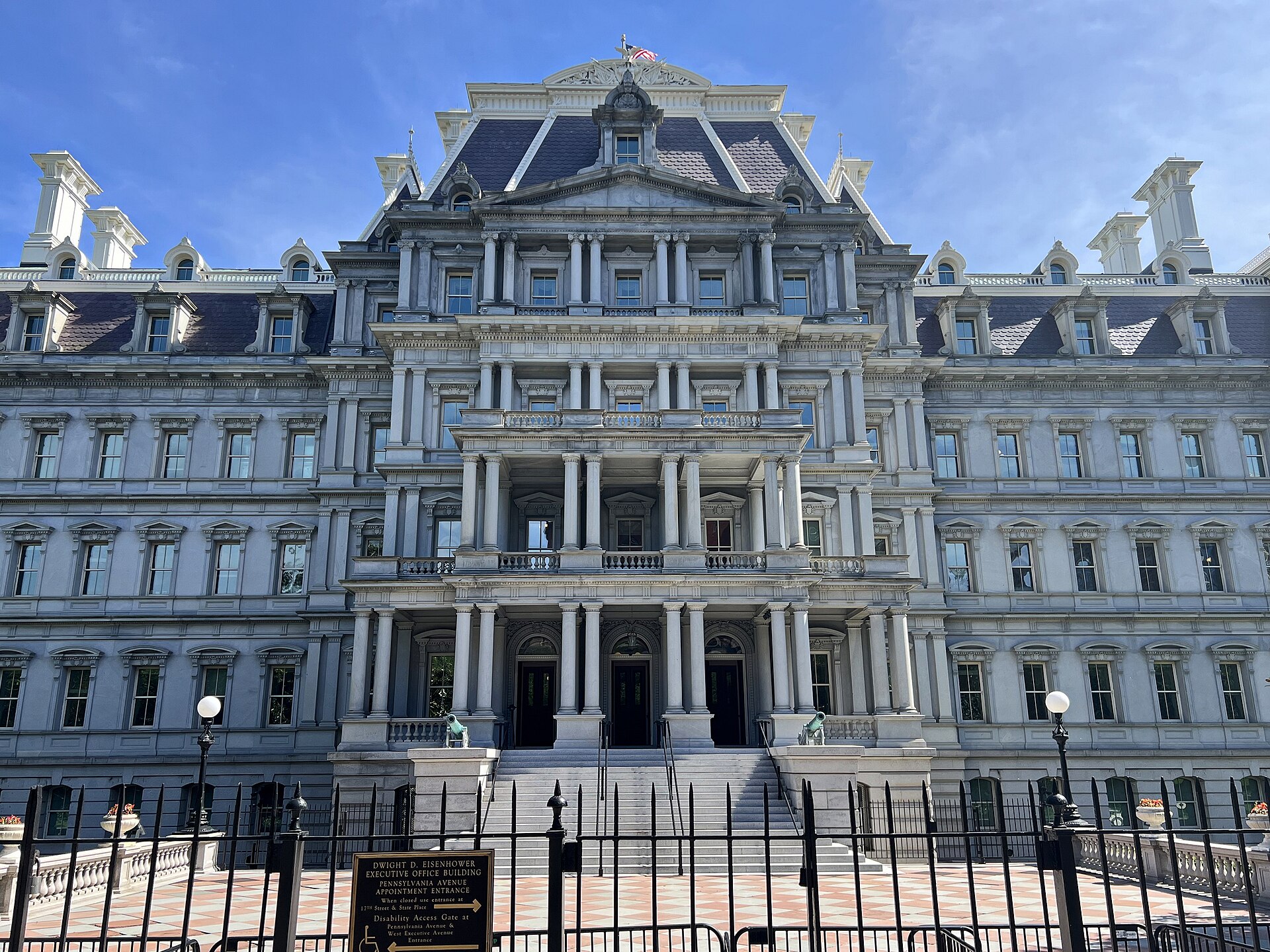
White House officials have presented two options: paint the entire gray granite exterior white, or paint most of it while leaving the granite base exposed. Officials have indicated that fully painting the building is their preferred option.
The administration frames the idea as part of Trump’s campaign to make Washington more beautiful. White House spokesperson Davis Ingle said Trump was continuing to beautify the White House and the nation’s capital.
That aesthetic argument is at the center of the disagreement. Supporters may see a brighter building as a way to coordinate its appearance with the White House. Opponents say the contrast between the white presidential residence and the neighboring gray granite landmark is part of the historic streetscape, not a flaw to be corrected.
The price estimate is preliminary
Ryan Erb, construction operations and facilities manager in the White House Office of Administration, told the National Capital Planning Commission that the exterior paint job alone could cost at least $7.5 million. That estimate does not include the future cost of maintaining the painted surface.
Maintenance is more than a budget footnote in this debate. Granite has endured on the building for more than a century, while a painted exterior would require decisions about cleaning, repair, repainting and what happens if the coating fails unevenly over time.
Erb said the White House is working with an outside vendor to test silicate paint. Because testing cannot be performed on the Eisenhower building itself, officials are using new granite samples from a Maine quarry.
That limitation has become a major point of scrutiny. New stone does not necessarily behave like weathered granite that has been exposed to Washington’s heat, cold, moisture and pollution for generations. Erb described the initial test data as encouraging but said the process could not be rushed.
Why preservationists object
Preservation advocates do not object simply because the building would look different. Their central concern is whether paint could harm the underlying granite and make future preservation harder.
Priya Jain of the Society of Architectural Historians told the planning commission that painting the facade would adversely and permanently alter the landmark and should be rejected. Other preservationists, architects and historians have argued that granite was not intended to be painted and that a coating could trap moisture, contributing to deterioration.
The Eisenhower Executive Office Building is a National Historic Landmark and is listed on the National Register of Historic Places. Those designations do not automatically freeze a building in time, but they raise the bar for changes that may affect its historically significant materials and appearance.
Critics also contend that repainting is the wrong solution to an aesthetic question. Some commenters have suggested landscaping, lighting or other improvements that could alter how the building is experienced without covering the historic stone.
Federal reviewers want more answers
The National Capital Planning Commission opened its review of the proposal but did not approve it at its meeting. Instead, it directed White House officials to provide more information before the agency considers the project again.
The commission wants further details about the type of paint, the testing process and possible alternatives that could improve the building’s appearance without painting it. The agency is chaired by Will Scharf, a senior Trump White House aide, but its staff review and public process have still produced a request for more documentation.
A second federal body, the U.S. Commission of Fine Arts, is also reviewing the proposal. It has likewise asked for additional information, including details related to paint testing, before holding a vote on approval.
Those parallel reviews matter because the issue now extends beyond presidential preference. The White House must persuade agencies responsible for planning and design in the capital that the project is technically sound, historically appropriate and worth its cost.
Thousands challenge the project
More than 2,000 public comments submitted to the planning commission were strongly opposed to the plan, according to materials discussed during the review. Many commenters called the expected cost a poor use of taxpayer money and argued that a white building would disrupt the visual balance along Pennsylvania Avenue.
The public reaction reflects two competing ideas about stewardship. One view gives an elected president broad latitude to set the look of the executive complex and pursue a cohesive visual vision. The other holds that nationally significant public buildings belong to a longer historical record that should not be substantially changed for a temporary administration’s taste.
There is also a lawsuit over the proposed paint job moving through federal court. The available account does not specify when the case will be resolved or whether a ruling could halt, delay or reshape the plan.
For now, the project remains a proposal rather than an approved renovation. Before any paint reaches the Eisenhower Executive Office Building, the White House faces more agency review, unresolved preservation concerns, questions about long-term costs and an unusually visible fight over whether a landmark’s original granite should remain uncovered.
The larger fight over Washington’s look
The Eisenhower building dispute arrives as Trump pursues other changes around the White House grounds and Washington. The administration has highlighted plans ranging from work at Lafayette Park to a new ballroom project, reinforcing the view that the paint proposal is part of a wider redesign agenda rather than an isolated maintenance decision.
That context raises the stakes for preservation groups. A coating of white paint may sound reversible in theory, but critics say the physical effects on aged stone and the precedent for altering protected federal architecture deserve a far more demanding review.
The immediate next step is procedural: White House officials must return with evidence that addresses the commissions’ questions. The longer question is cultural. Washington’s iconic buildings are constantly maintained and adapted, but this dispute will help define when updating a landmark becomes remaking it.






Leave a Reply