
The official agenda was Iran, but the optics mattered too. Netanyahu needs leverage with Trump abroad and proof of strength for voters at home.
Benjamin Netanyahu is seeking help from Donald Trump as Netanyahu faces a growing risk of losing the election in Israel, turning the Trump-Netanyahu meeting at the White House on Tuesday into more than a discussion about Iran. Netanyahu asks Trump for help at a moment when polls and prediction markets show his path to another term narrowing, and when Trump has not offered the clear political embrace the Israeli leader would benefit from back home.
According to Newsweek, the closed-door Oval Office session lasted a little more than an hour and was publicly described by both sides in upbeat terms. The politics around it were less simple: Netanyahu needed the meeting to signal influence, while Trump appeared careful not to hand him an explicit campaign boost.
A meeting with two audiences
The formal subject was Iran. Netanyahu’s office said, through an unnamed official cited by Newsweek, that the two leaders held an ‘excellent and comprehensive discussion’ focused first on Iran and reaffirmed a shared commitment to preventing Iran from acquiring nuclear weapons.
The White House also chose a positive frame. Press secretary Karoline Leavitt wrote on social media that Trump’s meetings that day with Netanyahu and Ukrainian President Volodymyr Zelensky were ‘positive and productive.’
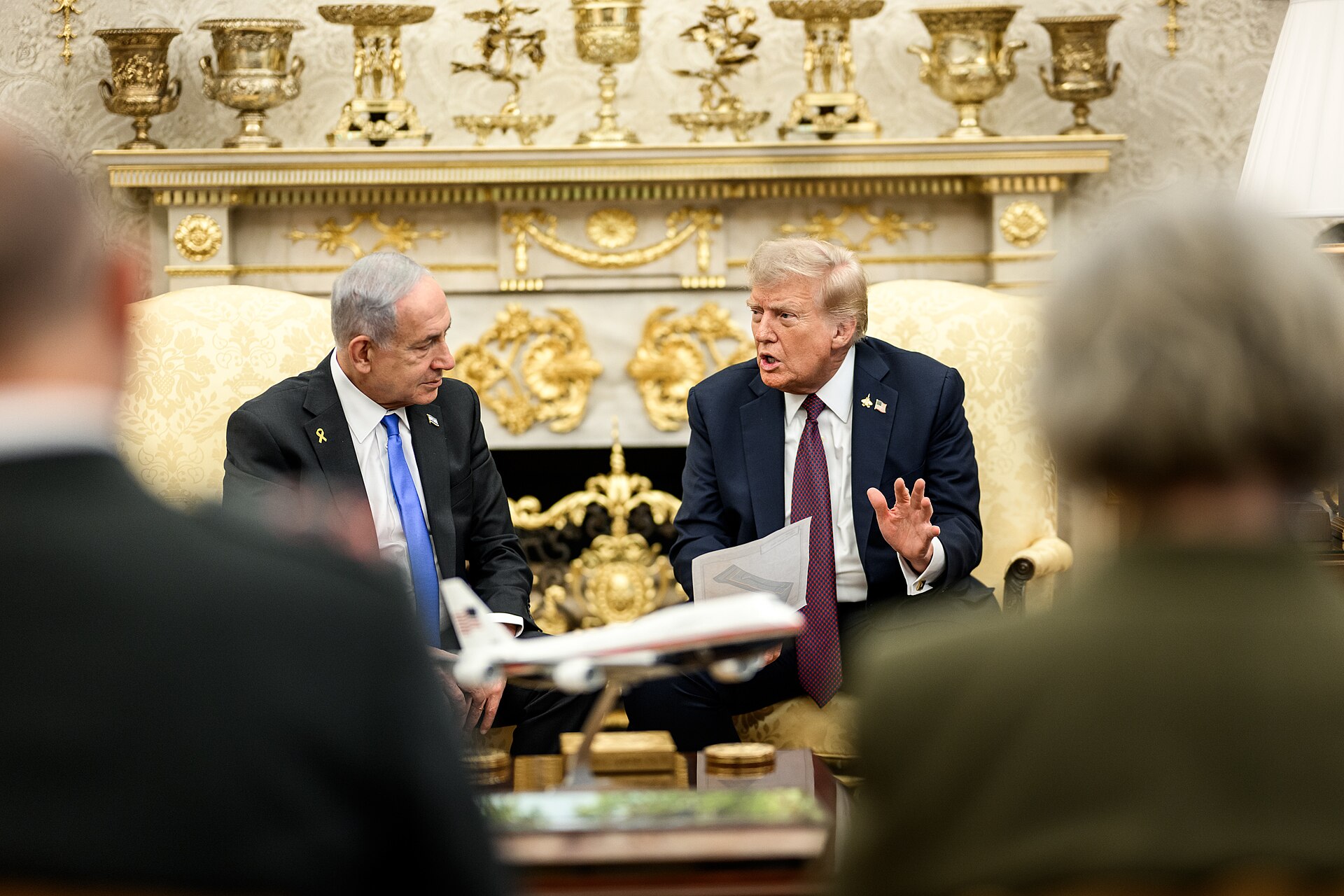
But the closed format mattered. A White House official, according to Newsweek, said Trump viewed the session as a working meeting rather than a photo opportunity. Israeli officials still released a photo of Netanyahu and Trump seated beside each other, smiling — exactly the sort of image that can travel well in an election season.
That split captures the tension. Netanyahu needed substance on Iran, but he also needed the visual proof that he remains a leader who can walk into the Oval Office and shape American policy.
Trump kept some distance
Trump’s public comments before the meeting were not the warm endorsement Netanyahu might have preferred. Asked whether he and Netanyahu remained aligned on Iran, Trump said they had ‘a little difference’ but were ‘pretty close,’ Newsweek reported.
Trump was sharper when discussing reports that Netanyahu intended to brief him on Iranian nuclear activity at a site known as Pickaxe Mountain. Speaking on Fox & Friends, Trump said he already knew what was happening there and suggested Netanyahu wanted him to stay involved.
That is a revealing line. Netanyahu’s long-standing political brand rests partly on convincing Israeli voters that he can manage Washington better than his rivals. If Trump signals that he is the one setting the pace, not Netanyahu, that brand becomes harder to sell.
Trump has praised Netanyahu as a ‘great wartime prime minister,’ but Newsweek noted that he has repeatedly done so in the past tense and has not endorsed him ahead of the vote.
The election math is worsening
The urgency behind the visit is visible in the numbers. A July 18 N12 poll cited by Newsweek found 49 percent of Israelis backing parties in the anti-Netanyahu bloc, compared with 36 percent for Netanyahu’s bloc.
That gap followed a major opposition move: former Prime Ministers Naftali Bennett and Yair Lapid merged their parties into a ‘Together’ alliance in late April. If that alliance holds, Netanyahu’s opponents could present a clearer alternative than the fragmented anti-Netanyahu camps that have often struggled to convert opposition into power.
Prediction markets are telling a similar, though not identical, story. On Polymarket, where more than $7.3 million had traded on who would become Israel’s next prime minister, Netanyahu was priced at 40 percent as of Tuesday, with Bennett close behind at 39 percent. Former Israel Defense Forces Chief of Staff Gadi Eisenkot was at 11.1 percent, while former Defense Minister Avigdor Lieberman stood at 7.1 percent.
Those markets are not polls and should not be treated as a forecast of voter intent. Still, they show that traders see a real contest, not an inevitable Netanyahu victory.
Iran policy no longer looks one-way
Netanyahu’s pressure is not only electoral. His influence over Trump’s Iran policy appears more uncertain than it once did, according to the Newsweek account.
Netanyahu has wanted continued pressure on Iran and Hezbollah in Lebanon. Trump, by contrast, has pursued a negotiated deal with Tehran, creating space between the two leaders after what Newsweek described as a joint war against Iran launched on February 28.
Israeli journalist Amit Segal, writing in Israel Hayom and quoted by Newsweek, put the imbalance bluntly: ‘The Americans are making it clear to the Israelis they are the ones who are running the war.’ He added that Israel had been placed ‘in the back seat.’
Israel’s ambassador to the United Nations, Danny Danon, told reporters in New York that Netanyahu had come to Washington to learn Trump’s next move. ‘There are different options,’ Danon said, adding that Israel was prepared for all scenarios.
Washington is a tougher stage
Trump also has domestic reasons to be cautious. Newsweek reported that he is under pressure to wind down an unpopular war that has contributed to higher prices ahead of November’s midterm elections.
American support for Israel has also become more politically complicated, particularly over the war in Gaza. An AP-NORC poll cited by Newsweek found that about one-third of U.S. adults, including roughly half of Democrats, believe Israel has committed genocide against Palestinians during the war in Gaza. Israel and the U.S. government have denied that accusation.
The same polling environment makes a full-throated Trump endorsement less cost-free than it might have been in an earlier era. Netanyahu remains popular with many U.S. conservatives, but Israel’s bipartisan standing has eroded, and Trump’s political operation is watching its own coalition.
Newsweek also cited Vice President JD Vance warning Israeli officials in June that Trump was their only friend left among world leaders. That remark, if taken at face value, underscores both Netanyahu’s dependence on Trump and Trump’s leverage over him.
What remains unresolved
The meeting gave Netanyahu a photo, a positive readout and another chance to press his case on Iran. It did not produce a public Trump endorsement or a clear sign that Washington will follow Netanyahu’s preferred path.
For Israeli voters, the question is whether the Oval Office image still carries the same force it once did. Netanyahu’s supporters may see it as proof that he remains indispensable in a dangerous region. His critics may see a leader leaning on Trump because his coalition is weakening at home.
The unanswered policy question is just as important: whether Trump will keep moving toward a negotiated Iran track or give Netanyahu the more confrontational posture he wants. The answer could shape not only the election narrative in Israel, but the next phase of U.S.-Israel relations.
For now, the political takeaway is clear. Netanyahu went to Washington needing help from Trump, but Trump has reason to offer only so much.






Leave a Reply