
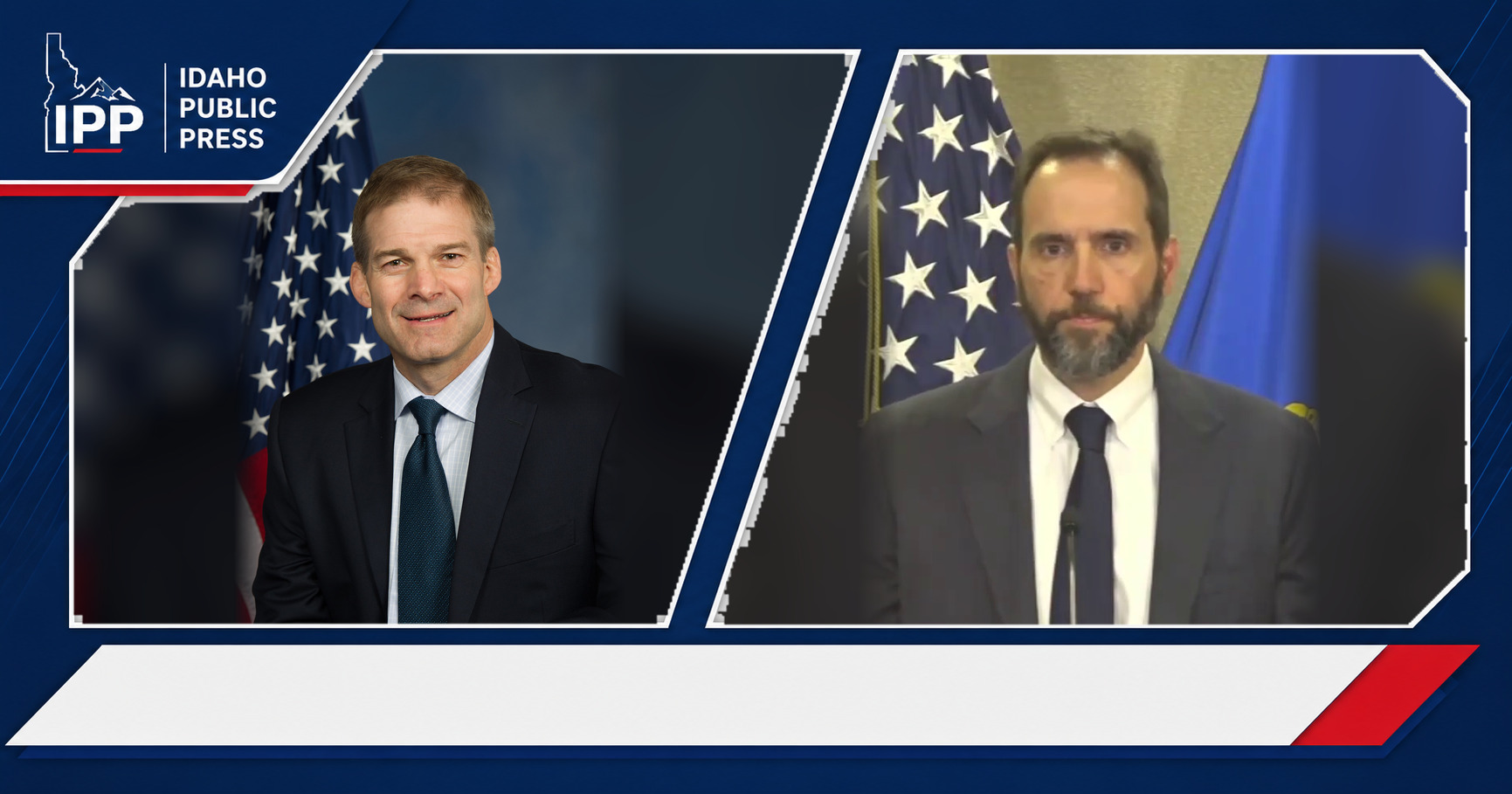
The dispute turns on a narrow but consequential question: whether Smith answered only what he was asked about toll records, or misled Congress by omitting other subpoenas. The answer now sits with a Justice Department already under scrutiny for how it handles Trump’s political adversaries.
Jim Jordan referred Jack Smith to the Justice Department for possible criminal prosecution in Washington, D.C., escalating a House Judiciary Committee fight over Smith’s testimony about the Trump investigations. The article explains the allegation that Smith made false statements in congressional testimony, and why Jordan’s criminal referral is being portrayed as political retaliation rather than legitimate law enforcement.
Smith’s lawyers deny that he misled Congress. According to an Associated Press report published by PBS, they say the former special counsel answered truthfully when asked about a specific type of phone-record subpoena, while Jordan argues the answer left Congress with a false impression.
The referral’s narrow trigger
Jordan, an Ohio Republican and chairman of the House Judiciary Committee, sent the referral after reviewing Smith’s closed-door testimony about records obtained during the investigation of Donald Trump’s efforts to overturn his 2020 election loss.
The key exchange came during a December 2025 deposition, the AP reported. Smith was asked whether toll records requested from senators included the content of phone calls. He said no. He was also asked whether the toll records included the content of text messages. Again, he said no.
That distinction matters. Toll records generally show metadata: the time, date and length of a call, along with phone numbers involved. They do not reveal what was said or written.
Jordan’s referral argues that Smith’s answers were misleading because records later released by Sen. Chuck Grassley, an Iowa Republican, showed Smith’s team had obtained the contents of text messages from 44 lawmakers through a separate subpoena to the National Archives and Records Administration.
Smith’s defense: wrong question
Smith’s lawyers, Peter Koski and Lanny Breuer, told Jordan and Rep. Jamie Raskin, the committee’s top Democrat, that Smith’s answers were “unimpeachably truthful,” according to the AP account.
Their argument is straightforward: Smith was asked about toll-record subpoenas, and those subpoenas did not seek the content of text messages. If lawmakers wanted to ask about other subpoenas, including those involving presidential records, they could have done so.
That is the heart of the dispute. Jordan says a witness can violate false-statement law by offering a half-truth or omitting necessary context. Smith’s side says he responded to the exact questions asked and had no duty to volunteer answers to questions Congress did not pose.
Raskin sharpened that point in his own statement, saying Republicans were trying to criminalize their own missed opportunity. He said Smith was not asked about presidential records during either his nine-hour closed-door testimony or a four-hour public hearing.
Why the revenge charge sticks
The phrase “revenge masquerading as law enforcement” is not just a partisan flourish. It reflects the political setting around the referral.
Smith was the special counsel who brought two federal criminal cases against Trump: one alleging conspiracy to overturn the 2020 election result, and another involving classified documents kept at Mar-a-Lago in Palm Beach, Florida. Smith later abandoned both prosecutions after Trump’s 2024 election win, citing Justice Department opinions that sitting presidents cannot be federally indicted.
Smith resigned from the Justice Department in early 2025, shortly before Trump returned to office. Trump had repeatedly attacked Smith, including by calling him “deranged” and urging that he be prosecuted, the AP reported.
That history makes Jordan’s move look, to critics, less like routine oversight and more like payback against a prosecutor who pursued Trump. Smith’s lawyers used similar language, calling the referral evidence of a “chilling eagerness to weaponize the justice system” against a career public servant.
Jordan’s case is not imaginary
None of that means Jordan’s complaint can be waved away without analysis. Congressional testimony is supposed to be truthful, and false statements to Congress can carry legal consequences. Lawmakers are allowed to refer possible crimes to prosecutors.
Jordan’s strongest point is that Congress was examining whether Smith’s team obtained lawmakers’ communications during a politically explosive investigation. If a witness’s answer led members to believe no message content had been obtained, and other subpoenas did obtain content, Jordan can argue that the testimony was materially incomplete.
The harder question is whether that alleged incompleteness is criminal. Prosecutors would need to assess the wording of the questions, the scope of Smith’s answers, his intent, and whether the alleged omission was material under the law.
That is why this fight turns less on broad political claims than on the transcript. “Did the toll records” include content is a different question from “Did your team ever obtain lawmakers’ text-message content through any subpoena?”
What DOJ can actually do
A criminal referral from Congress does not force the Justice Department to prosecute anyone. It is a request, not a charging document. Prosecutors can investigate, decline to act, or take intermediate steps without filing charges.
The Justice Department confirmed receipt of the referral and said it “will investigate all evidence of criminal conduct,” according to the AP report. That statement does not mean Smith will be charged. It also does not mean the department has accepted Jordan’s theory.
Still, the department’s handling of the referral will be watched closely because of the political identities involved. A quick dismissal could draw anger from Trump allies who want accountability for the prosecutions Smith brought. An aggressive investigation could reinforce Democratic claims that the department is targeting Trump’s enemies.
For DOJ, the institutional risk is obvious: a decision that looks like law can be read as politics, and a decision that looks like restraint can be attacked as protection.
The deeper fight over oversight
Congress has a legitimate oversight role, especially when investigators seek records connected to lawmakers. The Justice Department also has a duty to protect criminal investigations from political interference and to apply the law even when powerful figures are involved.
This referral sits directly between those principles. Republicans say Smith’s team crossed lines and then failed to fully disclose what it did. Democrats say Jordan is trying to punish a former prosecutor because Trump disliked being investigated.
What remains unclear is whether the separate subpoena cited by Jordan changes the legal meaning of Smith’s toll-record answers. The public record described by AP shows a factual dispute over context, not a settled proof of criminal intent.
The clean takeaway is that Jordan’s referral may be loud politics, but its legal fate depends on quiet specifics: the exact questions, the exact subpoenas, and whether prosecutors believe Smith knowingly gave Congress a materially false answer.








Leave a Reply