
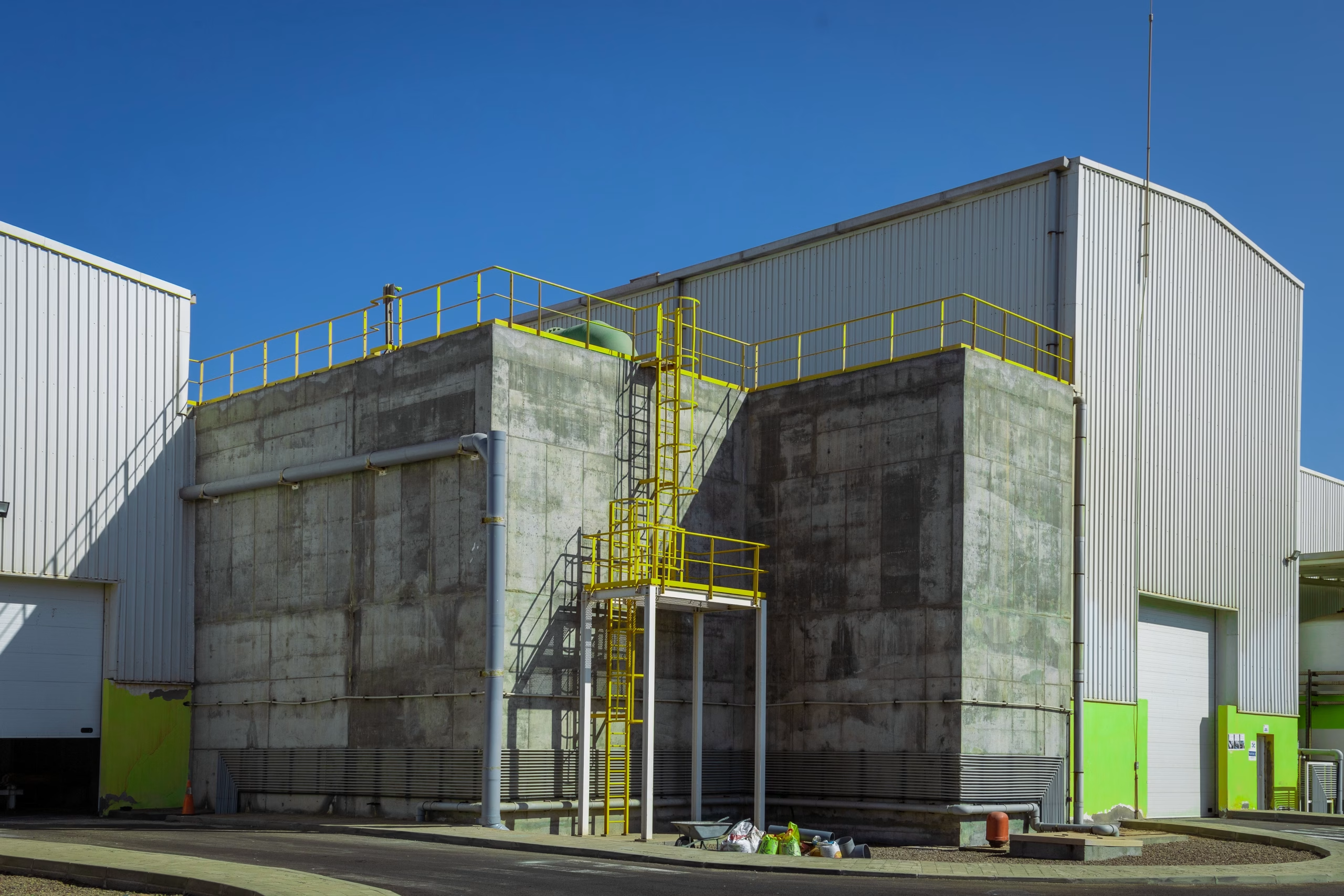
Officials describe the site as a short-term staging area. Advocates see a major shift in how the government could move families and children toward removal.
The most important thing about ICE’s planned Louisiana facility may not be its size. It is where it sits.
The Trump administration is preparing a 528-bed holding site for migrant families and unaccompanied children next to Alexandria International Airport, a major deportation flight hub in central Louisiana, according to reporting by The Associated Press. Officials describe it as a short-term staging area. Critics say its location could make deportations of children and families faster, harder to challenge and more opaque.
An airport hub changes the math
The proposed site would be built at the former England Air Force Base near Alexandria, roughly 175 miles northwest of New Orleans. The England Airpark Authority’s executive director, Ralph Hennessy, told the AP the facility could be operational as early as August.
That placement matters because Alexandria International Airport is already deeply tied to immigration enforcement flights. More than 4,400 immigration enforcement flights moved in or out of the airport in 2025, according to data from ICE Flight Monitor, an initiative of Human Rights First cited by the AP.
For ICE, a facility beside that hub could solve a practical problem: how to gather families and children from shelters, foster placements or other locations before putting them on removal flights. For advocates, that same efficiency is the danger.
A chaotic episode last year showed why the logistics matter. Guatemalan children were reportedly awakened at night and rushed toward Harlingen, Texas, where they waited for hours near an airport tarmac before a federal judge blocked their deportation. The proposed Louisiana site appears designed to prevent that kind of scramble by putting people closer to the planes before flight time.
ICE calls it staging
ICE is not presenting the Alexandria site as a traditional detention center. The agency has described it as a “staging area,” and records obtained by the AP indicate it would operate as a 72-hour holding center for migrants awaiting deportation.
That distinction is central to the government’s case. If people are held for only a few days, officials can argue the facility is a temporary step before travel rather than a long-term confinement site.
But the paperwork described by the AP also shows that families and children there would be in ICE custody and could be released only at ICE’s direction. That raises a basic question: if the agency controls movement, release and access, how different is “staging” from detention in practice?
ICE has also told contractors not to refer to families as prisoners, detainees or inmates, according to records reviewed by the AP. The agency directed that bars or cages not be used in transport, that families be allowed to wear their own clothes and that the facility not be required to conduct headcounts.
Children make this different
The presence of unaccompanied children is what makes the plan especially sensitive. Under federal law, children who arrive without parents or close relatives are generally transferred away from ICE and placed in shelters or foster programs overseen by the Office of Refugee Resettlement, part of the Department of Health and Human Services.
The Alexandria facility would sit outside that normal child-welfare structure. An airfield spokesperson told the AP that the Office of Refugee Resettlement is not involved in operating the site.
That has alarmed immigration and child-welfare advocates, who worry that a “temporary” site could become a place where children are held longer than advertised. Similar concerns have followed other federal immigration holding facilities when stays stretched from days into weeks or months.
Leecia Welch, chief legal counsel at the nonprofit Children’s Rights, told the AP the facility represents “an expansion of the deportation system in ways we haven’t seen before.” Her concern is not only the beds, but the new pathway: children could be moved from child-welfare settings into an ICE-controlled pipeline steps from deportation flights.
The contractor brings baggage
The official contractor for the new site is expected to be the LaSalle Family Foundation, the nonprofit arm of Louisiana-based LaSalle Corrections, according to the AP. LaSalle Corrections operates private prisons and immigration detention centers across the South.
The arrangement adds another layer of scrutiny. According to tax records cited by the AP, the nonprofit arm has provided chaplain services and educational programming in correctional facilities. But LaSalle Corrections itself would be involved in operating the holding facility and ensuring compliance, the company’s chief financial officer wrote in an email reviewed by the AP.
LaSalle spokesperson Scott Sutterfield declined to comment to the AP. The AP also reported that two detainee deaths have been reported since April at a LaSalle-run ICE facility in Louisiana, and that Winn Correctional Center was found in June to have violated standards related to environmental health and safety, food service and use-of-force documentation.
Compass Connections, a Texas-based nonprofit that runs shelters for unaccompanied immigrant children, had previously been involved in planning and presented details publicly in February. Its president, Sonya Thompson, later told the AP the organization was no longer involved, without explaining why.
Self-deporting families face pressure
Airpark officials have described the planned facility as a humanitarian effort for families who are “self-deporting.” Hennessy told the AP the people involved are “volunteering to go back home” as family units.
That language is likely to become a central dispute. In immigration cases, “voluntary” departure can cover a wide range of situations. Some families may decide they cannot continue fighting their cases. Others may not fully understand available legal options, may fear separation or may agree to leave after prolonged pressure.
Advocates argue that placing families near a flight hub could compress the window for legal review. If a parent or child is moved to Alexandria shortly before a flight, lawyers may have limited time to confirm whether the person has pending claims, court orders, medical needs or family circumstances that should delay removal.
For the government, the site could reduce missed flights and last-minute delays. For families, speed can mean fewer chances to ask whether the deportation is lawful, safe or properly documented.
The next fight is oversight
The immediate question is whether the facility opens on the timeline described by local officials. If it does begin operating as early as August, the next questions will be more difficult: who gets access, how long people are actually held and what rules apply when children are inside.
Key details remain unsettled publicly. It is not clear how legal visits would work, whether child-welfare experts would be on site, how medical or trauma concerns would be handled, or what outside monitoring would be allowed.
The administration’s position is straightforward: a short-term staging site near a flight hub can make deportation operations smoother and keep families together immediately before travel. The concern from advocates is just as clear: a facility designed for speed may reduce the friction that sometimes protects children from unlawful or rushed removals.
That is why the Alexandria plan is drawing attention beyond Louisiana. It could become a model for a faster deportation system, especially for families and minors. Or it could become the next flashpoint in the long-running fight over how the United States treats children in immigration custody.








Leave a Reply