
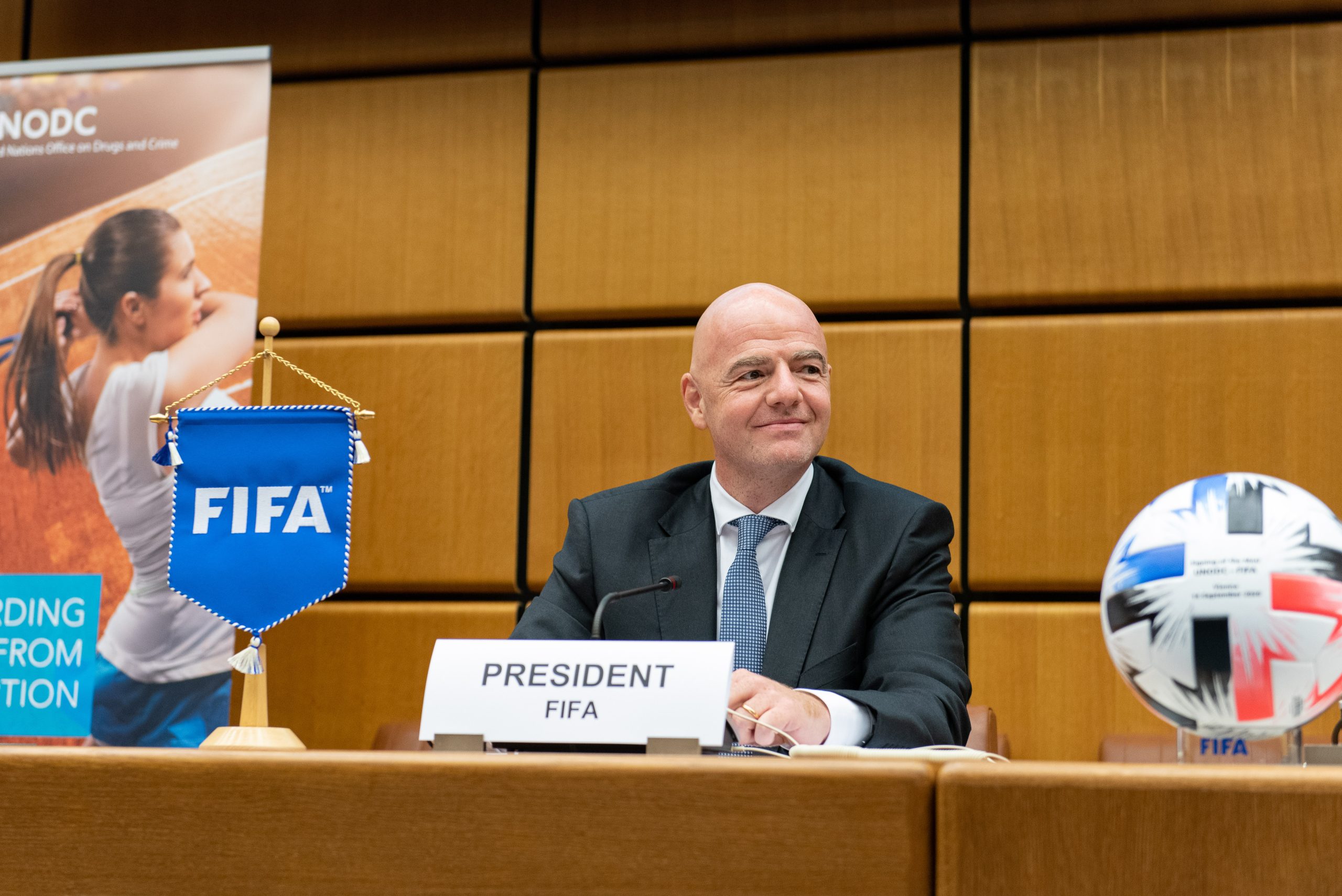
The case turns a red-card dispute into a larger test of whether football’s global rulebook can stay insulated from political power. It also puts Infantino’s close ties with Trump under new scrutiny.
Gianni Infantino is facing a complaint over alleged political interference tied to Donald Trump, after a human rights group said it will take the FIFA president to Olympic ethics investigators. The complaint, filed with the IOC, centers on Trump’s intervention in a FIFA disciplinary matter: his call for a review of Folarin Balogun’s red-card suspension, which FIFA later reversed and allowed the United States forward to play in the World Cup.
FairSquare says the case raises concerns about political neutrality in football governance and whether Infantino crossed a line by allowing a sitting U.S. president to influence a football disciplinary decision. The challenge is being framed as a formal ethics complaint over Trump’s lobbying in the Balogun ban reversal, not just a dispute over one player’s eligibility.
A red card became a governance case
The immediate flashpoint is Balogun’s availability for a World Cup match against Belgium. According to Associated Press reporting published by PBS, Trump took credit for FIFA’s decision to allow the U.S. forward to play despite receiving a red card in the previous game.
That is why the controversy has moved beyond the usual argument over officiating or suspensions. Red cards normally trigger disciplinary consequences handled inside football’s own systems. When a head of state says he helped change the outcome, the question becomes whether the sport’s institutions were pressured from outside.
The decision was described in AP’s report as unprecedented in modern World Cup history. Belgium, playing amid the furor, beat the United States 4-1 in Seattle.
For supporters of the complaint, the scoreline is not the central issue. The larger concern is precedent: if political pressure can shape one disciplinary call, critics argue, every future close decision involving a powerful host nation becomes suspect.
FairSquare is targeting Olympic ethics
The human rights and sports group FairSquare said it would file a complaint with the International Olympic Committee over what it called Infantino’s repeated breach of political neutrality rules. The route is notable because the complaint is not only aimed at FIFA’s internal machinery.
The IOC matters here because Infantino has been an IOC member since 2020. Olympic rules cite neutrality among the fundamental principles of Olympism, and the IOC Ethics Commission can review conduct by IOC members.
IOC President Kirsty Coventry said Tuesday that no complaint had been received at that point, according to AP. She also said that if one arrived, the body would look into it. Coventry added that the IOC had been watching the controversy play out.
That does not mean Infantino has been found to have violated any rule. It means an outside group is trying to move the matter into a forum where the FIFA president’s conduct can be assessed under Olympic ethics standards, not just football politics.
Why Infantino’s Trump ties matter
Infantino’s relationship with Trump is part of why the Balogun episode landed so hard. The FIFA president has cultivated close ties with Trump since the United States, Canada and Mexico won the vote to host the 2026 World Cup.
AP reported that Infantino attended Trump’s second inauguration in January 2025 and has been a regular White House visitor. He also publicly praised Trump’s work in November, saying people should support it because it was “pretty good.”
Then came the FIFA Peace Prize, created by Infantino and presented to Trump at the World Cup tournament draw in Washington, D.C., in December. Senior soccer officials said privately that the prize was Infantino’s executive decision, according to AP.
Those details do not prove improper conduct in the Balogun matter. They do explain why watchdogs see a neutrality issue. When a sports leader is visibly close to a political figure, decisions that benefit that figure’s national team invite a heavier burden of explanation.
The neutrality rule is the real fight
Political neutrality in sport can sound abstract until a powerful politician calls about a player ban. FIFA, the IOC and other global sports bodies routinely insist that governments should not interfere in team selection, federation elections, match discipline or field-of-play decisions.
That principle is often enforced against smaller countries. Federations can face suspension when governments meddle in football administration. The tension in this case is whether the same standard applies when the political actor is the president of a World Cup co-host nation.
FairSquare’s complaint, as described by AP, frames the matter as a “slippery slope.” The phrase fits the worry: one exception can become a template. If a leader successfully lobbies over a red-card suspension, another leader may try the same over refereeing, scheduling, eligibility or disciplinary hearings.
There is also a competing view. Supporters of Trump’s intervention may see it as advocacy for a national player in a tournament where disciplinary rules can feel harsh or inconsistent. They may argue that FIFA still made the decision and that a phone call, by itself, does not prove coercion.
FIFA’s own process is under scrutiny
The IOC complaint is not the only ethics track hanging over Infantino. FairSquare previously filed a complaint with FIFA’s ethics committee in December over political neutrality concerns involving Infantino. AP reported that the Norway soccer federation and about 50 members of the European Parliament supported that case.
FIFA had provided no update on that earlier complaint seven months later, according to the report. That silence is part of the reason critics may see the Olympic route as necessary. If FIFA’s own ethics system does not visibly address complaints against its president, outside forums become more attractive.
FIFA was asked for comment about the IOC complaint, AP reported. The available reporting does not establish FIFA’s full explanation for the Balogun decision, what communications occurred between Trump and Infantino, or whether disciplinary officials felt pressure.
Those gaps matter. A credible review would likely need to distinguish between political noise, personal lobbying and actual interference in a formal process. The public record so far leaves room for dispute over how much weight Trump’s involvement carried inside FIFA.
What happens next
The next practical step is whether FairSquare’s complaint is formally received and accepted by the IOC Ethics Commission. Coventry’s comments suggest the IOC would at least examine a submitted complaint, but there is no public outcome yet.
If Olympic investigators take up the matter, they could seek records, timelines and explanations around Infantino’s role. They could also assess whether his relationship with Trump created a conflict with neutrality obligations expected of IOC members.
The case arrives at a sensitive time. The World Cup is being staged across the United States, Canada and Mexico, while Los Angeles is set to host the 2028 Olympics. That puts U.S. political power, FIFA’s commercial showcase and Olympic governance in unusually close proximity.
The takeaway is not that the complaint has already proven wrongdoing. It is that a single red-card reversal has exposed a deeper trust problem for global sport: rules are only as credible as the public belief that presidents, prime ministers and friendly officials cannot bend them when the match is big enough.

Leave a Reply