
Trump framed higher prices at the pump as a cost of his administration’s confrontation with Iran. The dispute matters far beyond Washington and Tehran because the Strait of Hormuz is a critical route for global oil supplies.
Donald Trump told Americans to accept high gas prices as Iran remains defiant over the Strait of Hormuz, the strategic waterway through which a major share of global oil once moved. Trump said a modest increase at the pump was worth it, while Iran said it would continue enforcing its blockade of the strait.
The clash turns an overseas military and diplomatic crisis into a direct kitchen-table issue. With tanker traffic reduced to a fraction of normal levels and talks reportedly stalled, the central question is whether the administration can meet its security goals without leaving U.S. drivers facing a prolonged fuel-price penalty.
Trump ties pump prices to policy
Speaking Friday at a police academy in Nassau County, New York, Trump urged Americans to tolerate what he called “a tiny little bit more” for gasoline. He argued that higher prices were an acceptable cost of preventing Iran from obtaining a nuclear weapon.
That framing is politically consequential because gasoline prices are unusually visible: drivers see them on roadside signs, and higher fuel costs can work their way into transportation, delivery and household budgets.
Trump’s comments also make a clear trade-off. His position is that short-term economic pain is justified by the administration’s security objectives. Critics of that approach are likely to focus on whether the public has been given a clear timeline, a measurable endpoint and a realistic path to lower prices.
Iran rejects Trump’s Hormuz claim
Iran’s response was not conciliatory. According to NBC News, Deputy Foreign Minister Kazem Gharibabadi said the Strait of Hormuz could not be taken by a presidential declaration, military force or an election speech.
Trump had said he expected to declare the strait a “territory of the United States” after claiming Iran was being badly defeated. Iran’s position, as conveyed by Gharibabadi, is that the waterway will be opened and closed under Iranian command and that its blockade will continue.
The exchange underscores how far apart the two sides remain. Trump’s language projects control and a coming victory; Tehran’s language rejects both the premise of defeat and the idea that Washington can dictate access to the passage.
A chokepoint with global consequences
The Strait of Hormuz sits between Iran and the Arabian Peninsula and connects the Persian Gulf with the Gulf of Oman. Before the conflict, it handled roughly one-fifth of the world’s oil, according to NBC News.
That makes disruptions there far more consequential than a regional shipping dispute. Even countries that do not buy oil directly from the Persian Gulf can feel the effect when traders anticipate supply constraints and energy markets react.
Oil and gasoline prices do not move in perfect lockstep, and the price at a U.S. pump is influenced by refining, distribution, taxes and local competition. Still, a sustained disruption to a major oil route can raise the cost of crude, creating pressure that eventually reaches consumers.
Shipping traffic remains severely reduced
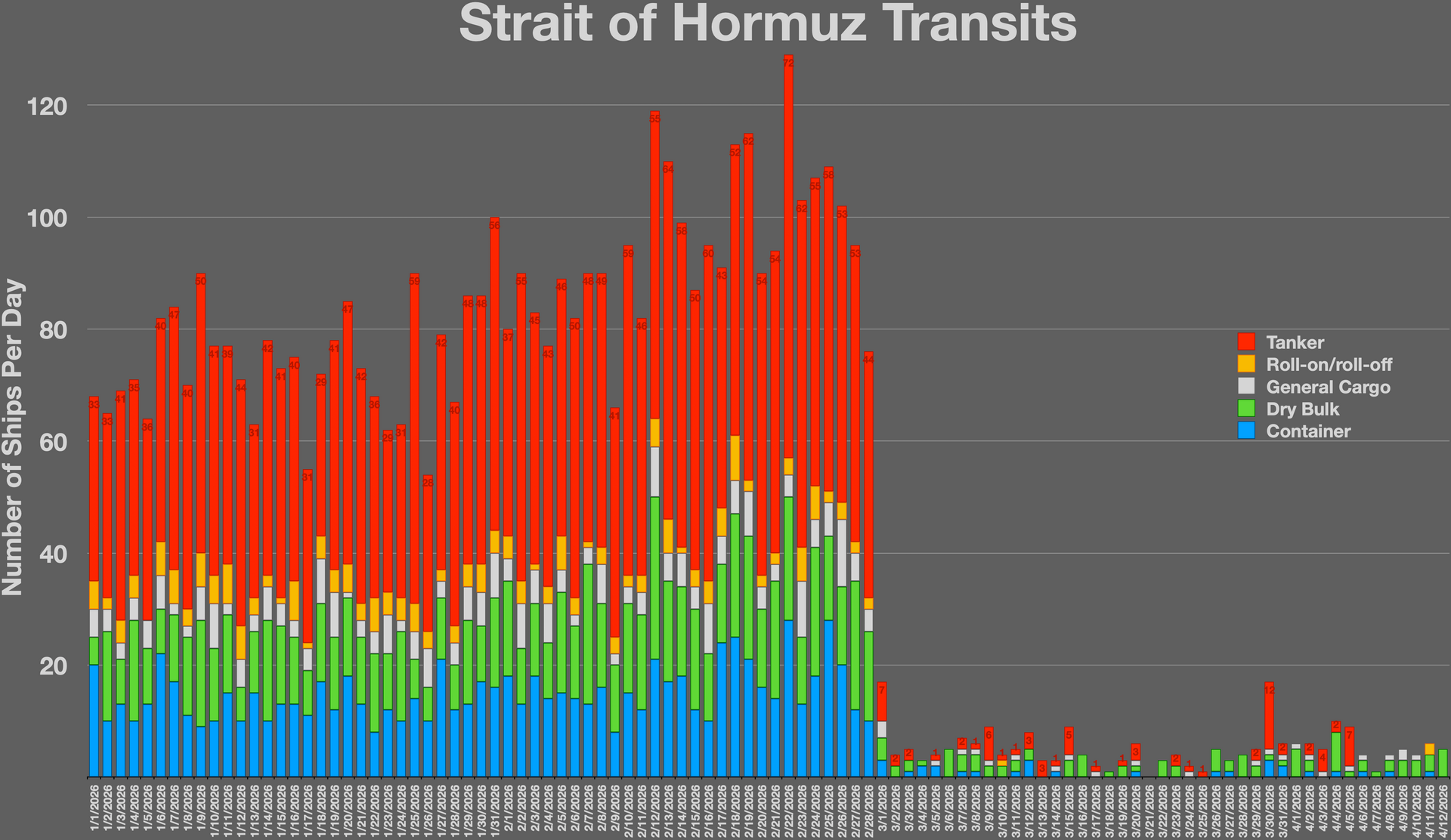
The practical problem is the lack of normal passage through the strait. Ship-tracking firm Kpler found that only two vessels passed through on Friday, compared with the roughly 130 to 140 vessels that typically transit during peacetime, NBC News reported.
No crude-oil shipments were visible in that analysis. Some ships may cross without broadcasting their transponder signals, but the overall picture remains one of sharply curtailed traffic rather than a functioning commercial route.
The danger is not theoretical. The United Kingdom Maritime Trade Operations Centre said a bulk carrier was struck in the hull by an unidentified projectile in the Strait of Hormuz on Friday. The crew was reported safe, though the extent of damage and any environmental impact had not been established.
Those incidents make reopening the route more difficult than simply issuing a statement. Shipping companies, crews, insurers and cargo owners must judge whether the risk of transit is acceptable.
Oil markets have not fully settled
Global oil and gas markets have calmed from the sharp early spike associated with the conflict, but they remain above their prewar levels, according to the reporting. Reuters reported that crude futures rose by about $1 a barrel Friday, while Brent was on track for a weekly gain of 6%.
For the administration, that creates a difficult messaging challenge. Trump is asking Americans to view higher gasoline prices as a temporary and necessary sacrifice. Yet households may judge the policy less by its strategic rationale than by how long the costs last and whether they keep rising.
Vice President JD Vance, who has been tasked with leading efforts to end the war, expressed the tension directly in a Fox News interview. He said the first goal was to keep oil and gas cheap for Americans, followed by ensuring that Iran does not obtain a nuclear weapon.
Negotiations offer little immediate relief
Diplomatic movement appears limited. NBC News reported that a 60-day negotiating period set in a memorandum of understanding signed in mid-June was due to end Monday, with few direct talks having occurred.
Iranian Foreign Minister Abbas Araghchi said in an interview that no negotiations were taking place between Tehran and Washington. Qatar and Pakistan were exchanging messages with Iran, he said, but he did not characterize those contacts as negotiations.
That leaves several major uncertainties: whether direct talks can restart, whether shipping can safely resume at scale, and whether either side will alter its public position. Until those questions have clearer answers, Trump’s request that Americans accept higher gas prices is likely to remain inseparable from the unresolved struggle over the Strait of Hormuz.



Leave a Reply