

Trump’s response puts a blunt political frame around a deployment that ended with sailors returning to San Diego after 295 days at sea. The record-setting mission also raises a broader question: how should military readiness be weighed against the strain on service members and their families?
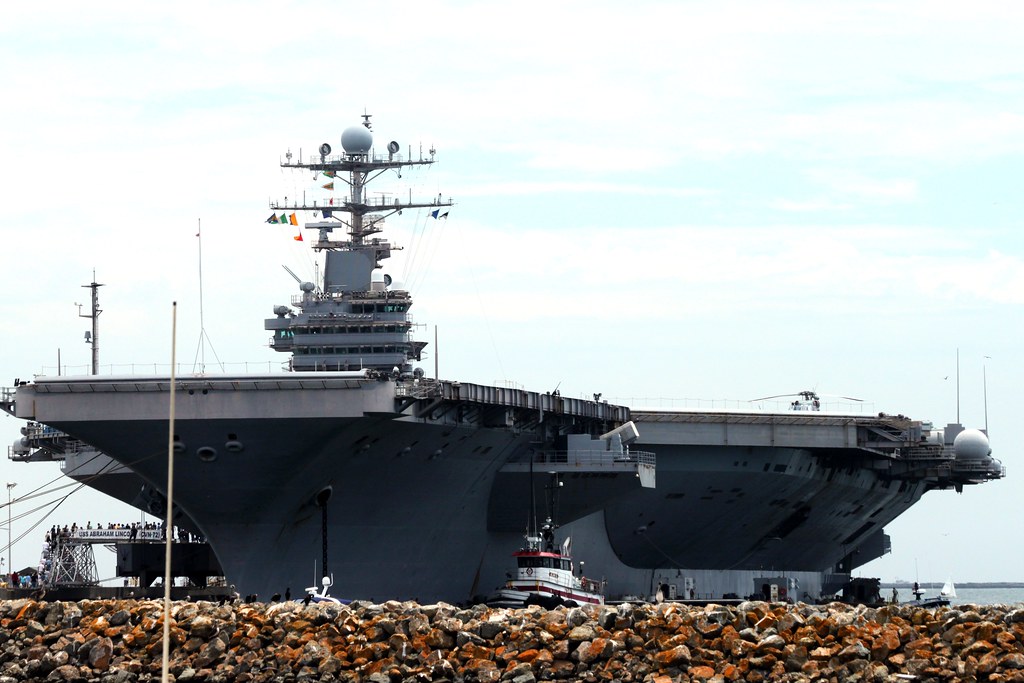
Donald Trump responded to families concerned about sailors by rejecting the idea that the USS Abraham Lincoln’s deployment had been too long. Trump said the ship’s deployment was “not nearly long enough,” even though the sailors’ mission lasted 295 days — about 10 months — before the carrier strike group arrived in San Diego on Jan. 20.
That answer has renewed attention on what the number represents. The Navy described the USS Abraham Lincoln mission as the longest U.S. carrier deployment of the post-Cold War era, a milestone that can be read as evidence of military reach or as a measure of the personal toll of extended time away from home.
Trump’s answer was unequivocal
Asked about the concerns, Trump answered, “No, they’re not,” according to CNN, referring to whether sailors had been deployed too long. He then argued that the USS Abraham Lincoln’s time away was insufficient rather than excessive.
The exchange offers little detail about which families raised concerns, how many did so, or whether their objections focused on the length of the deployment, the operational tempo, missed family time, or another issue. Those distinctions matter because military families can support a mission while still struggling with the demands it places on sailors and households.
Trump’s remarks frame the question principally as one of military strength and endurance. Critics of that framing may see it as dismissive of families coping with a long separation. Supporters may argue that sustained carrier deployments are sometimes necessary to protect U.S. interests and deter adversaries in contested waters.
A 295-day mission by the numbers
The U.S. Pacific Fleet said the Abraham Lincoln Carrier Strike Group’s 295-day deployment was the longest carrier deployment in the post-Cold War era. The group returned to Naval Air Station North Island in San Diego on Jan. 20 after a 10-month mission spanning the U.S. 6th, 5th and 7th Fleet areas of operation.
The strike group had departed Norfolk, Virginia, on April 1 and traveled east around the world. The Navy said it covered more than 64,000 nautical miles, a distance that illustrates why the duration has become central to the discussion.
- The mission included seven months in theater in the U.S. 5th Fleet area, according to the Navy.
- The carrier strike group conducted operations in the Mediterranean region, Middle East and Indo-Pacific.
- The Navy said the embarked air wing flew 392 combat sorties and logged more than 28,000 flight hours.
- The deployment also coincided with the ship’s homeport shift from Norfolk to San Diego.
Those details place Trump’s comment in a more concrete context. “Long” is not an abstract description in this case; it means a mission that involved a full transit around the world, combat operations, partner exercises and an eventual change of homeport.
The Navy’s case for the mission
The Navy presented the deployment as an operational success. It said the Abraham Lincoln was expedited to the U.S. 5th Fleet region after what it called credible threats to maritime security, where the group maintained presence operations intended to deter aggression.
Naval leaders emphasized the carrier’s ability to project power and support combatant commanders across wide areas. The ship and its air wing also took part in coalition security activity and exercises with partners including Great Britain, Italy, Romania, Lithuania, Spain and Thailand, according to the Pacific Fleet account.
From that perspective, an extended deployment can demonstrate that the United States can keep a major naval asset on station through a prolonged period of tension. A carrier strike group is designed to provide a visible and flexible military presence, and keeping one deployed longer can reduce gaps in coverage.
But operational value does not settle the question raised by families. The Navy’s description of mission accomplishments explains why leaders may value endurance; it does not establish that a 295-day deployment carries no costs for sailors, spouses, children or the wider support network around a crew.
Readiness and family strain collide
Extended deployments are a recurring point of tension in military life. Service members accept demanding obligations, and families often shoulder the practical consequences: parenting alone, disrupted routines, financial pressures, missed milestones and uncertainty around schedules that can change with operational needs.
That does not mean every family views a long mission the same way. Some may take pride in a ship’s role and in the sailor’s service. Others may be frustrated by how long a deployment lasts or by limited clarity on when a return will happen. Both reactions can exist within the same command community.
Trump’s statement did not address that tension. His response answered the length question by asserting a strategic preference for more time deployed, rather than acknowledging the difference between what a mission demands and what families experience at home.
The political significance lies in that choice of emphasis. Presidents set broad national-security priorities, while military leaders manage readiness, personnel and operations. Families, meanwhile, live with the real-world effects of those priorities long after a public exchange has ended.
What remains unclear after the remarks
The available reporting does not identify the families involved or provide a detailed account of their concerns. It also does not indicate whether Trump was proposing a particular future deployment policy, responding only to a reporter’s question, or making a broader argument about Navy force posture.
There is also no indication in the available material that the comment changed the Abraham Lincoln’s status. The Navy said that after reaching San Diego, the ship and crew would move into the next phase of the vessel’s operational and maintenance cycle, following time for sailors to reconnect with families.
That point is important: the 295-day mission is a completed deployment, not simply a rhetorical number. The sailors had already performed the mission the Navy called record-setting, returned to San Diego and faced the transition that follows a long absence.
Trump’s answer has made the old argument over deployment length newly visible. The unresolved issue is not whether the Abraham Lincoln served a major strategic purpose; the Navy’s account makes that case. It is whether a public debate about military power can seriously account for the people asked to sustain it for 295 days at a time.











Leave a Reply