
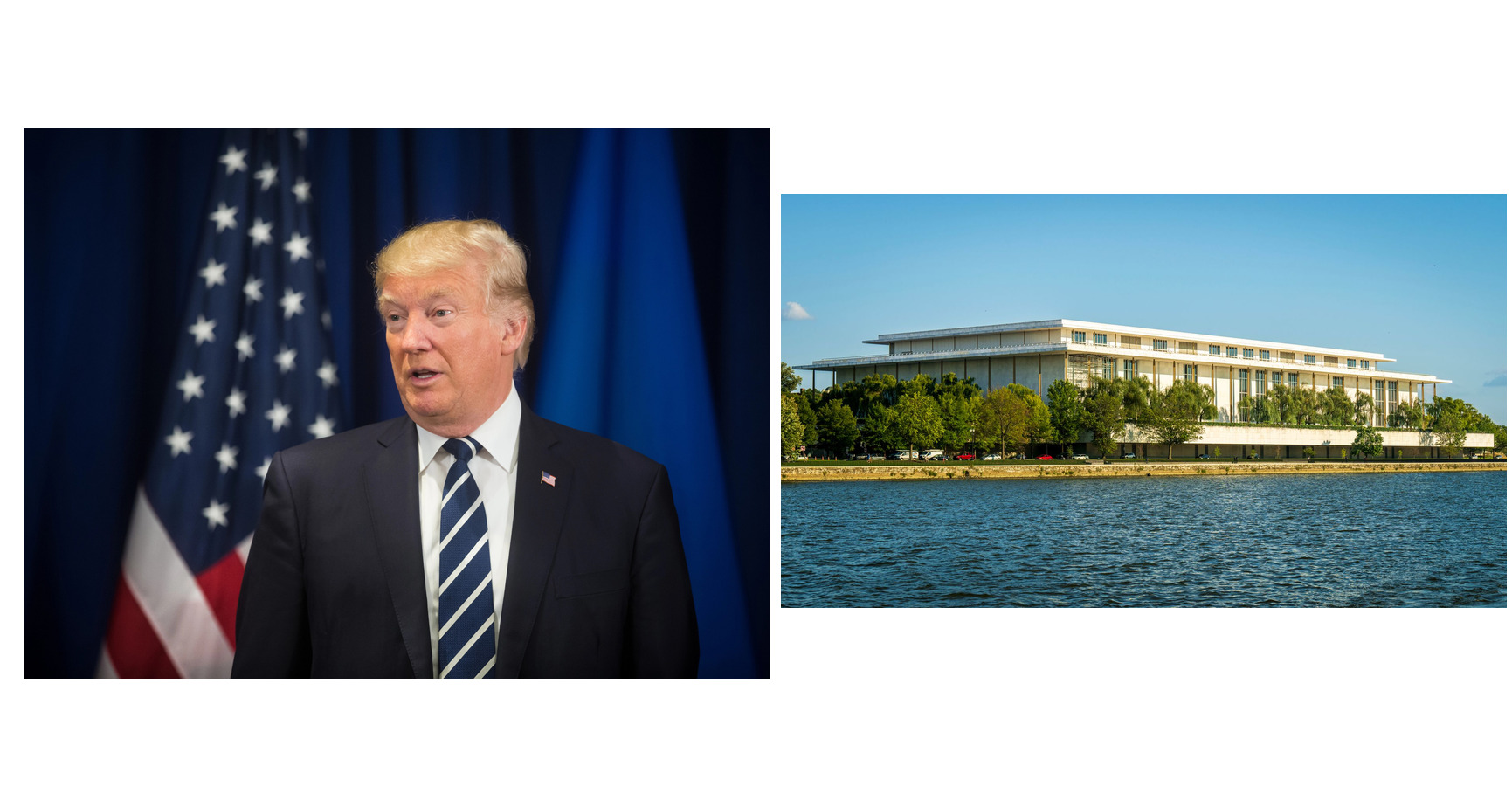
The tarp outside Washington’s Kennedy Center has become a visible symbol of a larger fight over who can rename a federally supported memorial. A new filing adds questions about board procedure, fundraising and the center’s planned renovation closure.
The Kennedy Center gave a court explanation for keeping a tarp over its facade after the tarp covered the area where President Trump’s name had been removed. In the legal dispute, the explanation involved hiding “their embarrassment,” a phrase that drew attention because the covered facade has become part of a larger fight over the institution’s identity and governance.
The dispute is about more than a piece of fabric outside a Washington performing-arts venue. It concerns whether the Kennedy Center’s board could add Trump’s name to a memorial established for John F. Kennedy, how that decision was made, and what the center must disclose as litigation continues.
The tarp became a court issue
U.S. District Judge Christopher Cooper asked the Kennedy Center’s board of trustees to explain why the tarpaulin and scaffolding remained on the center’s front portico after Trump’s name was taken down, according to NPR’s reporting on court filings.
The judge’s June 24 request was narrowly framed: the court wanted the purpose and status of the tarp and scaffolding. Yet the question carries unusual weight because the physical covering has kept the public from seeing the site where the disputed name had appeared.
In court, visual details can matter. A tarp may have practical purposes, including construction or protection of a facade, but in a case centered on public naming and institutional authority, it can also become evidence of an unresolved decision.
The filing’s reference to embarrassment gave opponents of the naming change another opening to argue that the center was trying to manage the appearance of a contentious episode rather than directly resolve it.
How Trump’s name entered the fight
Rep. Joyce Beatty, an Ohio Democrat and an ex-officio member of the Kennedy Center board, is suing to remove Trump’s name from the center and to block a planned shutdown for renovations. Her challenge centers on the board’s authority to add a secondary name to the John F. Kennedy Center for the Performing Arts.
The Kennedy Center is not an ordinary private arts organization. It is a federally supported living memorial to President John F. Kennedy, and federal rules governing the complex state that no additional memorials or plaques may be designated or installed.
Beatty’s position is that putting Trump’s name on the building conflicts with those limits and would require congressional approval. The Kennedy Center’s legal position has differed, and the case is still being litigated; the filings described in the reporting do not amount to a final ruling on whether the name could legally be added.
That distinction matters. A lawsuit can expose documents, procedures and conflicting accounts long before a judge decides the core legal question.
The board process faces scrutiny
A Department of Justice filing on the Kennedy Center’s behalf acknowledged that Beatty was “muted and prevented from speaking” during the December 18, 2025, meeting when the board voted to add Trump’s name, NPR reported.
The filing also acknowledged that she was prevented from voicing her opposition. Beatty’s court papers had said the agenda gave no advance notice that a name change would be considered; the Kennedy Center did not deny that point in the account described by NPR.
Another notable admission was that board members did not discuss potential risks or downsides of adopting a secondary name before the vote, according to the filing. Nor was there a discussion about a possible conflict of interest stemming from the decision.
Those admissions do not by themselves settle whether the vote was legally valid. They do, however, sharpen the accountability question: how should a board overseeing a national memorial handle a decision with political, financial and symbolic consequences?
Fundraising and attendance complicate it
The Kennedy Center’s lawyers had previously argued that removing Trump’s name could cost the institution donations from supporters of the president and hinder fundraising. That argument places a financial concern alongside the lawsuit’s statutory and procedural claims.
But the court record also added a separate financial complication. The center, which had disputed reporting about weakened ticket sales after Trump became board chair, acknowledged in the filing that nearly half of its tickets were unsold by October 2025, NPR reported.
Unsold tickets do not establish a single cause. Performing-arts attendance can be shaped by programming, pricing, tourism, economic conditions and public controversy. Still, the disclosure makes the debate over the center’s public image harder to separate from its financial position.
Supporters of the changes may view a Trump association as helpful with some donors and audiences. Critics may see the naming controversy, board process and facade tarp as signs that the institution has taken on avoidable reputational damage. The litigation provides evidence for neither side’s broadest prediction, but it has made those competing claims more visible.
A renovation plan adds pressure
The dispute also overlaps with Trump’s announcement that the Kennedy Center would close for two years for renovations. Trump said he made that decision after a yearlong review involving contractors, musical experts, art institutions and other advisers.
According to the center’s lawyers, however, the announcement was made without plans, analyses, timelines or funding information being presented to the other trustees and without a board vote. That account raises separate questions from the naming case about how major operational choices are being developed and approved.
A prolonged closure would affect performers, ticket holders, employees, nearby businesses and the many groups that use the venue. It also increases the practical importance of knowing whether a renovation plan has defined costs, a workable schedule and formal board backing.
The court case is not necessarily the forum that will decide every detail of a renovation. But the filings have put the center’s internal process under a level of public examination that may influence how such decisions are explained going forward.
What remains unresolved
Cooper’s request for information about the tarp did not decide the underlying naming dispute. The key unanswered legal issue is whether the Kennedy Center board had authority to attach Trump’s name to a congressionally created memorial without action by Congress.
There are also practical unknowns: how long the tarp and scaffolding will remain, whether the name could return, what renovation plan will ultimately be adopted, and how the institution will address concerns about notice and participation at board meetings.
For now, the covered facade is a concise public image of a much broader conflict. The Kennedy Center’s court explanation may address why the tarp stayed up, but the more consequential questions concern who governs a national cultural institution, what rules constrain that power and how openly the public is told about decisions made in its name.





Leave a Reply