
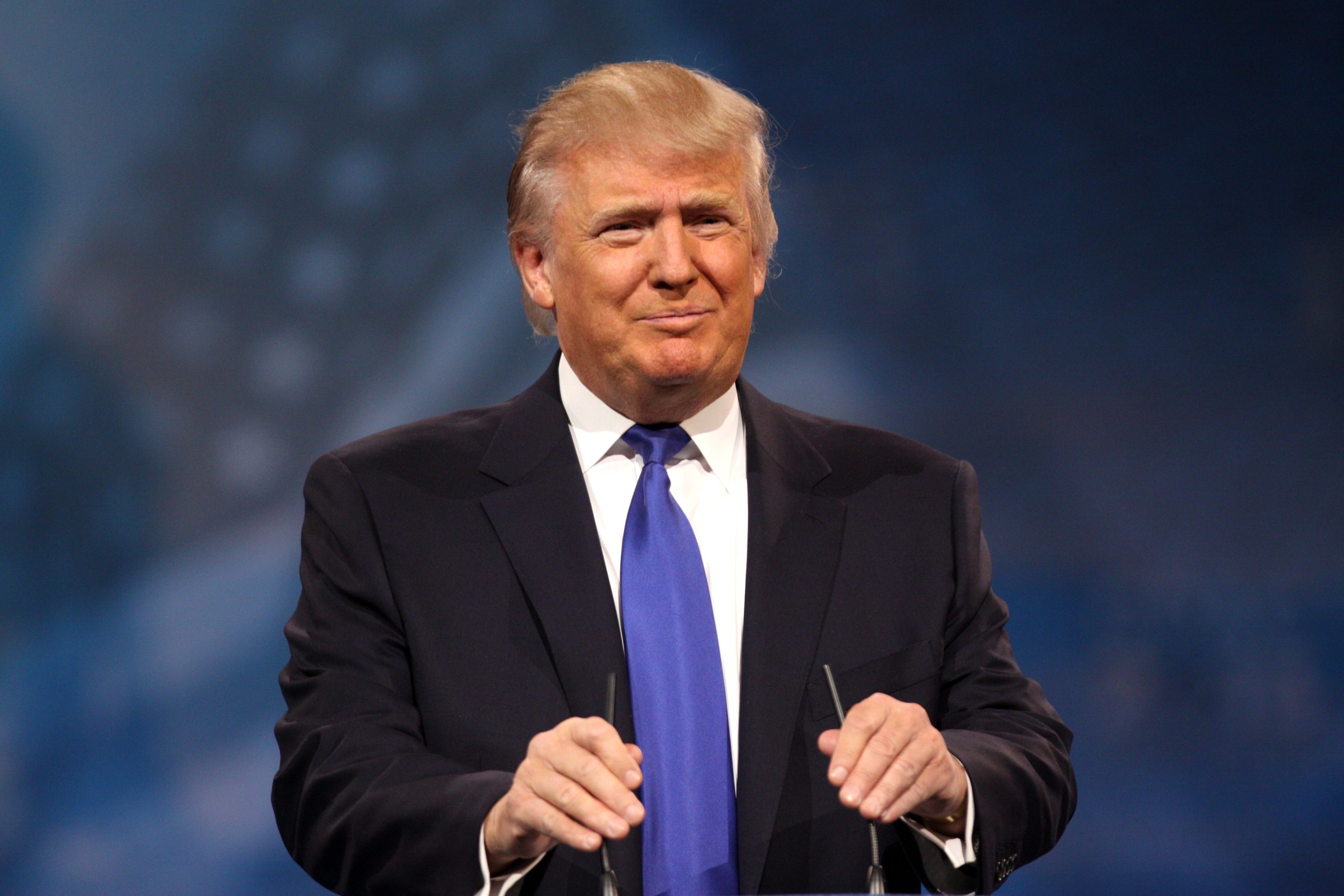
The issue is not just whether an anecdote is wrong. It is how false history can become a political shield for questions about money, power and accountability.
Donald Trump did not just tell a questionable story about George Washington. He used it to answer a question tied to his own money.
That is why the latest round of disputed history around Trump matters. The facts are old, but the political purpose is current.
A Washington story with a purpose
According to a Roll Call Factba.se transcript cited by CNN, Trump said Monday that George Washington had “two desks” before the White House, one for business and one for the presidency. Trump’s point was not presented as a museum tour detail. He used the story while responding after a reporter raised a question related to cryptocurrency.
The context is important. CNN reported that Trump’s annual financial disclosure showed he made more than $1 billion from cryptocurrency ventures in 2025. After that subject came up, Trump eventually shifted to Washington, saying the first president had separate desks for business and official duties.
Trump then drew a comparison to himself, saying he chooses not to talk to his children about “this stuff.” In other words, the anecdote was doing political work: suggesting that private business alongside presidential power has a founding-era precedent.
Historians previously rejected the “two desks” story when Trump told it years earlier, CNN reported. The outlet cited historians who called it “utter nonsense” and “an absurd allegation,” with another saying he did not know what Trump was talking about. CNN noted that Washington did conduct some personal business as president, but not in the tidy two-desk setup Trump described.
Why the desk claim matters
On its own, the Washington anecdote could sound like trivia. Presidents often reach for history. Politicians regularly use founding figures as shorthand for virtue, toughness or legitimacy.
But this was not a harmless misremembered tour fact. Trump used the image of Washington’s supposed business desk to address concerns about a sitting president’s wealth-building and conflicts of interest. The story’s accuracy matters because it functions as a permission slip.
If Washington did it, the implied argument goes, then critics should calm down. If the first president kept business and government side by side, then modern financial entanglements can be framed as normal, even patriotic.
That is a powerful move, especially for casual audiences. A vivid historical scene can travel faster than a correction. “Two desks” is easy to picture. The archival reality is harder to package.
The Panama Canal number collapses
The Washington claim was not the only disputed history Trump offered recently. In a July 4 speech marking the nation’s 250th birthday, Trump said “38,000 Americans died” to create the Panama Canal, calling it one of the great engineering feats of all time, according to CNN.
That number does not line up with the historical record CNN described. The American construction phase ran from 1903 to 1914. Records from that period are imperfect, but historians have put total deaths during the American phase at about 5,600 workers.
Julie Greene, a University of Maryland history professor and author of “The Canal Builders: Making America’s Empire at the Panama Canal,” told CNN after Trump made a similar claim previously that the vast majority of those who died in the American phase were Afro-Caribbean workers, including people from Barbados and Jamaica.
The late historian David McCullough, who wrote a major history of the canal, found that about 350 white Americans died during construction, CNN reported. Thousands more workers died during the earlier French phase, possibly around 22,000, but Trump specifically described the deaths as American.
Old facts, new politics
The Panama Canal is not just a history-book topic for Trump. He has repeatedly argued that the United States should not have relinquished control of the canal to Panama in the 20th century. Inflating American deaths can strengthen a grievance narrative: the U.S. paid in blood, then foolishly gave away the prize.
That is why the distinction matters. The canal was built through empire, disease, dangerous labor and a racialized workforce. Reducing that history to a dramatically exaggerated count of American deaths changes who is centered in the story.
It also turns a complicated international history into a simpler political claim. The higher the supposed American sacrifice, the easier it becomes to frame the canal as something stolen from the United States rather than a waterway built on Panamanian land through a broader imperial project.
For many voters, the details may be unfamiliar. That gives a confident presidential claim extra force, even when specialists say the numbers are wrong.
The salary claim repeats too
Trump also claimed in a CNBC interview last week that he was “the only president” to give up his salary, CNN reported. That is not accurate.
Herbert Hoover and John F. Kennedy both donated their presidential salaries. News organizations pointed this out during Trump’s first term, when he made similar claims.
Trump did provide evidence that he donated his $400,000 annual presidential salary for most of his first term, according to CNN. The picture is less clear for his current term. CNN reported that the White House declined to provide evidence of second-term salary donations in response to its request.
CNN also reported that the White House Historical Association said in October 2025 that Trump had donated $66,000 to the organization since January 2025, after Trump said in August 2025 that he had donated his first “paycheck” to the nonprofit.
A pattern beyond one misspeak
One wrong historical anecdote can be a mistake. Several in a short stretch start to look like a method.
In the examples CNN identified, the disputed claims are not random. They each serve a present-day message:
- George Washington: a story used to soften concerns about presidential business interests.
- The Panama Canal: an inflated death toll that supports a nationalist grievance over U.S. control.
- Presidential salary: a claim that casts Trump as uniquely self-sacrificing, despite earlier examples from Hoover and Kennedy.
- The 2020 election: Trump again suggested he “won three elections” with Lee Greenwood’s “God Bless the U.S.A.,” though he won in 2016 and 2024 and lost in 2020.
That last claim is especially familiar. Trump has long falsely claimed he won the 2020 election, despite the certified results, court losses and lack of evidence showing fraud sufficient to change the outcome.
Taken together, the claims show how history can be reshaped into a set of talking points. The past becomes less a record to be checked than a backdrop for the argument of the day.
The takeaway for readers
Trump’s political style has always leaned heavily on repetition, memorable images and sweeping claims. A story about Washington’s desks fits that style perfectly. So does a big round number about Panama Canal deaths.
The challenge is that both types of claims can sound plausible if a listener does not already know the history. Most people are not carrying around detailed knowledge of canal labor records or presidential salary precedents.
That makes fact-checking more than a scolding exercise. When a president uses history to justify conduct in office, the accuracy of the history becomes part of the accountability question.
The central issue is not whether every voter remembers how many people died building the Panama Canal. It is whether false or unsupported stories are allowed to stand in for evidence when the topic is presidential power, personal profit or democratic legitimacy.





Leave a Reply