
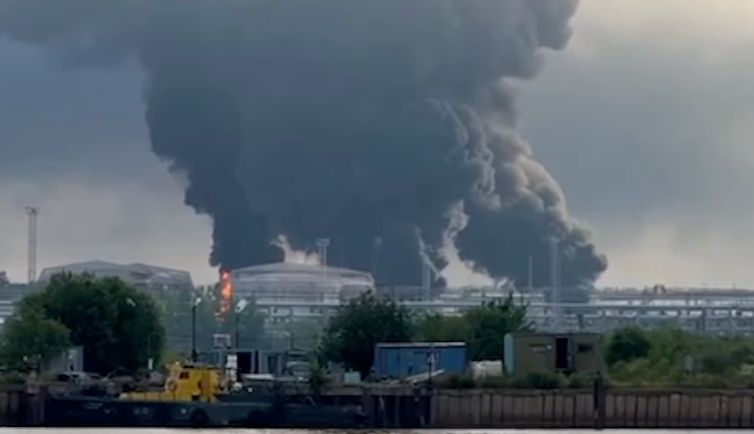
The attack, reported by Bloomberg and Reuters, brings the war’s energy battlefield into Russia’s second-largest city. Local officials said there were no injuries, but the target matters.
Ukraine’s long-range drone campaign appears to have reached one of Russia’s most symbolically important cities again: St Petersburg, the country’s second-largest city and a major Baltic port hub.
Bloomberg reported that drones targeted an oil terminal in the city’s Kirovsky district overnight, citing local officials. Reuters also reported Ukrainian drone strikes on an oil terminal in St Petersburg, along with a warship in dry dock at a nearby naval base.
Why this target stands out
An oil terminal is not just another industrial site. It sits inside the system that moves, stores and exports fuel — the same system that helps finance and supply Russia’s war effort.
That is why strikes on fuel depots, refineries, terminals and ports have become a recurring feature of the war. They can create fires and local disruption, but their larger purpose is pressure: forcing Moscow to defend more territory, spend more on air defense and repair infrastructure that was once considered safely distant from the front.
St Petersburg adds another layer. The city is far from Ukraine’s front lines and carries political weight as President Vladimir Putin’s hometown and one of Russia’s most visible economic gateways to Europe and the Baltic Sea.
A successful drone strike there, even one with limited damage, sends a message that distance alone is no longer protection.
What officials said after the attack
St Petersburg Governor Alexander Beglov said on Telegram that unmanned aerial vehicles targeted a facility in the Kirovsky district, according to Bloomberg. He said the “technogenic” consequences of the attack had been eliminated and that there were no injuries.
That wording is typical of Russian official statements after strikes on industrial sites. It often points to a technical or infrastructure-related incident without offering a full public accounting of the damage.
Bloomberg reported that Ukraine said a gas production facility was struck by Russia around the same period, underscoring the tit-for-tat nature of the current phase of the war. Both sides have increasingly targeted energy systems, though the scale and intent of attacks differ by site and timing.
Reuters, citing its reporting on the incident, said Ukrainian drones hit the St Petersburg oil terminal and a warship in dry dock at a nearby naval base. Details about damage to the naval target were not fully clear from the available extracted reporting.
The drone campaign is widening
Ukraine’s drone strategy has evolved from battlefield reconnaissance and short-range strikes into a long-range pressure campaign. The targets have increasingly included oil refineries, ammunition depots, airfields, ports and transport nodes across Russian territory.
That shift reflects both necessity and opportunity. Ukraine has fewer traditional long-range strike options than Russia, while Western restrictions and political sensitivities have shaped how Kyiv uses imported weapons. Domestically produced drones have become one way to reach deeper targets while preserving deniability or flexibility around specific operations.
The value is not measured only in explosions. A drone that forces air defenses to activate, disrupts flights, slows fuel movement or compels Russia to move assets away from the front can still matter strategically.
For Russia, the challenge is scale. Defending front lines, border regions, oil facilities, air bases, ports and major cities against relatively low-cost drones is expensive and difficult, especially when attacks come in waves or from unexpected directions.
Oil infrastructure is the pressure point
Oil and fuel targets have become especially attractive because they connect battlefield logistics with Russia’s broader economy. Fuel moves tanks, trucks, aircraft and ships. Oil revenue also remains central to the Russian state, even under sanctions and price caps.
A terminal in St Petersburg is different from a refinery deep inland, but it still belongs to the same network. Terminals can handle storage, transfer and shipment. Even temporary interruptions can create operational headaches, particularly if repeated attacks make insurers, shippers or local authorities more cautious.
Ukraine has repeatedly argued that Russia’s energy infrastructure is part of the war machine when it supports military operations or state revenue. Moscow calls such strikes attacks on civilian or economic infrastructure, depending on the target.
The legal and military picture can be complex, but the strategic picture is simpler: energy has become one of the war’s main battlegrounds because both countries know how much depends on it.
Russia’s home front feels closer
For much of the war, many Russians far from the border could experience the invasion as distant — visible through propaganda, mobilization waves or economic strain, but not necessarily through incoming drones.
That has changed. Drone alerts, airport disruptions and strikes on energy or military sites have brought the conflict into regions that once felt insulated. St Petersburg is especially notable because it is a major urban center with global name recognition, not a remote border town.
Russian officials often emphasize that air defenses intercepted drones and that damage was limited. Those claims may be true in specific cases, but interceptions do not erase the broader problem: drones are still getting close enough to force emergency responses in high-value areas.
That psychological effect matters. Ukraine cannot match Russia missile for missile, but it can try to make Russians and Russian planners feel that the war’s costs are spreading.
What remains unclear now
The most important unanswered question is the extent of the damage. Local officials said there were no injuries and that the immediate consequences were handled. That does not necessarily reveal whether storage tanks, equipment, pipelines, loading systems or operations were affected.
It is also unclear how the drones reached the target, how many were involved and whether the reported naval base strike caused meaningful damage. In wartime, both sides have incentives to shape the first version of events: Russia to minimize impact, Ukraine to emphasize reach and effectiveness.
More confirmation may come through satellite imagery, shipping data, local videos or later official statements. Until then, the firmest takeaway is narrower but still significant: a reported drone attack reached an oil facility in St Petersburg, and local authorities acknowledged the incident.
That is enough to show where the war is heading. Ukraine is trying to make Russia defend not only trenches and occupied territory, but also the infrastructure that keeps the war running.











Leave a Reply